
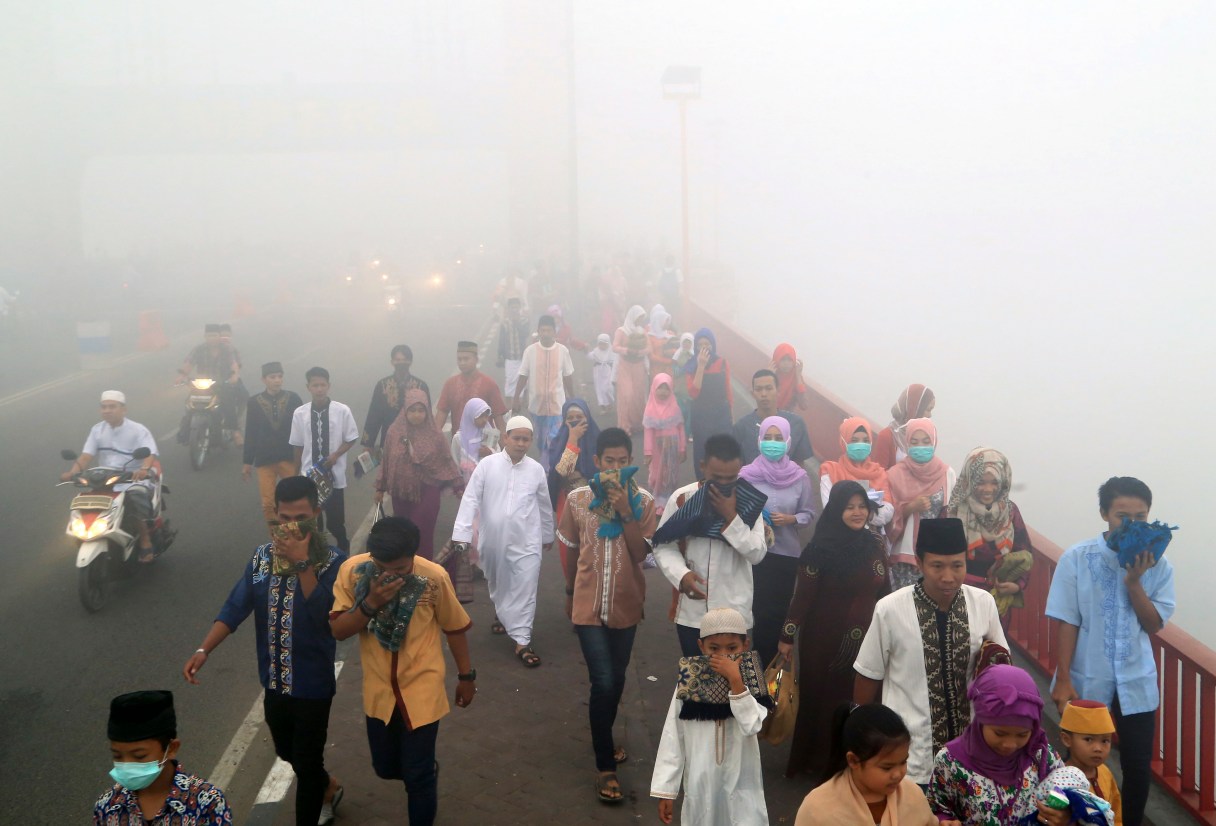
SINGAPORE (AP) – A thickening, smoky haze cast a shadow over festivities in Singapore on Thursday, as Muslims headed to mosques to celebrate the culmination of the annual hajj pilgrimage and Chinese readied for a traditional harvest festival.
The three-hour Pollutant Standards Index (PSI), which measures air pollution in the country, hit the day’s high of 262 at noon on a public holiday. It then dropped to 225 in the mid-afternoon. The haze is blowing in from neighboring Indonesia where forests are being burned to clear the land for farming, as is done every year causing the annual problem for the region.
Although there are no official air quality descriptors affiliated with the three-hour index, a reading of these levels on a 24-hour index would mean that air quality is in the “very unhealthy” range, according to the National Environment Agency.
The 24-hour PSI at noon had a range of 173 to 216. Anything above the official “very unhealthy” bandwidth of 200 is particularly taxing on young children, the elderly and those with heart or lung diseases.
High-rise buildings surrounding Masjid Hajjah Fatimah, a mosque in an area historically associated with the island nation’s Malay community, were barely visible through the veil of smog.