
Friday, October 30, 2026Oct 30

This story is free to read.

Rosetta comet likely formed from 2 separate objects

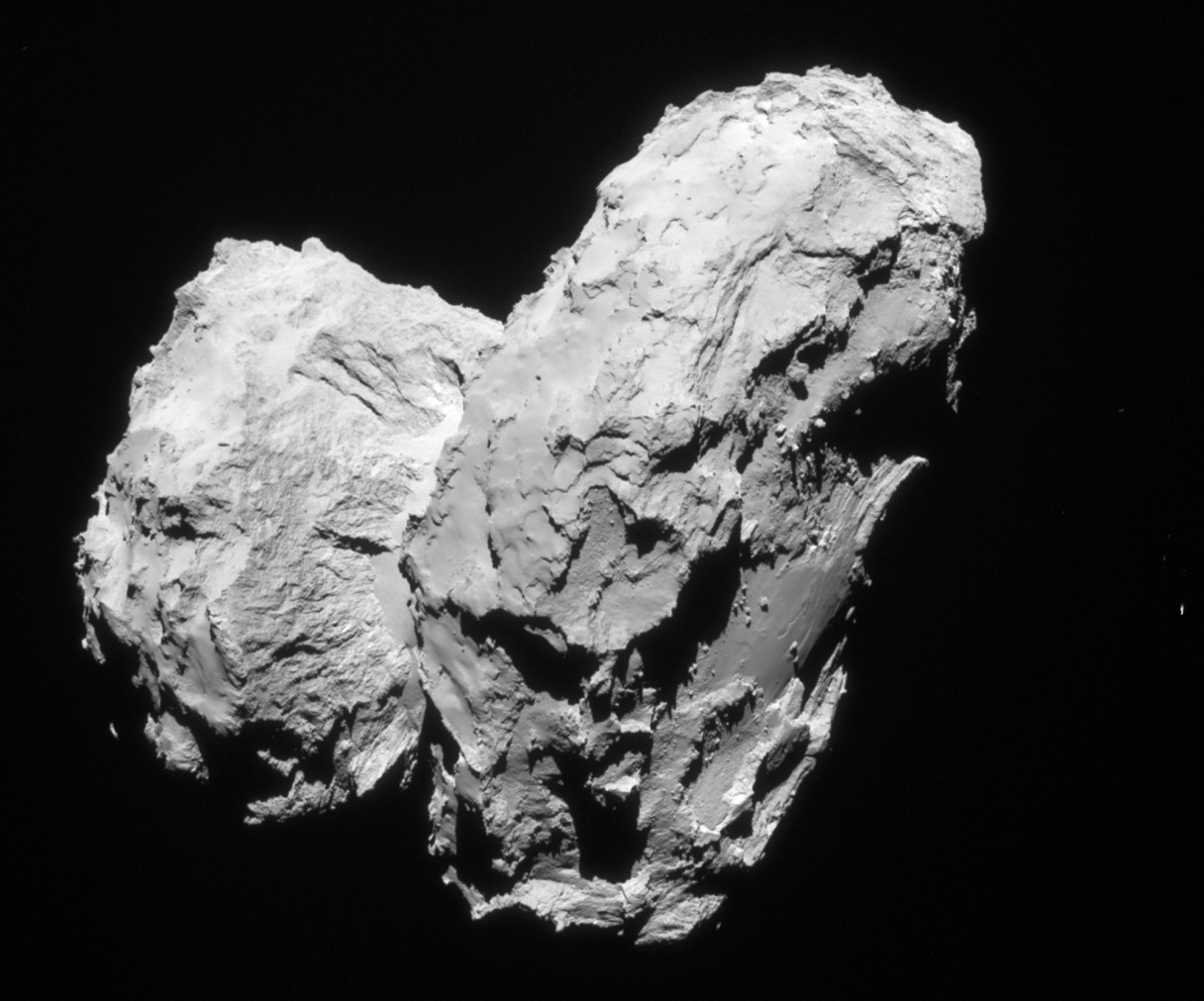
The Aug. 22, 2014 photo taken by the Navcam of the Rosetta space probe and released by European Space Agency ESA on Monday, Sept. 28, 2015 shows Comet 67P/Churyumov–Gerasimenko. Researchers have now concluded that the comet was probably formed when two separate objects collided during the early stages of the Solar System, according to a paper published Monday in the journal Nature. (ESA/Rosetta/Navcam via AP)
The Aug. 22, 2014 photo taken by the Navcam of the Rosetta space probe and released by European Space Agency ESA on Monday, Sept. 28, 2015 shows Comet 67P/Churyumov–Gerasimenko. Researchers have now concluded that the comet was probably formed when two separate objects collided during the early stages of the Solar System, according to a paper published Monday in the journal Nature. (ESA/Rosetta/Navcam via AP) The Aug. 22, 2014 photo taken by the Navcam of the Rosetta space probe and released by European Space Agency ESA on Monday, Sept. 28, 2015 shows Comet 67P/Churyumov–Gerasimenko. Researchers have now concluded that the comet was probably formed when two separate objects collided during the early stages of the Solar System, according to a paper published Monday in the journal Nature. (ESA/Rosetta/Navcam via AP)

BERLIN (AP) – When the Rosetta space probe sent back its first close-up pictures of a comet last year, scientists got a bit of a surprise: Instead of the ball of rock and ice they had expected, the comet turned out to have two distinct lobes connected by a “neck.”

Some said it looked like a giant rubber duck.

Researchers have now concluded that the comet 67P Churyumov-Gerasimenko was probably formed when two separate objects collided during the early stages of the solar system, according to a paper published Monday in the journal Nature.

Using data collected by the OSIRIS cameras onboard Rosetta, scientists were able to determine that the flat planes and arcs on 67P’s surface are in fact terraces that wrap around the two lobes like layers around an onion.

“For the first time, this study gives observational evidence on how the primordial bodies formed,” said Matteo Massironi, one of the study’s authors.