
Glossary
Ectotherm: An animal that is dependent on external sources of body heat.Head start: A program developed to intervene with a population in decline with the goal of breeding and/or raising healthy young. The animals are reared in captivity until they are past the critical juvenile phase, then released into a closely monitored habitat with the hope that the population can then begin to thrive on its own again.Siltation: Water pollution due to soil erosion and sediment spill, often caused by land-clearance for construction sites.
When David Hedrick was a kid, he grew up hearing his father’s fisherman friends talk about the huge hellbenders they’d seen.
Fascinated by the tales of the eastern hellbender (Cryptobranchus alleganiensis alleganiensis) – a species of giant salamander which has survived in North America for 7 million years – Hedrick now helps run the Chattanooga Zoo’s “head start” program to prevent population extinction. At more than a foot in length, healthy adult hellbenders were once a common sight across Tennessee, as well as in adjacent southern states. Now?
“They’re considered functionally extinct in Alabama and Mississippi, and Middle Tennessee isn’t far off from that,” says Hedrick, the zoo’s lead ectotherm keeper.
And the problem extends beyond just the hellbender itself.
“These guys are a good indicator of water quality and overall ecosystem health in aquatic environments,” Hedrick explains. “So if you have a good population, it’s a good sign that your waterway is healthy.”
Those healthy, biodiverse ecosystems are becoming rarer and rarer. In fact, Hedrick says, there are only six streams identified as sustaining a healthy population.
“And if you think about it, even in those six good streams that we have, those streams might be really long, but the quality zone is a specific section. So really, we only have six sections of streams that are good,” he says, “some of which are streams that are no wider than a small room and, at their deepest, six feet.”
That is precisely what Hedrick intends to help change. And work so far seems promising.
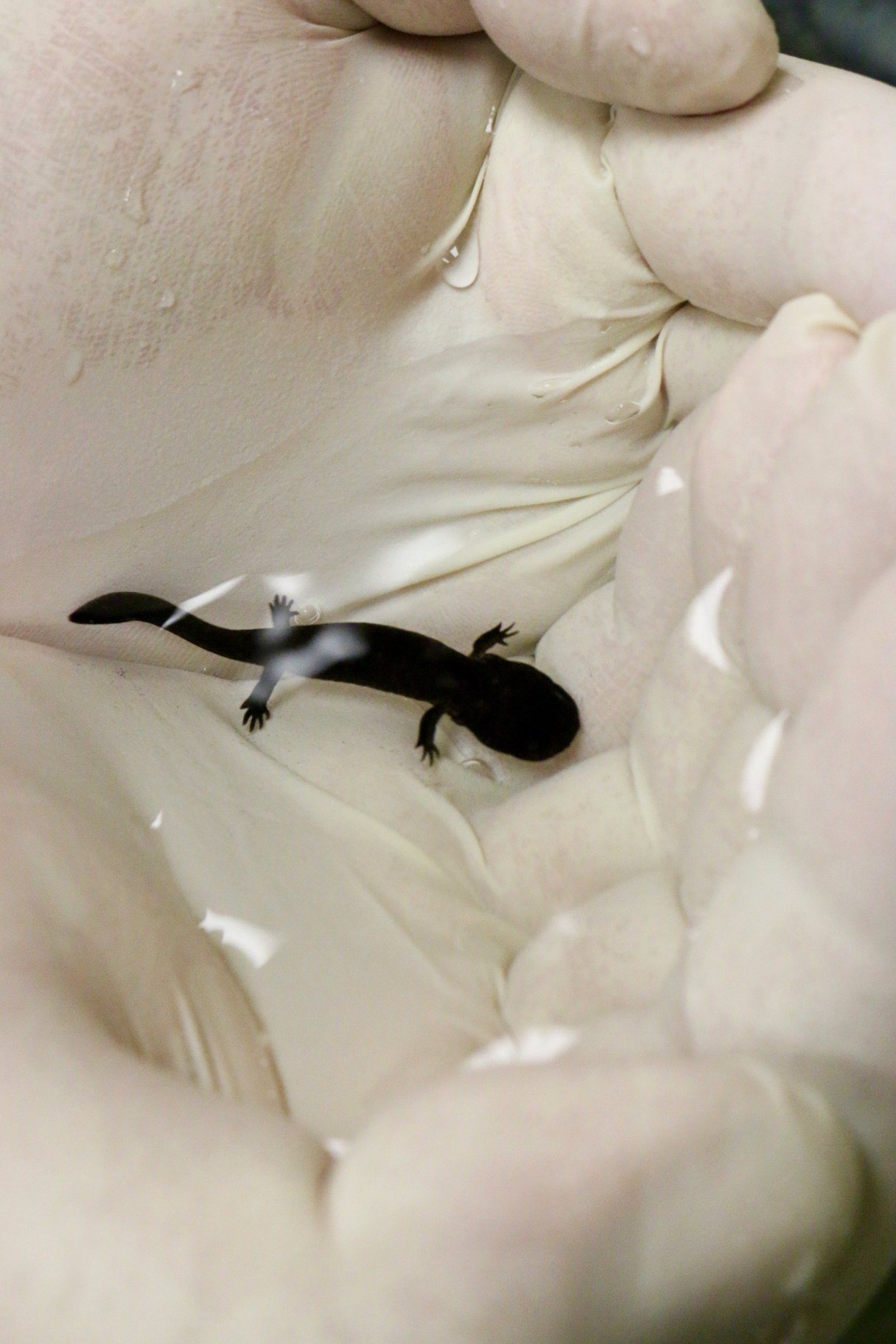
He is now raising the first hellbenders successfully hatched from wild eggs collected in East Tennessee. And through a partnership with Grassmere Zoo in Nashville, researchers are working to successfully breed captive hellbenders.
The next step, he says, is to correct the issues facing hellbenders’ habitat, which suffers mainly from siltation. Then, once the captive-bred hellbenders have reached adulthood, they can be released, and closely monitored.
“The next 20 years are kind of going to decide what happens to the species,” says Hedrick. “Among conservationists the goal is kind of to identify those spots that did hold those populations and work to make sure those don’t regress then to assess and work to bring our other streams up in quality. That’s where these newly hatched guys will come in.”