
BOGOTA, Colombia (AP) – Colombia’s president said Wednesday that government negotiators and leftist rebels are putting the final touches on an important peace deal that they hope to announce in the coming hours.
“Today I hope to give historic, very important news to the country,” President Juan Manuel Santos said at an education event Wednesday.
Earlier government negotiators told local news media that all major obstacles to a deal have been cleared up in around-the-clock sessions taking place in Cuba for the past week. But some representatives for the Revolutionary Armed Forces of Colombia are cautioning on social media that some details remain to be worked out.
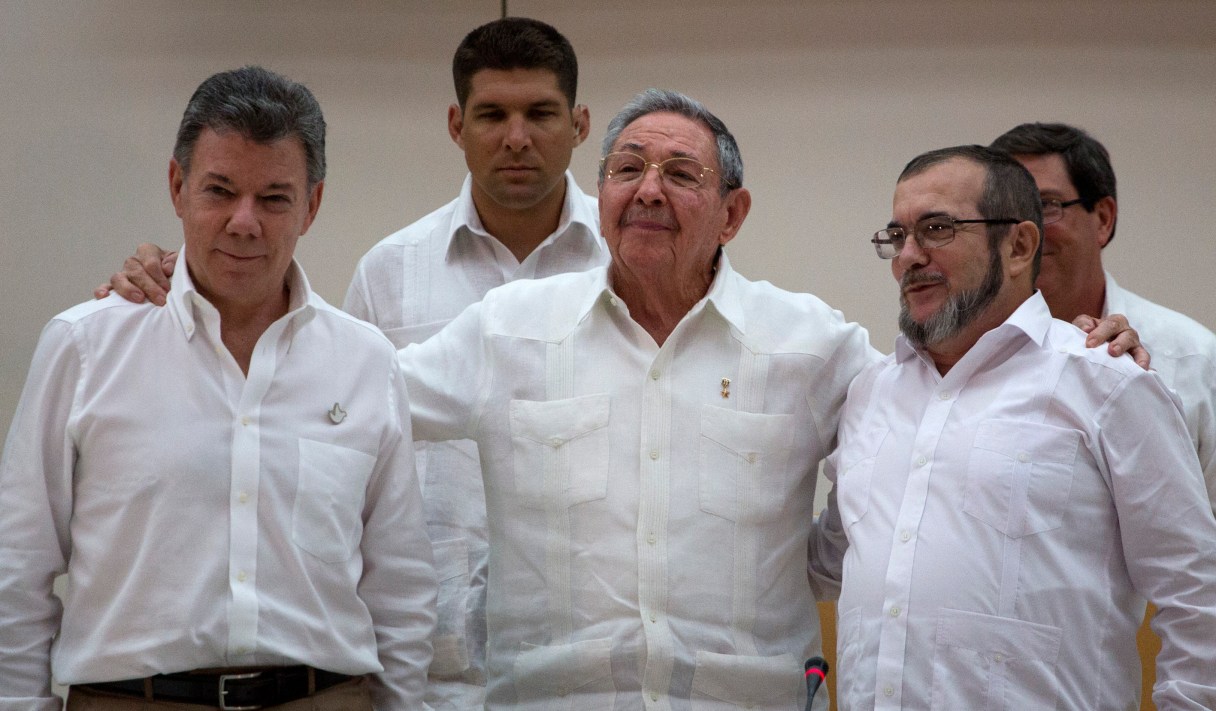
Speculation that a deal was around the corner went into overdrive after the government published a photo Tuesday night of negotiators in a circle and smiling under a headline reading: “The day is coming. We’re on the road to peace.”
Once negotiations conclude, the accord must still be ratified by voters in a plebiscite. But just the wrapping up of talks opens the possibility for future generations of Colombians to put behind them more than 50 years of political bloodshed that has claimed more than 220,000 victims and driven more than 5 million people from their homes.
The accord would commit Colombia’s government to carrying out aggressive land reform, an overhaul of its anti-narcotics strategy and an expansion of political protections for leftist activists and traditionally marginalized groups.
Negotiations began in November 2012 and were plagued by distrust built up during decades of dehumanizing war propaganda on both sides. Polls show most Colombians loathe the FARC and show no hesitation labeling them “narco-terrorists” for their heavy involvement in Colombia’s cocaine trade, an association for which members of the group’s top leadership have been indicted in the U.S. Meanwhile the FARC held on to a Cold War view of Colombia’s political and economic establishment as “oligarchs” at the service of the U.S.
The rebel army was forced to the negotiating table after a decade of heavy battlefield losses that saw a succession of top rebel commanders taken out at the hands of the U.S.-backed military and the its ranks thinned by half to the current 7,000 troops.
But overcoming the lingering mutual acrimony took longer than expected and led to a number of near- collapses during the talks. President Juan Manuel Santos, an unlikely peacemaker given his role as architect of the military offensive, throughout maintained a steady pulse even as he was labeled a traitor by his former conservative allies and suffered a plunge in approval ratings. Last September, he traveled to Havana to announce a breakthrough alongside top rebel commander Rodrigo Londono.
That advance, the most-contentious of the process, laid out a framework for investigating atrocities, punishing guerrillas for their involvement in those abuses and offering compensation to victims.
But in a move harshly criticized by conservative opponents of Santos and some human rights groups, guerrillas who confess their crimes won’t spend any time in prison and will instead be allowed to serve out reduced sentences of no more than eight years helping rebuild communities hit hard by the conflict.
Another toad to swallow, as Santos calls the concessions he’s had to make, is the sight of former rebel leaders occupying seats in congress specially reserved for the FARC’s still unnamed political movement. The exact number was among the last details being hammered out in marathon 18-hour sessions taking place in recent days.
“We haven’t slept but it was worth the effort,” Sen. Roy Barreras, among political reinforcements sent in by Santos to work on the deal, told Caracol Radio from Havana.
The announcement that talks have successfully concluded will trigger a series of events, some entailing political risks.
First and foremost, Santos must present the accords to congress and ask it to set a date for a plebiscite that could take place as early as next month. Polls show Colombians would likely endorse any deal in a simple yes or no vote.
But the still-unknown final accord may contain some last minute surprises and the opposition is likely to try to convert the vote into a referendum on Santos, whose approval rating plummeted to 21 percent in May according to a Gallup poll, the lowest since he took office in 2010.
Low turnout is also a concern because 13 percent of the electorate, or about 4.4 million voters, must vote in favor for the accord to be ratified. A 2003 referendum on proposed constitutional reform failed because of a lack of a quorum although Santos has hedged the risk this time by getting congress to redesign electoral rules in what opponents say effectively lowers the voting threshold.
Only after the agreement is signed will the FARC begin mobilizing its troops to 31 zones scattered across the country where 90 days later they’ll begin handing their weapons over to United Nations-sponsored monitors who will store the weaponry in containers. Later the arms will be melted down to construct three peace monuments.
A peace deal is unlikely to lead to any immediate security improvement in Colombia’s long-abandoned and lawless countryside. Over the last 13 months, since the FARC declared a unilateral ceasefire and the government reciprocated with a truce of its own in all but name, violence has fallen to the lowest level since the FARC was created 52 years ago by outlaw peasant groups joined by communist activists. Only four deaths attributed to the FARC have been reported during that period and in the last 68 days the group hasn’t carried out a single offensive action, according to a report last week by the Bogota-based Conflict Analysis Resource Center.
There’s also concern that as the rebels integrate into Colombian society, well-organized criminal gangs will fill the void and fight among themselves for control of the lucrative cocaine trade that kept the FARC well-armed much longer than other Latin American insurgencies. While Colombia’s homicide rate has fallen sharply over the years, it remains among the world’s deadliest countries, with violence driven largely by its status as the world’s top supplier of cocaine. The much-smaller National Liberation Army will also remain active although it’s pursuing a peace deal of its own.
___
Joshua Goodman is on Twitter: https://twitter.com/apjoshgoodman His work can be found at http://bigstory.ap.org/journalist/joshua-goodman