
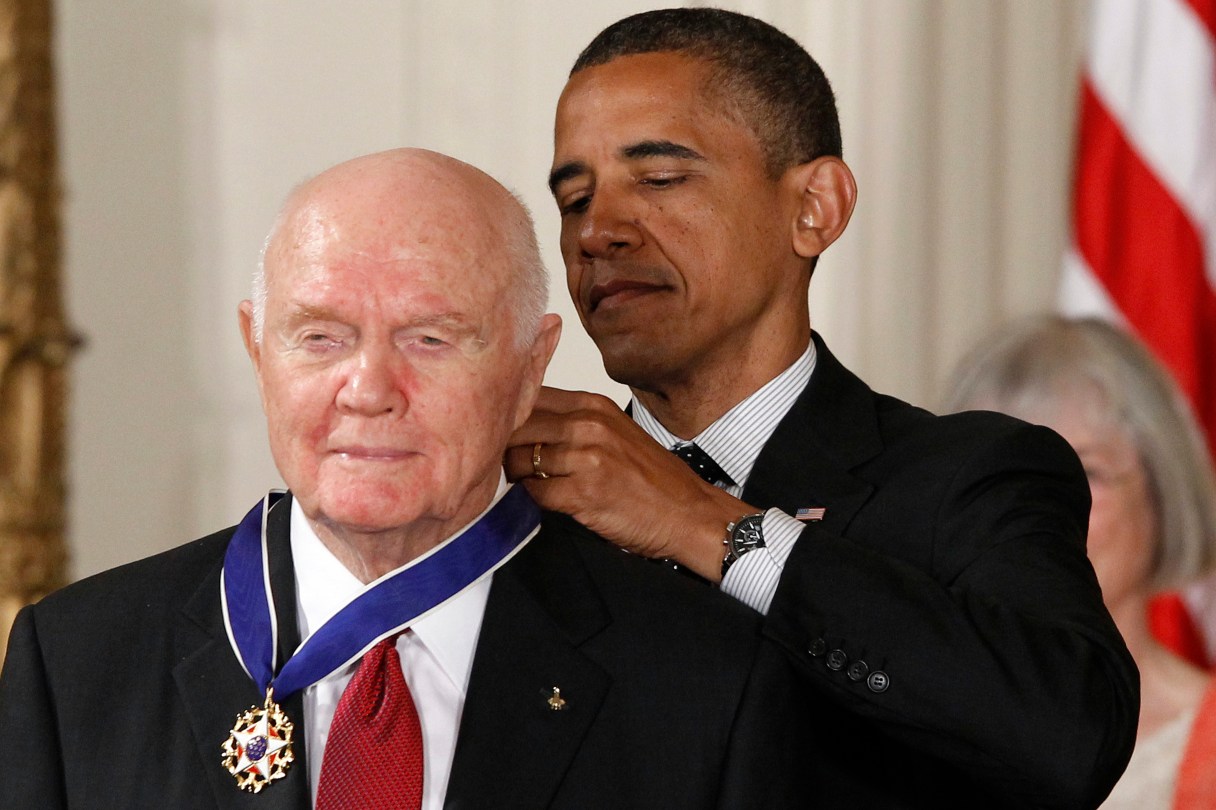

For many baby boomers, John Glenn was as close to an authentic American hero as anyone could get. It was largely due to his feat of being the first American to orbit the Earth that if you asked most elementary school-aged children in the mid-1960s what they wanted to be when they grew up, “astronaut” would have been the most popular answer.
It was a different era.
Glenn, who died Thursday at the age of 95, represented a time when the United States still seemed ascendant, able to do anything. Stung by the 1957 launch by the then-Soviet Union of Sputnik, the first artificial satellite, and the 1961 first human spaceflight by the Soviet Union’s Yuri Gagarin, the country vowed to win the space race to the moon – and did.
The Ohio native was the last of the “Mercury Seven,” the group of military test pilots selected in 1959 by NASA to become the nation’s first astronauts and later immortalized in the Tom Wolfe book “The Right Stuff” (which became a movie of the same name). And as he was nearly 40 when he was selected and didn’t have a degree in science (which his alma mater, Muskingum College, awarded him after his flight around the Earth), he barely made the cutoff.
But perhaps because of the ticker-tape parade given him after his Friendship 7 flight that took him around the globe three times in 1962 and a succeeding address to a joint session of Congress, Glenn became the best known of the early astronauts.