

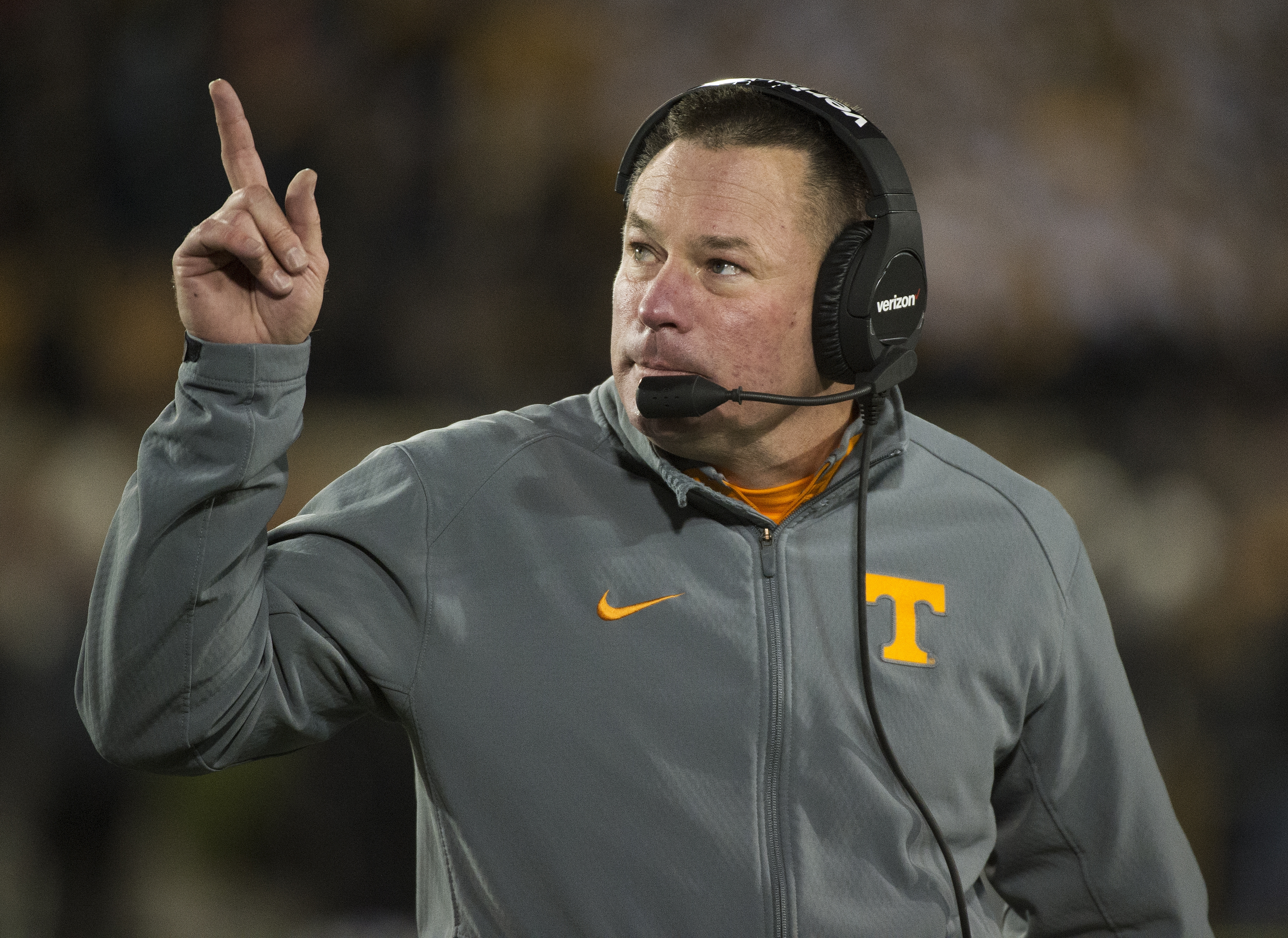
 FILE – In this Nov. 21, 2015 file photo, Tennessee head coach Butch Jones points to the scoreboard during the first quarter of an NCAA college football game against Missouri in Columbia, Mo. Tennessee head coaches will hold a rare joint press conference Tuesday morning, Feb. 23, 2016, two weeks after a group of unidentified women sued the school over its handling of sexual assault complaints made against student-athletes. Athletic department spokesman Ryan Robinson said Monday night the coaches decided they wanted to make themselves available to answer questions on a variety of issues. (AP Photo/L.G. Patterson, File)
 Tennessee athletic director Dave Hart speaks during a press conference at University of Tennessee’s Ray & Lucy Hand Digital Studio in Knoxville, Tenn., on Thursday, Feb. 25, 2016. Hart stood by his embattled football coach during the news conference Thursday at the university, two weeks after a federal lawsuit was filed Feb. 9 in Nashville alleging that Tennessee mishandles assault complaints against athletes. (Adam Lau /Knoxville News Sentinel via AP) MANDATORY CREDIT
KNOXVILLE – Dave Hart on Thursday delivered the message the University of Tennessee probably needed to convey two weeks ago.
The athletic director defended how his department handled multiple allegations of rape and sexual assault and made public the university’s stance on the issue currently drawing so much attention to Tennessee.
“I trust Butch Jones implicitly,” Hart said. “I know who he is. I know what his work ethic is. I know what he’s meant to this university, well beyond the department of athletics, and I know how he’s represented the university.”
Hart spoke for nearly 40 minutes, for the first time since a Feb. 9 federal lawsuit claimed UT created a “hostile sexual environment” for women and violated federal laws in its handling of sexual assault allegations involving male athletes, particularly football players.
“We have good people, and we’ll continue to work to eliminate (this issue),” Hart said. “And that’s a big task when you’re talking about a campus with (our) numbers. Within reason, that should be our goal, to eliminate this issue on campuses.
“Those people who make those choices, they need to pay the price of the disruption they’ve caused for women and families who have been subjected to sexual assault.”
Nearly 20 student protesters stood outside the Ray and Lucy Hand Digital Studio on the first floor of the building that houses Tennessee’s athletic department. They held signs and chanted support for the eight Jane Doe plaintiffs listed in the amended lawsuit.
Hart said he wanted to be “open and transparent” but couldn’t delve too deeply into the specific allegations in the lawsuit. He said he feels “tremendous empathy and sympathy for the alleged victims and all victims of sexual assault across the country.”
“It is simply an unacceptable act, and I can tell you that at the University of Tennessee, the chancellor has made this his top priority. This has to gain the attention of everyone,” he said.
He repeated often that the university’s leadership has had conversations about how to prevent sexual assaults and handle allegations when they do occur.
Hart said he hopes issues raised and publicity generated by the lawsuit won’t discourage future victims from coming forward and reporting crimes, while also drawing the collective focus on how colleges can improve their handling of such cases.
While he asserted that “the culture in our building is good,” he also said, “Now, I cannot stand here and tell you of those 550-plus student-athletes that we’re not going to have future issues with poor decisions, because we are, as would any other institution with that type of number.
“Anytime something is not what you want it to be, the first place you look is in the mirror.”
Hart said UT has boosted resources, held ongoing discussions and sought advice from other universities as it tries to improve the problem on its campus.
The crux of the lawsuit is Tennessee’s process of handling sexual assault cases, and Hart said the athletic department “plays no role” in the investigations by either the university or local law enforcement.
Athletics instead has one liaison in Vince Carilli, Tennessee’s vice chancellor for student life. Jenny Richter is the director of the Office of Equity and Diversity and Tennessee’s Title IX coordinator. The Office of Student Conduct and Community Standards handles cases involving students.
“We are not the judge and jury,” Hart said of the athletic department. “We have to remember that each person is entitled in due process. We don’t engage in that. We don’t engage in the investigations, be they with law enforcement or student conduct. That’s not our role.
“Other people have been designated to those roles. We do have open lines of communication with people on campus that are important to the process. We have a communication process, which we developed in 2012, that encompasses everyone on campus that would be engaged in conversations about prevention and in dealing with situations that occur.”
Hart said he was confident his coaches have followed protocol in handling allegations and disputed the notion put forth in the lawsuit that athletes receive preferential treatment.
“They are absolutely not treated any differently,” he said.
“Our student-athletes are treated just like any member of the student body, and they should be. The only difference that we preach to them on a very regular basis [is] they’re the most visible university ambassador. That’s a burden to carry for someone in that age range of 17 to 22, and we’ve got to help them carry that burden.
“But no, they’re not treated any differently in this process or any other university process.”
Contact Patrick Brown at pbrown@timesfreepress.com.