
Monday, November 16, 2026Nov 16

Rare galaxy with 2 black holes has 1 starved of stars

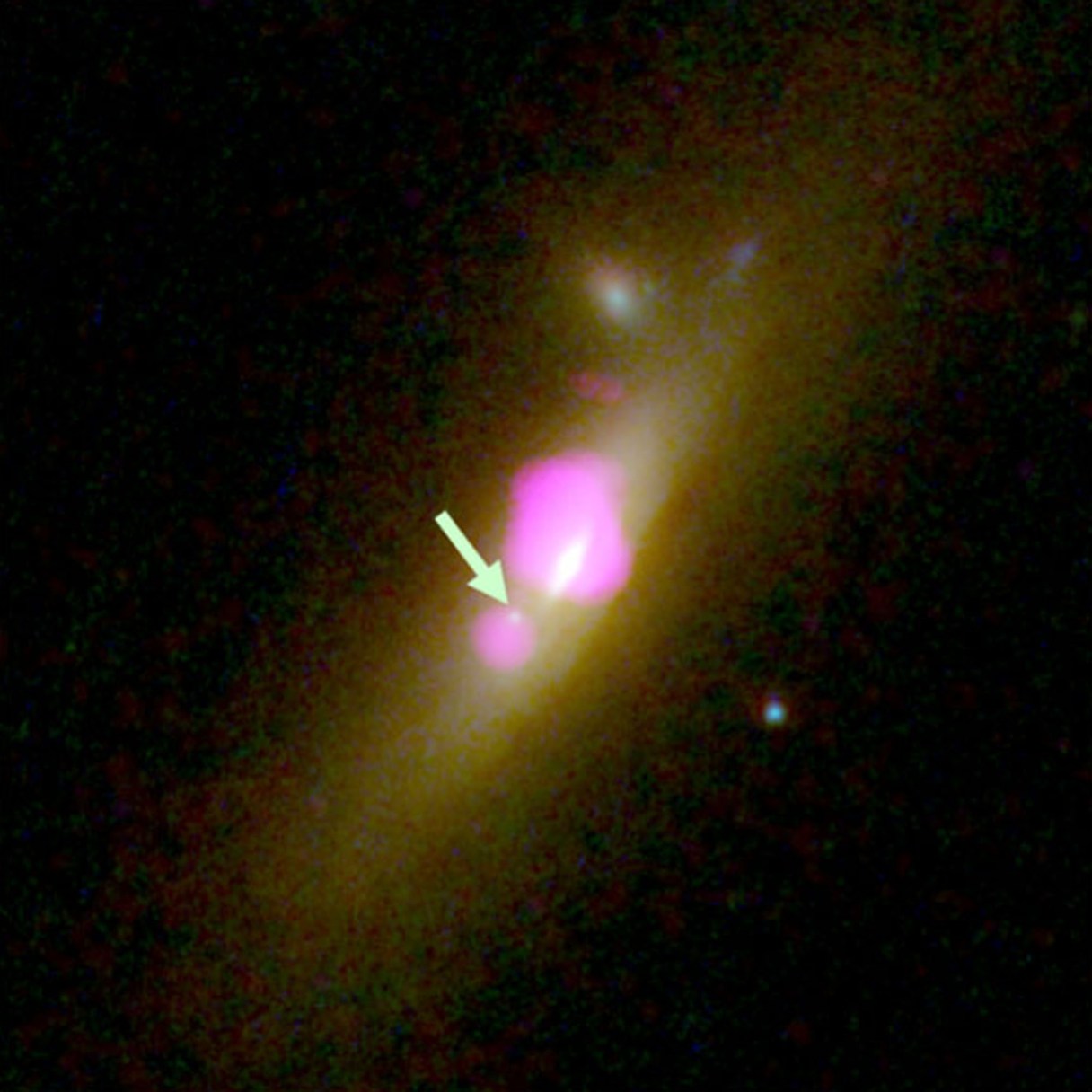
This image provided by CU-Boulder shows the galaxy SDSS J1126+2944 taken with the Hubble Space Telescope and the Chandra X-ray Observatory, with an arrow placed by the source pointing to a black hole that lost most of its stars. The University of Colorado's Julie Comerford has discovered something even rarer than a double-black hole galaxy: a skinny black hole. Her findings were reported Tuesday, Jan 5, 2016 at the American Astronomical Society's annual meeting. (NASA/CU-Boulder via AP)

KISSIMMEE, Fla. (AP) – An astrophysicist has discovered something even rarer than a double-black hole galaxy: a skinny black hole.

The University of Colorado’s Julie Comerford reported her findings Tuesday at the American Astronomical Society’s annual meeting in Kissimmee (kuh-SIMM-ee) Florida.

Comerford says only 12 galaxies are known to exist with two black holes in their midst. Normally galaxies have a single supermassive black hole at the center.

But in this newly identified galaxy about 1 billion light-years away, one of the two black holes is smaller than the other and apparently starved of stars.

Comerford speculates the slim black hole either lost mass in the collision of two galaxies that merged into this one – a crash diet. Or it’s a rare example of an intermediate-sized black hole that will grow.