
Monday, November 9, 2026Nov 9

In Iowa, establishment GOP candidates play expectations game

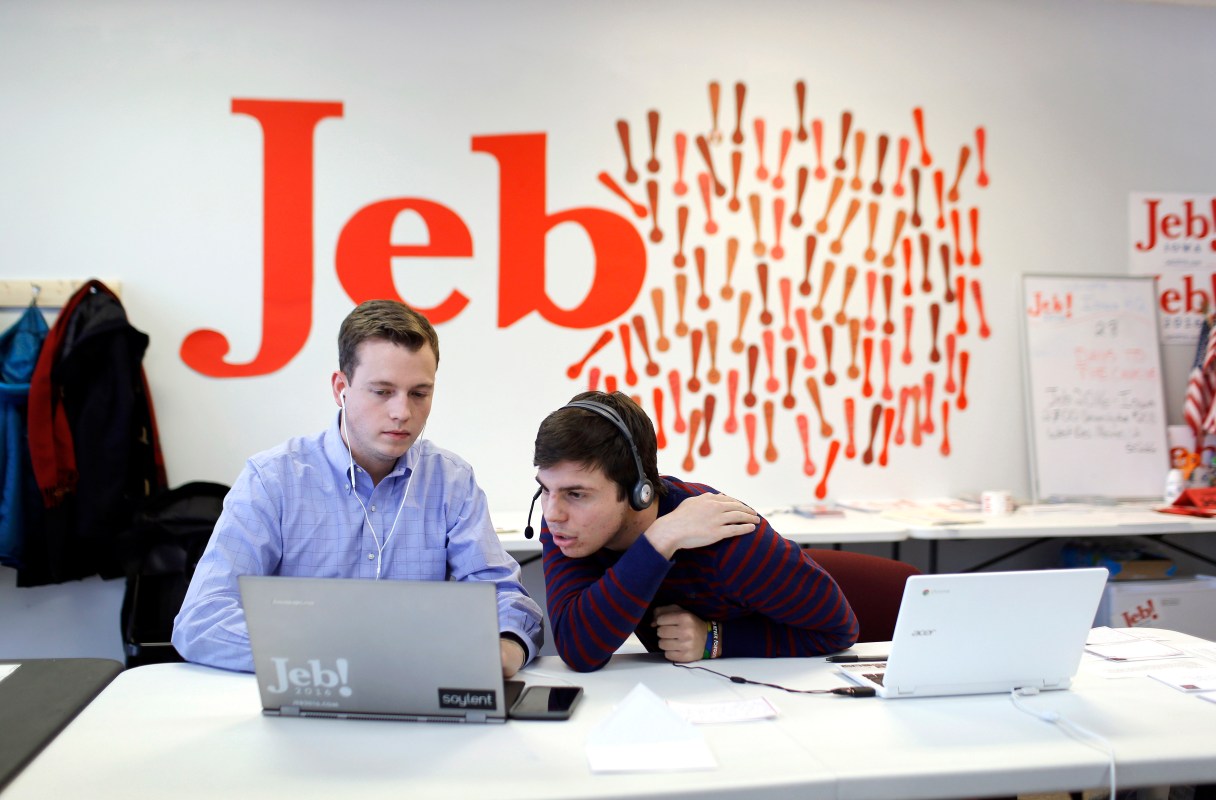
In this Jan. 6, 2016 photo, campaign staffer Kyle Radon, left, and volunteer Jack Davidson look over information on a computer as they call Iowa residents from the state headquarters for Republican presidential candidate, former Florida Gov. Jeb Bush in West Des Moines, Iowa. Bush won’t win Iowa. Neither will Chris Christie. But the Republican governors are battling to beat expectations, and each other, in the GOP caucus, hoping that a surprisingly strong showing will give them a boost heading into the New Hampshire primary. (AP Photo/Patrick Semansky)
In this Jan. 6, 2016 photo, campaign staffer Kyle Radon, left, and volunteer Jack Davidson look over information on a computer as they call Iowa residents from the state headquarters for Republican presidential candidate, former Florida Gov. Jeb Bush in West Des Moines, Iowa. Bush won’t win Iowa. Neither will Chris Christie. But the Republican governors are battling to beat expectations, and each other, in the GOP caucus, hoping that a surprisingly strong showing will give them a boost heading into the New Hampshire primary. (AP Photo/Patrick Semansky) In this Jan. 6, 2016 photo, campaign staffer Kyle Radon, left, and volunteer Jack Davidson look over information on a computer as they call Iowa residents from the state headquarters for Republican presidential candidate, former Florida Gov. Jeb Bush in West Des Moines, Iowa. Bush won’t win Iowa. Neither will Chris Christie. But the Republican governors are battling to beat expectations, and each other, in the GOP caucus, hoping that a surprisingly strong showing will give them a boost heading into the New Hampshire primary. (AP Photo/Patrick Semansky)

DES MOINES, Iowa (AP) – Jeb Bush and Chris Christie won’t win Iowa. Marco Rubio probably won’t either.

But these Republican presidential candidates are devoting significant time and resources to the state in a battle to beat expectations – and each other – in the Feb. 1 GOP caucuses. Each hopes a surprisingly strong showing in Iowa will give him a boost heading into the New Hampshire primary, where the political landscape is more favorable to more traditional candidates.

The expectations game for “establishment” candidates has added intrigue to the final sprint to Iowa’s lead-off caucuses. While the fight for first place has settled into a two-way race between conservative favorites Ted Cruz and Donald Trump, some of the biggest unknowns surround the candidates for whom a loss in Iowa could still be viewed as a win.

“January in the Iowa caucus is all about the establishment race,” said Doug Gross, an Iowa Republican strategist who has not backed a candidate in the 2016 contest.

While Iowa’s social and religious conservatives hold significant sway, 43 percent of GOP caucus-goers said they did not identify as evangelicals and 34 percent said they were either neutral or did not support the tea party, according to polls of participants in 2012.