
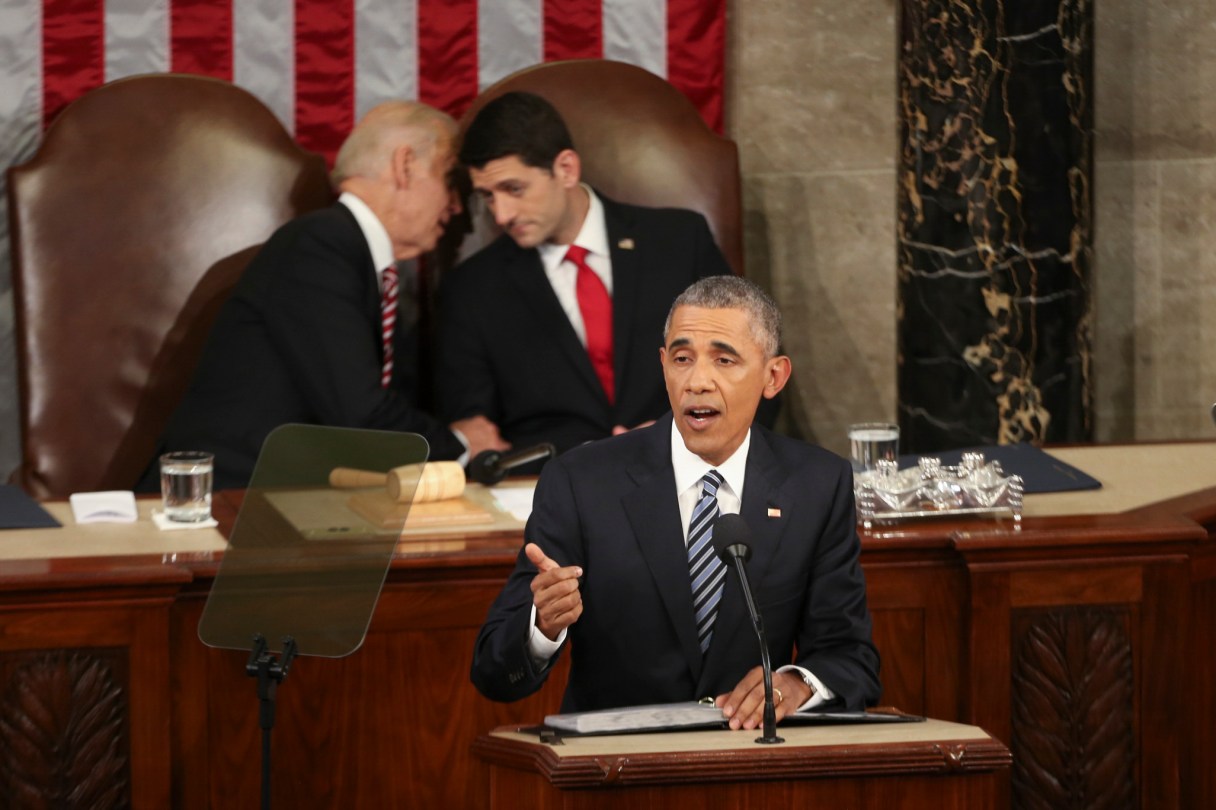
WASHINGTON – Now let us praise laundry lists. Every year at State of the Union time, the president and his staff say the speech will not include them. But the laundry won’t keep track of itself. Enumerating accomplishments and objectives amounts to lists, which Obama had in plenty Tuesday night.
The interesting thing is why this particular laundry was chosen. By what principle does the president want personalized medical treatments, paid leave, pre-K for all, the cure for cancer, a transition away from dirty energy, and the Trans-Pacific Partnership?
Obama advanced no ideological claim of what government should do; no technocratic vision of how its performance might be improved. His person unites his agenda – not quite in the leadership league, he admits, of Lincoln or Roosevelt, but he has obviously thought hard and long about the comparison.
This was the way Obama was introduced to the country eight years ago. His victory in the Iowa caucuses had little to do with an ideological vision or policy agenda (which was, in fact, the utterly predictable liberalism of a backbench senator). That giddy night, he claimed that a “divided” and “disillusioned” country found “a common purpose.” His 38 percent in the caucus proved “we are one people.” We would “move beyond the bitterness and pettiness and anger that’s consumed Washington.” “This was the place,” Obama said, “where America remembered what it means to hope.”
Obama would bring balance to the Force. Prospectively, with eight years ahead, this was inspiring. Retrospectively, with seven years behind, the same claim comes across as self-centered and a little sad – a world-historic figure picking through the refuse of the years for this shiny accomplishment and that. His solutions to 21st-century problems look suspiciously like 20th-century liberalism. And where has Obama actually left his party and American liberalism?
Obama is the first Democrat since Franklin Roosevelt to win back-to-back majorities of the national popular vote. But members of his party who venture beyond the 18 acres of the White House will find political ruin. Since taking office, Democrats have lost 13 Senate seats, 69 House seats, 11 governorships, 30 state legislative chambers and more than 900 state legislative seats. Few presidents have done better for themselves and worse for their parties.
And perhaps most disturbingly for America’s liberal party, trust in government to do the right thing is near historical lows. According to a Pew Research Center average, just 19 percent of Americans trust government to do the right thing all or most of the time.
Declining trust in government is part of a larger decline in the trust of institutions generally. But it is fair to say that the launch of Obamacare, the Veterans Affairs hospital scandal and the IRS political targeting scandal did little to halt the slide. Obama was either complicit in the trend, or helpless against it.
The same could be said of political polarization – which Obama eventually decided he could not fight, and joined with enthusiasm. Or the rise of an angry, anti-establishment populism. More than 10 years of belief that America is on the “wrong track” has hardened into outrage and cynicism, and left some Americans vulnerable to ideologues and demagogues. These will be remembered as the characteristics of the Obama era – not hope, but anger and cynicism. It was a time when many Americans learned to rage.
The president and the future nominee of his party now have one advantage. Somehow these trends have produced another cult of personality, on the other political side – untethered to ideas, offering only himself as the solution to our problems, turning bitterness and pettiness into a previously undiscovered political art. This might be the strangest turn: a Republican Party that copies and amplifies the worst tendencies of our time.
Washington Post Writers Group