
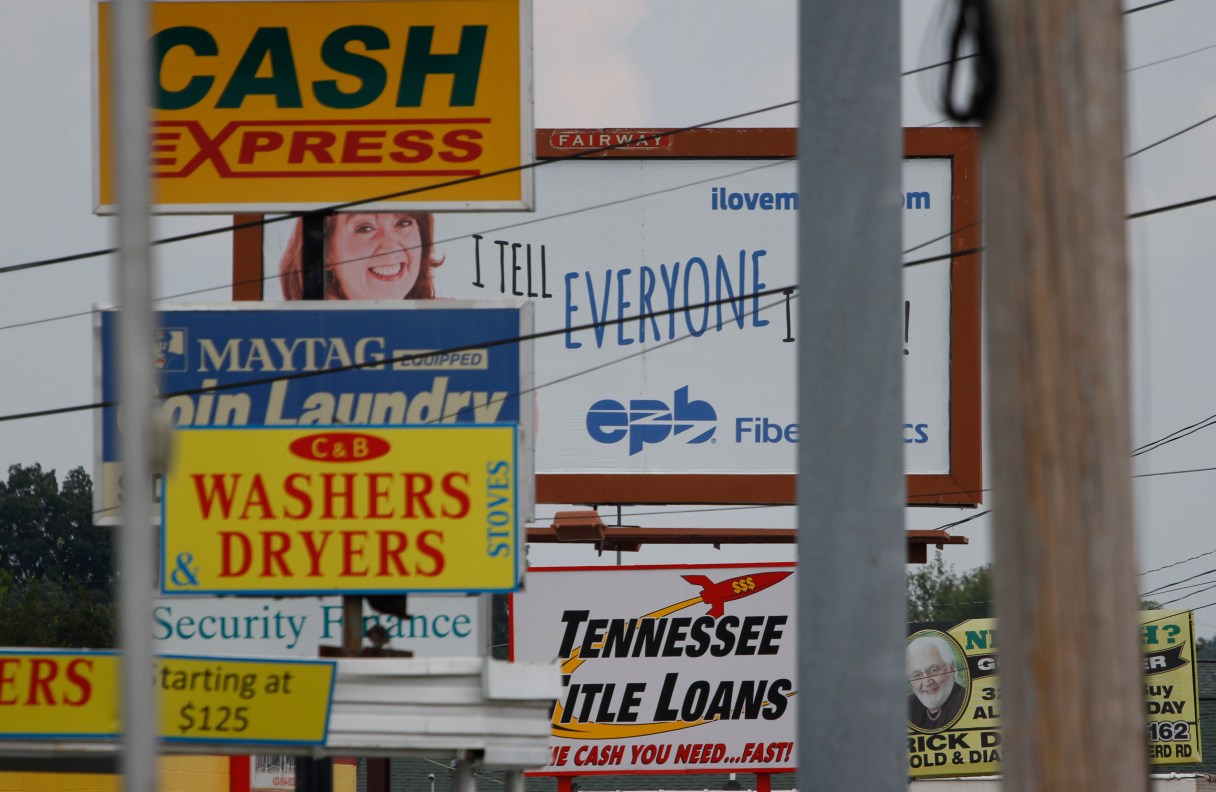
The Consumer Financial Protection Bureau will propose new federal limits today on payday and auto title loans to help borrowers avoid what the agency says is often a “debt trap” for millions of Americans.
The federal agency, which was created by the Dodd-Frank law adopted by Congress in 2010 in the wake of the financial crisis, is proposing rules to require payday lenders to take steps to make sure consumers have the ability to repay their loans and to give notice before making checking account withdrawals for loan repayments.
“Too many borrowers seeking a short-term cash fix are saddled with loans they cannot afford and sink into long-term debt,” said CFPB Director Richard Cordray, who will unveil the new rules during a hearing today in Kansas City. “It’s much like getting into a taxi just to ride across town and finding yourself stuck in a ruinously expensive cross-country journey. By putting in place mainstream, common-sense lending standards, our proposal would prevent lenders from succeeding by setting up borrowers to fail.”
Studies show that one of every five payday loans end up in default and one in five single-payment auto title loan borrowers end up having their car or truck seized by the lender for failure to repay. Cordray said too many consumers are being set up to fail with loan payments that they are unable to repay.
The proposed new rules would require lenders to use credit reporting systems to report and obtain credit information on certain loans and would limit repeated debit attempts that rack up fees for many borrowers.
CFPB said payday loans typically have an annual percentage rate of around 390 percent or even higher, but the industry insists such costs are simply fees on two-week loans that help consumers get cash in advance of their next paycheck at work.
“Faced with unaffordable payments, consumers must choose between defaulting, reborrowing, or skipping other financial obligations like rent or basic living expenses like food and medical care,” Cordray said in a statement released today.
But payday lenders insist they fill a vital role in helping millions of Americans meet short-term credit needs, like when their car breaks down and they can’t get to work or when they are faced with unexpected medical bills they must pay to keep their home or job.
“The CFPB, a group of unelected officials, is reaching out from Washington and eliminating customer choice in states where elected state legislators have already made significant progress for consumers,” said Kimberly Gardner, president of the Tennessee Cash Advance Association, a trade group for the more than 330 payday lending companies that operate in the Volunteer State. “The CFPB’s proposals ignore the needs of consumers as well as the work our state has done to provide them with much-needed regulated credit options.”
In Tennessee, there were 1,325 payday locations licensed and regulated by the Tennessee Department of Financial Institutions at the end of 2014, and collectively such offices employ about 10,000 workers.
By comparison, Tennessee had 2,186 bank branches across the state as of June 30, 2015. But banks are generally reluctant to make the small, unsecured consumer loans provided by payday lenders.
In Tennessee, payday lenders may charge a fee of up to $17 per $100 loan, although most charge less than that level. The higher interest rates, or fees, are due to the costs of handling small loans and the higher risk of default for making such unsecured loans, lenders say.
Nationwide, the payday lending industry generated fee revenue of $3.6 billion last year from the 15,766 payday loan stores across America – more even than the 14,350 McDonald’s restaurants in the United States.
One of the largest payday lenders in the country is Check Into Cash in Cleveland, Tenn., which is owned by multi-millionaire Allan Jones. Check Into Cash operates 980 offices across the country, down from a peak of about 1,200 offices a few years ago.
Jabo Covert, vice president of governmental relations at Check Into Cash, said the new CFPB rules will likely hurt the industry and its consumers. But he said Check Into Cash now generates more than half of its business from other financial services, such as bill payments and other loans besides payday loans.
“We’re not going away, and the need for our services will certainly continue,” he said.
The proposed rules are the latest step in the CFPB’s efforts to reform the markets for payday and installment loan products. The bureau already exerts supervisory oversight of payday lenders and has taken action against both online and brick-and-mortar payday lenders for excessive fees and illegal collection practices.
The CFPB will take public comments on its new rules for the next 90 days, through Sept. 14, and then consider those comments in drafting its final rules.
Such regulations could be overturned by Congress, however.
Congress is already considering legislation that would prohibit the CFPB from enforcing its payday rules in any state that had enacted its own regulations such as Tennessee and Georgia.
In the House, H.R. 4018, the “Consumer Protection and Choice Act,” is being sponsored by 15 Republicans and nine Democrats, including Democratic National Committee Chairperson Deborah Wasserman Schultz.
Contact Dave Flessner at dflessner@timesfree press.com or at 423-757-6340.