
Question of ownership
At a recent MACC planning meeting, Town Manager Boyd Veal brought up a potential issue of ownership of the building after discussion with Town Attorney Phil Noblett. After some investigation, Noblett assured citizens at the town council meeting that it was a moot point.While the town does own the building and has the deed, there was a clerical issue at the Register’s Office that led to it never having been filed. Noblett said filing that paperwork is only a minor concern and he doesn’t expect it to delay any potential work to the building.
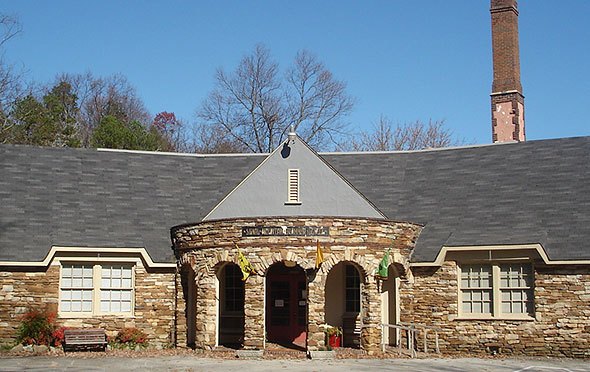
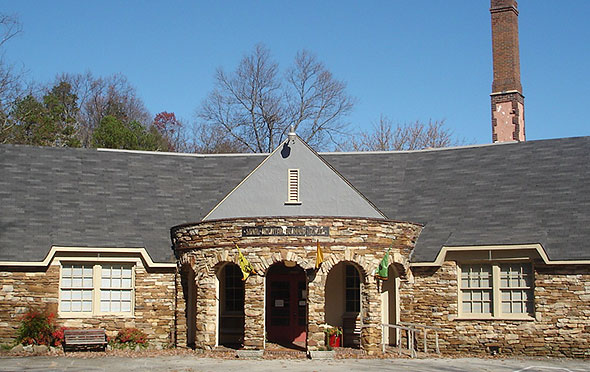 Facade of the Mountain Arts Community Center.
The Signal Mountain Town Council took the first concrete steps toward rehabilitating the Mountain Arts Community Center at its June meeting.
The council unanimously approved measures to enable the town manager to advertise for and entertain bids for an estimated $1.2 million improvement project for the historic part of the former school-turned-community-center, as well as bids to demolish the newer, back half of the facility.
The vote came in the wake of numerous public discussions about what should be done with the 90-year-old building following the results of a physical needs assessment detailing estimated costs for various stages of improvement, as well as many of the root causes of the building’s issues.
“We’re not committing any funds at this time,” Mayor Dick Gee – and other council members – stressed before the vote. “We’re authorizing the town manager to entertain proposals. The town isn’t tied to spending any money.”
The consensus among the council was that concrete figures from the bidding process would be necessary to determine how to move forward with any sort of rehabilitation.
According to the physical needs assessment, the back half of the MACC would cost more to repair and bring up to code than the front half. Furthermore, issues with the incline the back portion of the building is built on have contributed drastically to the water damage plaguing the historic part of the MACC.
“Hypothetically, eliminating the back half would make solving the water issues much easier,” Gee said at the meeting.
Compounding the issue is the lack of a sprinkler system in all parts of the MACC, which means the building does not meet fire code and therefore is not deemed safe for public use. The council had a project to install a sprinkler system ready to begin, when mold was found in the building in December 2015.
“The fire marshal’s office has allowed us to operate with certain provisions in place,” Town Manager Boyd Veal said in an interview following the council meeting. “They are fully aware of the situation, but they do expect that if we continue to operate, a [sprinkler] system will be put in.”
It wouldn’t be fiscally responsible, Veal explained, to put in a sprinkler system only to tear it down if it was determined that demolishing the building was the most viable way to move forward. He said the fire marshal has been “very good” to work with, but that is under the condition the council works diligently toward a responsible plan to bring the building up to code.
At some point, the fire marshal’s office could say the MACC has been out of code too long and cannot continue operations. However, Veal said he doesn’t foresee that happening soon due to the good working relationship between the fire marshal’s office, the town council and the MACC.
Council members made it clear that they were aware of the potential space issues for classes and meetings should the rear part of the facility be demolished. Veal said they would not do something that would displace those services until they had found alternate space for them.
“I just can’t imagine that scenario playing out,” he said.
While no determination was made at the meeting about what would ultimately happen with the MACC, there was significant discussion among council members and citizens regarding the issue. One possibility discussed by Councilman Chris Howley was moving town hall operations to the historic part of the MACC and undergoing a project to transform the current Town Hall into a meeting and recreation place for all the classes currently held at the MACC.
Such a project, he said, could prove more cost-effective than building a new structure to house the MACC’s programs, though the council will have to further investigate the financial viability of such a plan.
Numerous other ideas have been thrown around at the many public planning meetings held by the council to discuss the MACC, including taking the rehabilitation of the historic part of the building even further and making significant improvements, such as reworking classrooms to accommodate more music classes and creating a space for an art gallery.
However, at the meeting, Gee said the council feels the most likely scenario is to merely preserve the original building, and gathering more information about what that would entail is vital.
Email Shane Foley at sfoley@timesfreepress.com