
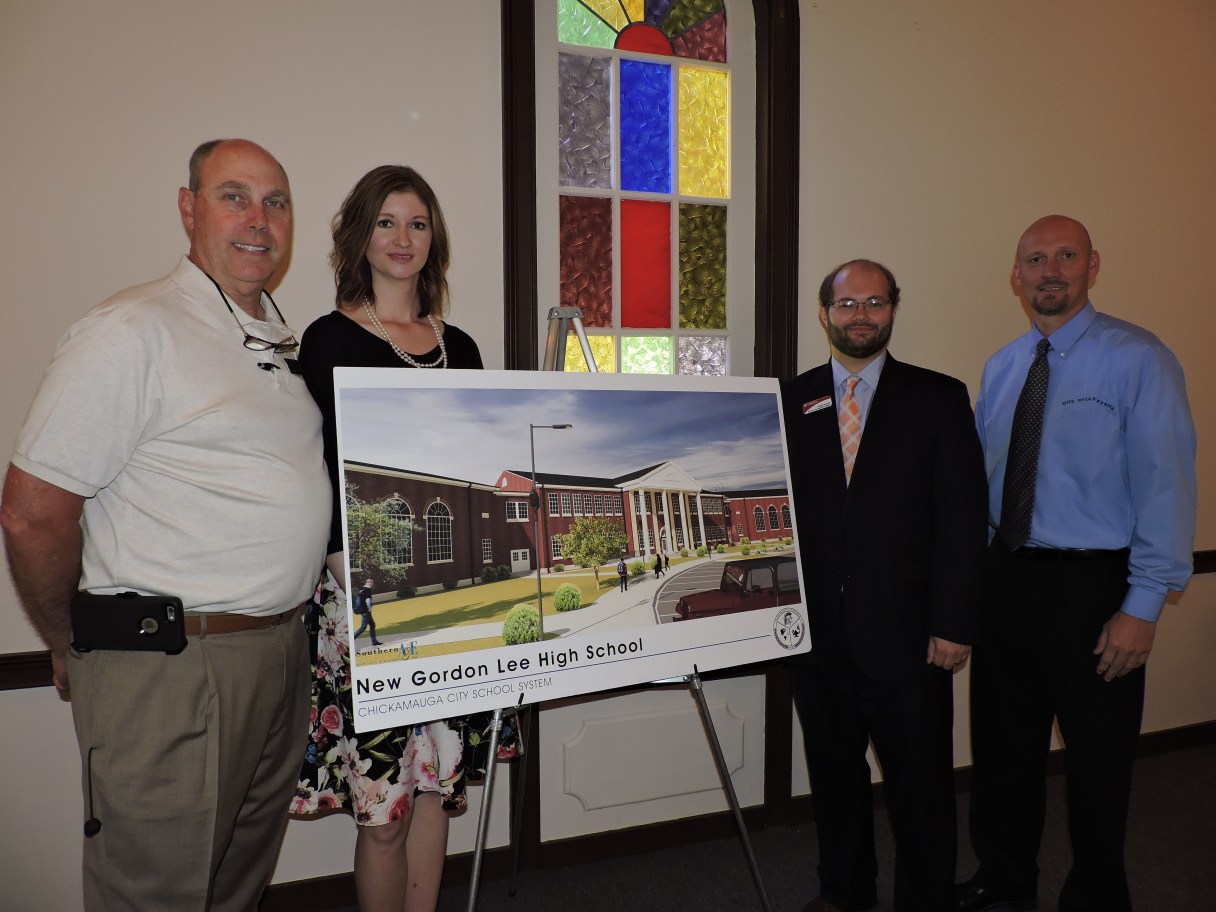
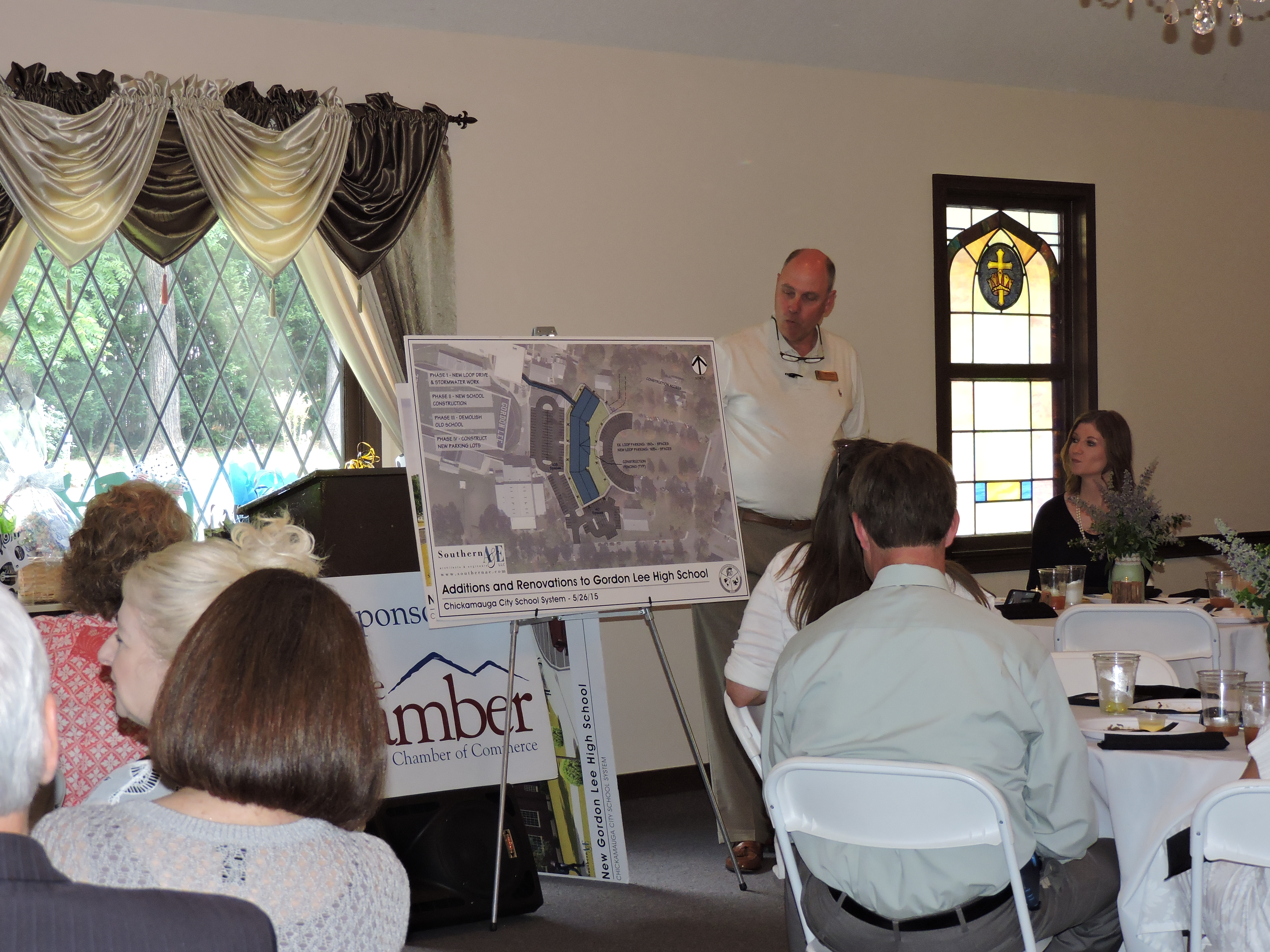
 Chickamauga City School Board Chairman Corky D.A. Jewell presents the plans for the new Gordon Lee High School to those in attendance.
City’s visioning process moving forward
Chickamauga City Councilman Evitte Parrish informed One Walker attendees the city has a new group, the Community Growth Association.Spurred by community visioning sessions earlier this year to help establish a long-range plan for the city, the group’s purpose is to bring together all civic organizations, churches, government, schools, merchants and anybody else who has a love for Chickamauga.Dubbed “Downtown Chickamauga Renaissance Strategic Visioning and Planning,” the process is being headed by the Carl Vinson Institute, a public resource affiliated with the University of Georgia.“The … $55,000 [project] is about bringing the community together to preserve what we have and meet the challenges of the future,” Parrish said. “It is about partnerships and collaboration. We are a little over halfway through the process. In March we had 305 surveys and over 50 people at the town hall meeting, including 15 focus groups and 100 interviews. Thirty-five volunteers took 14 action items such as [looking at] a place for our youth, planting trees and a recreation playground.”The group meets the third Monday of every month at 6:30 p.m. at the Chickamauga Civic Center. The group shares events on Facebook and coordinates volunteers.Visit facebook.com/ChickamaugaCommunityGrowthAssocation to learn more and stay up-to-date.
City budget update
Speaking about the city’s budget, which is separate from the school district’s, Councilman Evitte Parrish said revenues exceeded expenses.“Last year, on paper it looks like we went over budget, but if you add back the $350,000 we spent on a Memorial Family Practice our revenues greatly exceeded our expenses,” he said.The city had the opportunity to buy the building so the community would still have a physician in town, Parrish explained of the unforeseen expense, which the city had enough in savings to cover.The city is leasing the building to Memorial Hospital, and eventually, Memorial will pay Chickamauga more than the building’s purchase price, he added.“Dr. Paul Ballinger and Dr. Judith Anderson are there. They offer adult and pediatric care serving over 200 patients per week,” said Parrish. “It’s a long-term lease with a short-term payoff.”
The Chickamauga School Board will host public hearings for Chickamauga City Schools’ proposed fiscal year 2017 budget July 5 at 11 a.m. and July 28 at 4:45 p.m.
Included in the proposed budget are millions of dollars earmarked for the new Gordon Lee High School building.
“The state architect and facilities managers estimate we can do the project for about $15 million,” said School Board Chairman Corky Jewell.
The school is providing approximately $3 million up front from ESPLOST funds, he said, and the state will provide the remaining estimated $12 million interest-free, to be paid back by the city over a long period of time.
“We estimated it would take [an additional] $1 [million] to $2 million for incidentals,” Jewell added.
In a May referendum, city voters agreed to allow the school district to sell a bond of up to $2.5 million and borrow additional money if needed. The vote carried by 76 percent.
Jewell explained that the $15 million estimate “does not pay for asbestos mitigation. It doesn’t pay for demolition of the present building. It does not pay for parking lots and paving or site work here on the front. After we build this building and it’s ready for occupancy, we have to have funds available for deconstruction, site prep and hauling off debris.”
While speaking at the One Walker meeting on the grounds of the Gordon-Lee Mansion, he showed the plans for the new school.
“They are working on drawing the new building,” City Schools Superintendent Melody Day said of Southern A & E, a full-service architectural and engineering firm out of Austell, Ga. “We will use some of the old bricks within the new building.”
Day said construction bids are due July 26, and she expects to name the winning bid shortly thereafter.
“After our meeting on July 28th, we will award the contract. They will not be on our campus until the first or second week of August,” she said of the selected contractor.
Jewell estimates it will take 30-36 months to construct the two-story building. He outlined the project’s several phases – Phase I: stormwater work and installation of a loop drive; Phase II: construction of the new building; Phase III: demolition of the old building; and Phase IV: construction of new parking lots.
Following demolition, some of the bricks from the original 86-year-old buildings – both the main building and the Olive Lee building will be razed – will be available for alumni to purchase, giving them a keepsake while also helping the Gordon Lee Alumni Association, said Jewell.
“We will gain 10,000 square feet of classroom space,” he said, adding the new loop parking will include 165-plus parking spaces, 108 parking spaces will be behind the new building and 40 will be to the left when facing the building. The horseshoe currently has 180-plus parking spaces, he said.
Day said the new 10,000 square feet of classroom space is needed.
“We want to have more adequate classroom space for the students that we have,” she said, explaining that while many in the community – including some officials – wanted to renovate the original buildings, it would not have been efficient. ” We would have had to put girls’ and boys’ restrooms on both floors of every building [and an elevator]. And to do that we would have lost too much classroom space, and we are already crowded, so we could not have less space.”
Jewell said to bring all three existing buildings up to current code, the school system would have to put in structural steel and make the buildings ADA compliant. The system did not have the funds to do that, so a new building is the best option, he said.
“We were fortunate enough that voters allowed us to have ESPLOST money,” said Jewell, referencing a city referendum in November to reinstate an additional 1 percent of sales tax for the school system. “We were told that the new school must be cost effective and must last 40 years. The current school has 80-year-old plumbing and electrical. The heating and air comes and goes.”
OPPORTUNITY SCHOOL DISTRICT
In the upcoming November election, Jewell said voters will see a measure proposed by Gov. Nathan Deal to help chronically failing schools statewide by allowing the state to set up its own school system with its own superintendent.
According to the state’s website, the Opportunity School District proposal would allow the state to “temporarily step in to assist chronically failing public schools defined as those scoring below 60 on the Georgia Department of Education’s accountability measure, the College and Career Performance Index, for three consecutive years.”
Such schools would remain in the Opportunity School District for five to 10 years, with no more than 20 brought in per year and a cap of 100 at any given time.
Jewell said it will be listed on the ballot as “Shall the state be authorized to take control of a school’s facility to help with achievement.”
Day said the district has high-performing schools and won’t be affected, but she doesn’t believe that overall it’s a good idea.
“It sounds good in theory, but it will definitely be a detriment if it occurs,” she said. “The state says it will not cost any additional money, but I don’t think it’s possible. It’s more money out of schools’ coffers to go to that.”
“Most members of the school boards don’t think it’s a good idea because it takes local control away and gives it to the state,” added Jewell. “If the referendum passes, it changes local control and the way the school system operates.”
Day said the system has not had success anywhere it has been tried. The state’s website states that it’s “based on similar, successful initiatives in Louisiana and Tennessee.”