
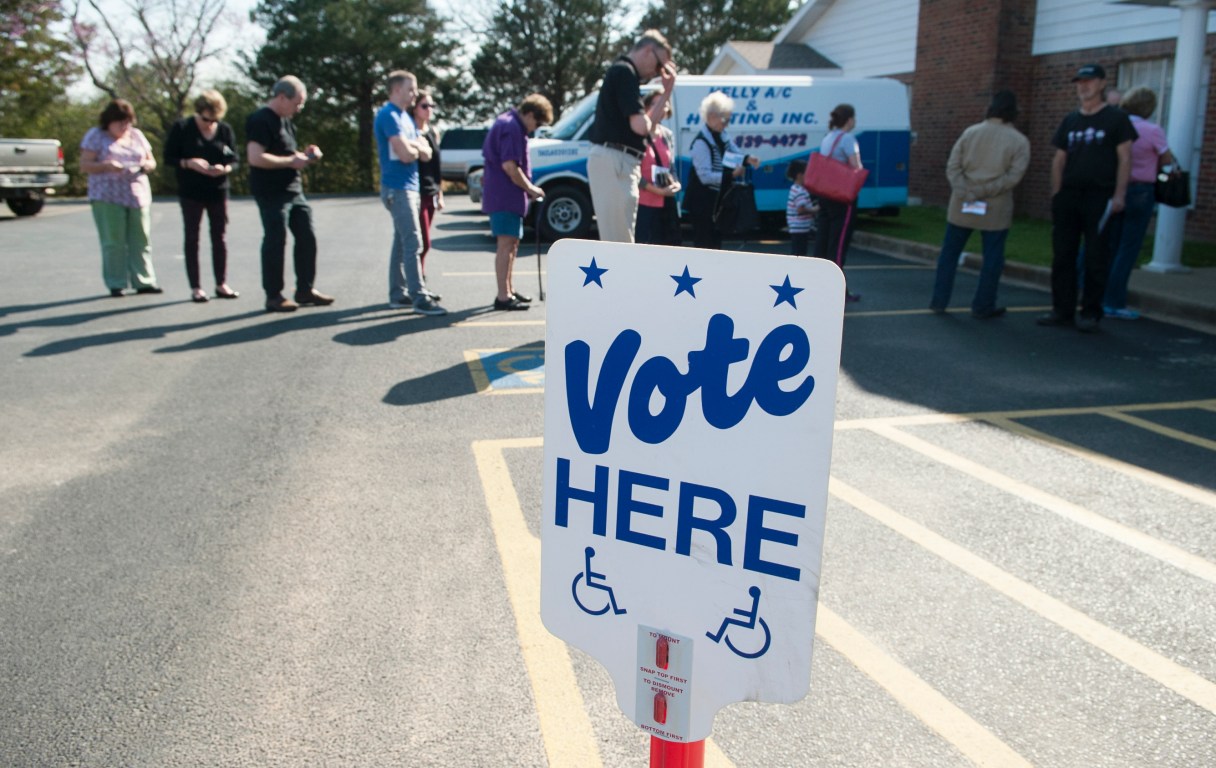
WASHINGTON (AP) – Angry and dissatisfied, large majorities of Republican primary voters went to the polls Tuesday with sour feelings toward the federal government.
At least 8 in 10 GOP primary voters in nine states had negative thoughts toward Washington, according to early results of exit polls conducted for The Associated Press and television networks by Edison Research.
The negative sentiments popped up all around the country: The dissatisfied outnumbered the angry and accounted for half or more of Republican voters in Virginia, Vermont and Massachusetts. In Texas, half of GOP primary voters said they were angry. In Alabama, Arkansas, Georgia, Oklahoma and Tennessee, GOP voters were more evenly split between dissatisfaction and anger.
Other highlights from the exit poll:
___
ABOUT OBAMA
On the Democratic side, meanwhile, voters in 8 of 9 primary states were more likely to want to see a continuation of President Barack Obama’s policies than a shift in a more liberal direction.
Majorities of Democratic voters in Alabama, Georgia, Tennessee and Virginia said they want a continuation of Obama’s policies, along with more than 4 in 10 voters in Arkansas, Massachusetts, Oklahoma and Texas. In each of those states, about a third of Democratic voters or less want a switch to more liberal policies. In Sen. Bernie Sanders’ home state of Vermont, about half of Democratic primary voters said they want the next president to change to more liberal policies.
___
HONESTY v. EXPERIENCE
Democratic voters across each of the nine states had very different priorities as they chose between Hillary Clinton and Sanders.
Nearly half of Clinton’s voters said experience was the quality they were looking for, while only about a fifth or less selected electability, empathy or honesty.
Nearly half of Sanders’ voters said honesty was the most important quality and about a third said they were looking for someone who cares.
___
STRAIGHT TALK
On the Republican side, 4 in 10 of Donald Trump’s voters said “telling it like it is” was the most important quality in a candidate, and a third said they were looking for a candidate to bring about change. About 55 percent of Ted Cruz’s voters said sharing values was most important, as did 4 in 10 of Marco Rubio’s voters.
___
THE ELECTORATE
Overall, white voters accounted for half of voters, or less, in three of the nine Democratic primaries where exit polls were conducted on Super Tuesday.
Nearly half of Democratic primary voters in Alabama and Georgia were black. In Texas, about 3 in 10 Democratic primary voters were Hispanic and a little less than 2 in 10 were black.
In three other states – Virginia, Arkansas and Tennessee – black voters accounted for about a quarter of Democratic primary voters.
___
The surveys were conducted for The Associated Press and television networks by Edison Research as voters left their polling places at 20 to 40 randomly selected sites in nine states holding primary elections Tuesday. Preliminary results include interviews with 534 to 997 Democratic primary voters and 328 to 1,313 Republicans primary voters in each state contest. In Arkansas, Georgia, Tennessee and Texas, the results also include telephone interviews early and absentee voters. The results among all those voting in each contest have a margin of sampling error ranging from plus or minus 4 percentage points to plus or minus 7 percentage points.
___
Follow Nancy Benac on Twitter at http://twitter.com/nbenac