
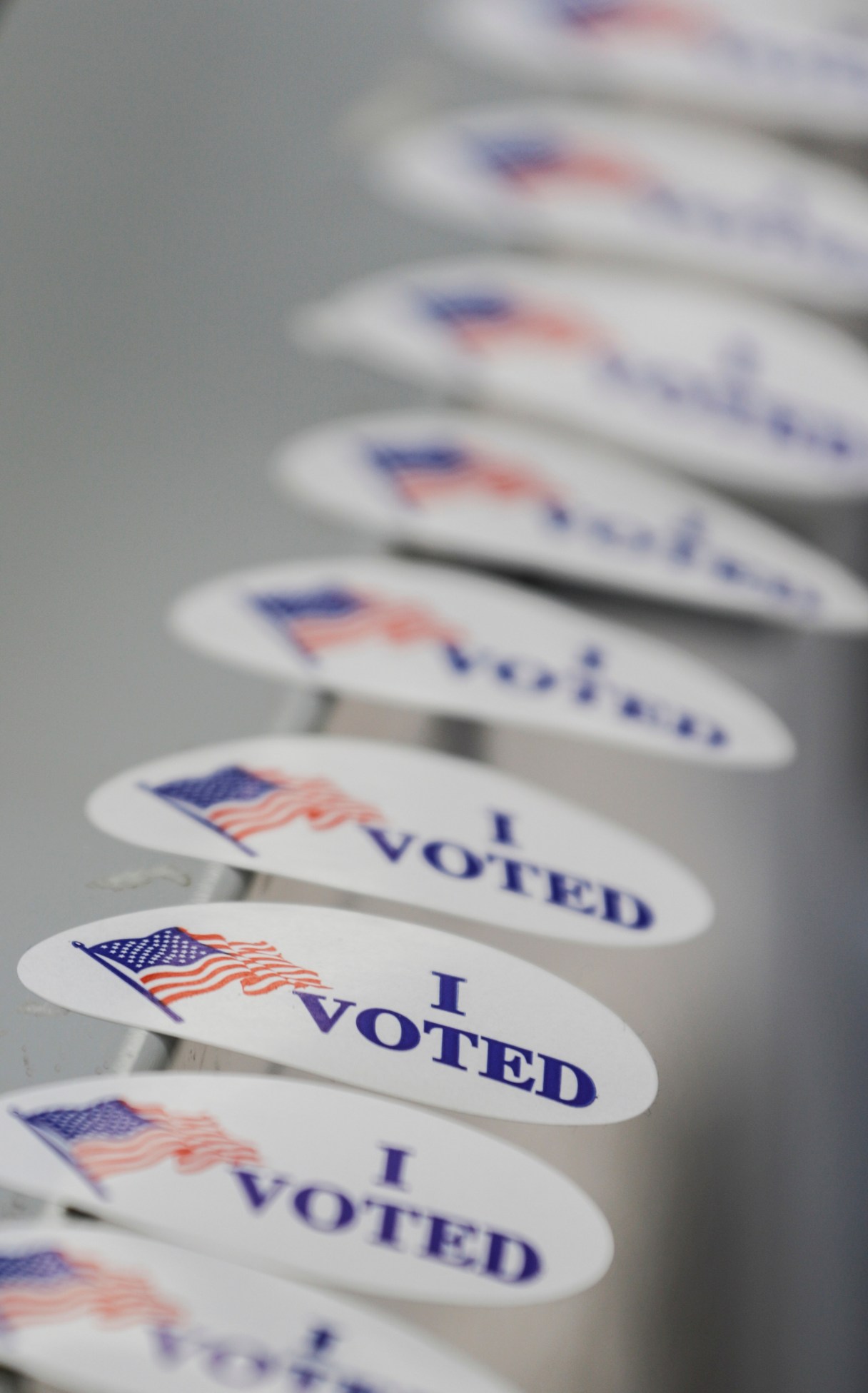
Get out and vote!
The 2008 presidential election boasted the highest U.S. turnout since the 1968 elections – and still more than four in 10 Americans of voting age stayed home.
In primaries, that number is far lower. In fact, in the 2008 Iowa caucuses, then-candidate Barack Obama’s victory was determined by a mere 16.1 percent of eligible Iowan voters who participated. Doesn’t that seem like too few people are making a call on a crucial decision?
Given all the negatives we hear every day – the influence of money in politics, the Electoral College and gerrymandered congressional districts – it’s easy to understand some apathy. But that sad fact does not make it OK to commit apathy.
Your vote does matter, and not just from the standpoint of supporting your favorite candidate.
In the broader view, higher turnout makes our democracy more representative. Just ask yourself why nearly three-quarters of the American public supports raising the minimum wage to $10.10 an hour, but Congress refuses to act. The simple matter is basic arithmetic: 75 percent of Americans want Congress to raise the wage, but during the 2014 midterms, fewer than half of eligible voters in 43 states bothered to go to the polls and vote. So why should Congress care what we want?
We can be mad all day every day about our dysfunctional Congress, but when we don’t vote, we aid and abet that dysfunction.
During presidential elections and midterms, Democrats especially need to pay attention to this.
A small shift in the national vote is all it would take for Republicans to break through Democrats’ supposed demographic advantages of diversity, according to FiveThirty Eight editor Nate Silver: If all five generally perceived voting blocks (college educated whites, non-college educated whites, blacks, Hispanics, Asians) were to shift just 3 percentage points toward the GOP in 2016, Republicans would “flip” the blue states of Colorado, Florida, Iowa, New Hampshire, Ohio, Pennsylvania, Virginia, Wisconsin and win 315 electoral votes.
And, yes, that does matter in red Tennessee, Georgia and Alabama. The Senate having a filibuster proof, 60-vote super-majority in the Senate can enable or cripple a president – any president.
Case in point: Democrats lost the Senate majority in the 2014 midterm election. Why? The gap between midterm and presidential turnout falls disproportionally among people of color. While non-Hispanic white turnout dropped by 29 percent between 2012 and 2014, it dropped by 40 percent among blacks, and 43 percent and 44 percent for Asians and Latinos, respectively. Bernie Sanders is right on this one: Turnout matters. Especially for Democrats.
As the Huffington Post noted last week, the consequences reverberate for years.
“In 2010, the Republican party not only took back the House of Representatives, crippling President Barack Obama’s agenda, but it also won a majority of state legislatures at an especially decisive moment.”
Those state legislatures were able to gerrymander congressional districts in a way that will likely keep the House under Republican control until after the next census in 2022. Pennsylvania, for example, voted for Obama twice, yet now just five of 18 House seats are held by Democratic congressmen.
Your vote may or may not decide the election, but it will make a dent in the winners’ margins of victory and, thus, extends or limits what “mandate” they can claim or how moderate or extreme their future stands may be.
Democrats: Please vote.
—
In the presidential primary, the Times editorial page endorses:
* For president: Hillary Clinton
* For assessor of property: Mark Siedlecki