
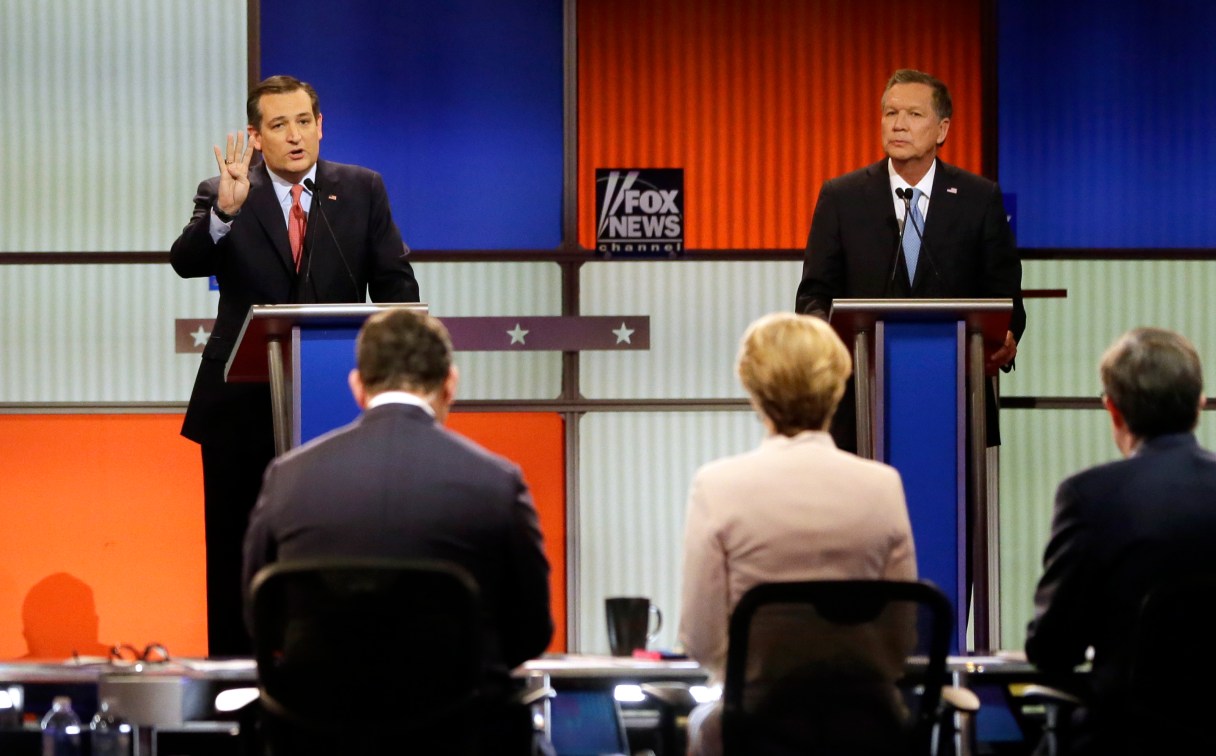
WASHINGTON (AP) – On taxes, trade and drug prices, viewers of the latest Republican debate didn’t get a straight story.
A look at some of the claims Thursday night and how they compare with the facts:
DONALD TRUMP: “We are getting absolutely crushed on trade…. With China we’re going to lose $505 billion in terms of trades. You just can’t do it. Mexico, $58 billion. Japan, probably about, they don’t know it yet, but about $109 billion.”
THE FACTS: Trump is way off on the U.S. merchandise trade deficit with China. It was $365.7 billion in 2015 – indeed, a record and the largest deficit the United States had with any country.
But the U.S. deficit with all countries last year was $531.5 billion, up from $508.3 billion in 2014, close to the $505 billion deficit that Trump assigned just to one country, China. Trump did get the deficit with Mexico correct.
But not Japan. His estimate of a $109 billion trade deficit with Japan compares with the actual deficit of $68.6 billion last year.
___
CRUZ on his proposal to abolish the IRS: “There will still be an office … to receive the postcards.”
THE FACTS: Cruz dodged the question of how the tax system will be enforced if he abolishes the IRS and has people pay taxes on simple postcard-like forms. No matter how simple taxes might become, the government still has to make sure people are paying their share, and that takes a large workforce. It’s not just a matter of receiving postcards.
Cruz’s flat tax would consolidate seven tax brackets into one at 10 percent. It’s almost certain that this level would give the wealthy huge tax breaks and cause budget deficits to soar.
___
TRUMP: “Because of the fact that pharmaceuticals are not mandated to bid properly, they have hundreds of billions of dollars in waste.”
THE FACTS: This relates to Trump’s unachievable promise to save $300 billion by allowing Medicare to negotiate prescription drug prices. That’s impossible because the entire country – Medicare, private insurance, individuals and other government programs – spends about $300 billion on drugs ($297.7 billion in 2014).
Trump’s promise could only be fulfilled, in essence, if drugs were free.
Savings estimates from Medicare-negotiated drug prices have not been nearly as huge as Trump supposes.
A study last year by the advocacy group Public Citizen and a professor at Carleton University in Ottawa estimated that Medicare’s prescription program would save $15.2 billion to $16 billion a year if it were able to get the same discounted prices for brand name drugs that state Medicaid programs and the Veterans Health Administration receive.
That’s far from a $300 billion savings.
___
Associated Press writer Ricardo Alonso-Zaldivar contributed to this report.