
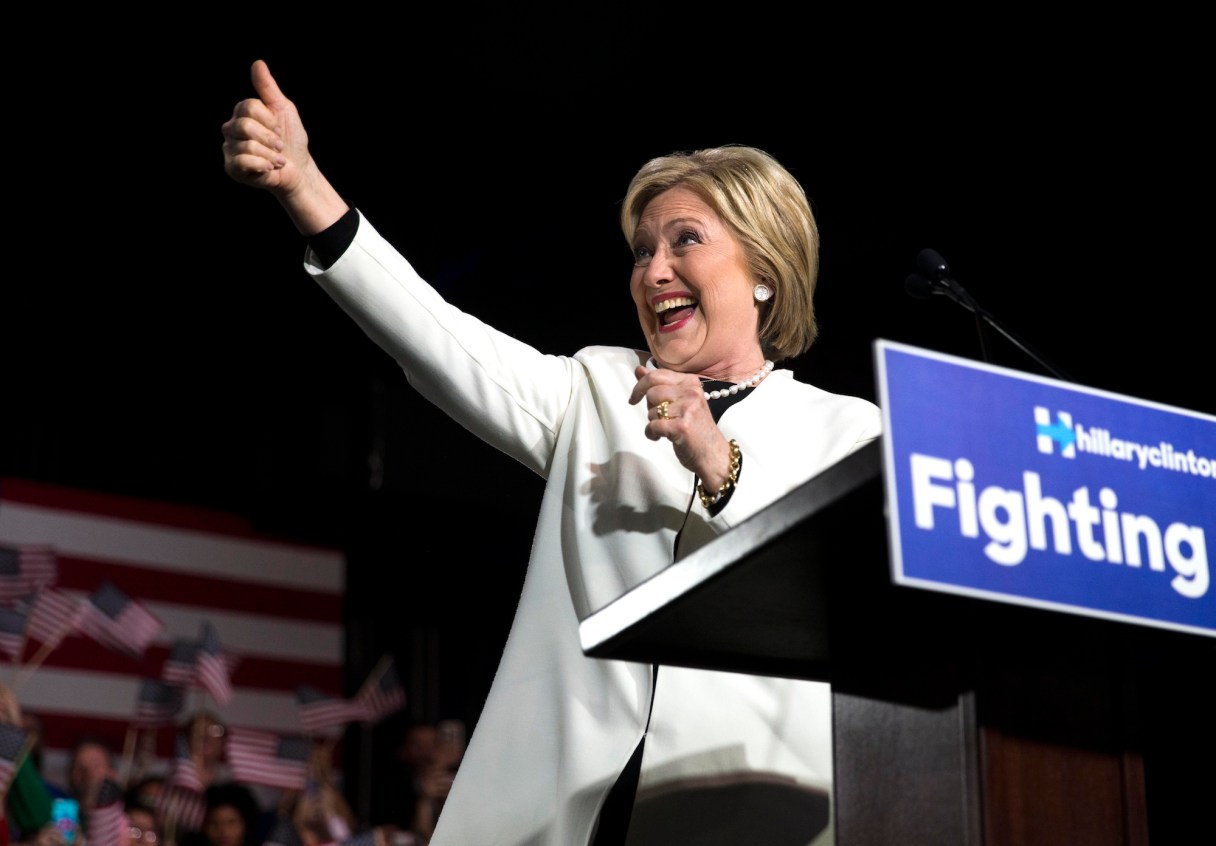
You can look at Hillary Clinton’s path to this juncture and marvel at how difficult she has often made things for herself, creating messes where there didn’t need to be any, frittering away advantages, misunderstanding the mood of voters, underestimating the mettle of opponents, and failing to cement an image – and a message – that seemed authentic and right.
That’s a legitimate perspective. She’s a deeply flawed politician.
But she’s also a preternaturally determined, resourceful and patient one. Her path illustrates that just as compellingly. For about a quarter of a century, she has been vilified as loudly as she has been lionized, told that her talents pale beside her husband’s, called “likable enough” but seldom lovable, and cast in supporting roles: the first lady, the secretary of state.
She never retreated. Never gave up.
And as the returns from Super Tuesday came in, nudging her closer to the Democratic nomination, I realized that we weren’t just seeing greater clarity in a messy race for the White House and the possible approach of history: a first-ever major-party female presidential nominee.
We were seeing the vindication of a fortitude and fierceness that warrant as much notice as her less savory qualities.
She notched important wins Tuesday in Massachusetts, Texas, Virginia, Tennessee, Georgia, Arkansas and Alabama, echoing her triumph in South Carolina on Saturday.
Let’s give her this moment, because she fought her way here. She tuned out the naysayers. She turned a blind eye to all her scars. Her ability to do that may reflect unrestrained ambition, a sturdy confidence in her mission or – more likely – an intricate cat’s cradle of both. Whichever the case, it demonstrates a grit that could be her greatest asset in a general election.
But grit won’t be enough.
The surprising, impressive success of Sanders, who had his own key wins Tuesday, has made that clear. There’s an ire and a disgust in the body politic – they fuel his campaign just as they do Donald Trump’s.
Clinton is poorly positioned to mollify that rage, and the reason isn’t just coziness with Wall Street. It’s her familiarity, her celebrity, her crowd. She’s political royalty.
And oh, the baggage she carries! Many more Americans have an unfavorable impression of her than a favorable one: In a Quinnipiac University poll from early February, the split was 56 to 39 percent.
She conquers that how? By introducing herself better to voters? They know her plenty well. By unveiling yet another new image? It’s hard to imagine there are any permutations left.
Democrats are aware of that, and have consoled themselves by focusing on who her Republican opponent might be: Trump.
To attain the presidency, a politician needn’t be adored – just less loathed than the alternative.
In that same Quinnipiac poll, Trump’s unfavorable to favorable ratio was even worse than Clinton’s: 59 to 34 percent. Her supporters and advisers are accordingly crafting a strategy of brutal negativity and relentless attacks, as The New York Times reported earlier this week. Envisioning that, David Plouffe, who managed Barack Obama’s 2008 campaign, said that a Clinton bid would be less “hope and change” than “hate and castrate.”
There are several problems with “hate and castrate.” One is that Trump already dwells in the sewer and most voters know it; to join him there isn’t to expose him but to degrade yourself.
Another is that it doesn’t address the ire I mentioned earlier, the yearning to rebel. And a disappointed Sanders voter with that yearning could, in a general election, sit on the sidelines or vote for Trump before siding with Clinton.
Worst of all, an epically nasty general-election campaign would do nothing to unite the country and give the next president much of a chance of governing effectively.
Clinton has the toughness to engage in – and survive – a brutally ugly contest. She also has the smarts to know the cost of it. Has she honed the character and nimbleness to prevail in a more inspiring, unifying way?
As well as we know her, this is yet to be revealed.