
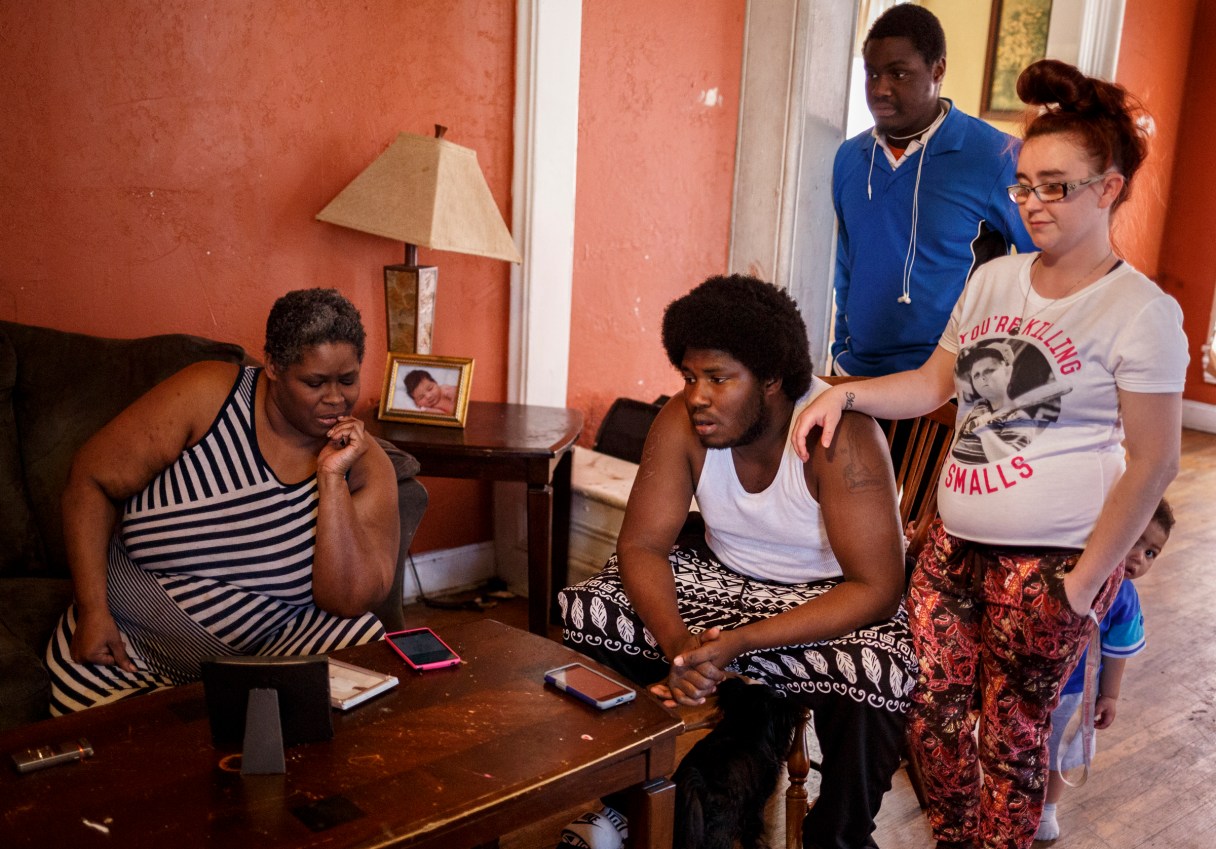
 A photo of Delivetrick Blocker, who is in prison with a life sentence without the possibility of parole for a crime he committed when he was 17, rests on a table as his mother Jeanette Blocker talks to him on the phone from her home Wednesday, March 9, 2016, in Chattanooga, Tenn. After a recent Supreme Court ruling, Blocker and others who were sentenced to life without parole as juveniles may soon be able to apply for a new sentencing hearing that allows for the possibility of parole.
Four-year-old Imunique Brown knows her uncle only as a disembodied voice coming through her grandmother’s cellphone.
But when that call comes in, it doesn’t matter that she’s never met him.
“Hey there, Uncle Pooh Bear,” she shouts at the phone.
“I love you.”
This has become a common ritual for Delivetrick Blocker’s family.
Jeanette Blocker, his mother and the matriarch in the Chattanooga home, gathers her children, grandchildren and friends several times a week to crowd around the phone, which sits on a living room coffee table, to chat with a man most of them have not seen in decades.
“He interacts with all of them like he was here, even down to my grand-baby,” she says. “He’s never seen some of them a day in his life, but he loves them.”
Brieasha, his 19-year-old sister, is going to be moving out of the house soon, and her mother is talking with Delivetrick about some apartments on Tunnel Boulevard.
Brieasha makes a wisecrack about her older brother to the group and he fires back with a laugh over the phone, “I heard you, you smart-mouth little girl.”
In these precious few moments, there are jokes back and forth, updates on the latest, and life advice thrown around, whether it’s asked for or not.
In these moments, it doesn’t seem to matter that the call is coming from Whiteville Correctional Facility in Hardeman County, Tenn.
Delivetrick Blocker has spent the last 20 years in prison, serving a life sentence without the possibility of parole, believing he will die behind bars for a murder he committed as a teenager.
But after a recent U.S. Supreme Court ruling, all of that might change.
THE MURDER
On Oct. 8, 1995, Delivetrick met with two other boys at his house, the three of them deciding to rob a taxi driver.
He was 17 years old at the time and carrying a sawed-off, 12-gauge shotgun that a friend gave him.
At 10:15 p.m., the trio walked to a convenience store at the corner of Alton Park Boulevard and West 38th Street, where they called a cab.
Charles Ray Williamson came to pick up the fare and the boys told him to drive to a wooded location on Cain Avenue, only about a half-mile away from where he picked them up.
According to court records, Delivetrick got out of the cab when they arrived and put the shotgun through the passenger-side window, pointing it at Williamson and demanding his money.
Williamson began reaching for something beside the driver’s seat and Delivetrick pulled the trigger.
All three boys fled the scene.
Fifteen minutes later, Williamson was found after the cab crashed into a nearby home. He was near death, slumped over next to the steering wheel, half of his face missing from the shot.
He died within the hour before arriving at Erlanger hospital. All three suspects were arrested on Oct. 23 in connection with the slaying.
The following year, a jury found Delivetrick Blocker guilty of first-degree murder, and on March 20, 1997, he was sentenced to life in prison without the possibility of parole.
‘PRISON AIN’T FOR NOBODY’
Since then, Delivetrick has bounced around the Tennessee penitentiary system from county to county, finally landing in Hardeman County near Memphis about three years ago.
He’s learned to cope with life in prison, just as his family has with his absence, but since he was arrested at 17 it’s the only adult life he’s ever had.
“I had to grow up in here and adapt to the environment,” he said over his mother’s cellphone sitting on the table on a recent afternoon. “This is basically all I know, how to survive in prison.”
He will turn 39 in November, and his family says the man they call “Pooh Bear” is worlds away from the boy who was arrested all those years ago.
Now he passes his time at Whiteville by participating in every program offered to him, whether it’s anger management or job training. He said his favorite is the parenting course.
He’s even completed a commercial cleaning program and started thinking about what he’d like to do with those skills if he ever walks free.
“I’m willing to take whatever job I can get, but I’d like to save enough money to build my own commercial cleaning company with a couple of my brothers and try to keep them out of trouble,” he said.
Another priority for him would be to work with children in the Chattanooga community by becoming a mentor who could warn them against making the choices he did as a juvenile.
“I want to try and prevent someone from coming through the same situation I’ve known, the situation that led me to where I am today,” he said.
“Prison ain’t for nobody.”
His mother is determined to see him fulfill those dreams. She said she made her son a promise the day he was first locked up.
“I said, ‘I’m not going nowhere until I see you a free man.’ So I’m not going nowhere.”
She said if he were to walk free again, it would be one of the happiest days of her life.
“I could touch him, I could feel him,” she said. “I could actually cook him macaroni and cheese.”
That dream has become less and less likely as the years have marched on, but recently the family has found a new reason to hope for the future.
A LANDMARK CASE
On Jan. 25, the United States Supreme Court made a landmark decision in a case called Montgomery v. Louisiana that might open the door for convicts like Blocker to spend at least some time outside of prison.
Henry Montgomery was 17 when he murdered a sheriff’s deputy in 1963. Just like Delivetrick, he received the mandatory sentence of life without the possibility of parole and has spent his entire adult life behind bars.
But in his case, the court ruled 6-3 in favor of Montgomery to retroactively apply a 2012 ruling that determined the mandatory sentence for juveniles constituted “cruel and unusual punishment” and was in violation of the Eighth Amendment.
“Henry Montgomery has spent each day of the past 46 years knowing he was condemned to die in prison,” Justice Anthony Kennedy wrote in the majority opinion.
“Perhaps it can be established that, due to exceptional circumstances, this fate was a just and proportionate punishment for the crime he committed as a 17-year-old boy.”
Now Montgomery may have his case reviewed, receive a new sentencing hearing and, potentially, receive parole.
The pivotal ruling could affect nearly 2,300 other inmates who are serving life sentences without parole for crimes they committed as juveniles, by allowing them to fight for different, more lenient sentences.
Delivetrick’s family hopes he can get the same.
WHAT HAPPENS NEXT
For Delivetrick Blocker, his family and the thousands of other convicts this case could apply to, there’s a long road ahead in their pursuit of freedom.
There are lawyers to talk to, papers to file and, if his case ever comes before a judge again, his fate depends on whether it is clear he has been rehabilitated.
There are some people in Chattanooga who don’t know if that’s possible – namely, the family members of the man he killed.
Louise Boran, the victim’s sister, said she thinks it’s ridiculous to consider letting him out.
“They knew what they were doing,” she said. “He’ll get out and kill somebody else, that’s exactly what will happen.”
According to her, things went wrong in Delivetrick’s childhood and it would take something monumental to convince her that he had changed through his time in prison and deserved to be on the outside.
For his part, Delivetrick said, “I take full responsibility as the man I am today for what I have done and the pain I have caused to the victim’s family.”
“I know I can’t bring Mr. Williamson back, but I don’t want them to think that after all these years I’ve been cold-hearted.”
Boran’s niece, Terrie Goss, works as a paralegal in Chattanooga. She said Williamson was more of a father figure to her than an uncle and it will take more than words to make her believe Blocker has been rehabilitated.
“[He] ruined our lives,” she said this week.
If the case begins to build toward a new sentencing hearing, Goss said, she would like to sit down with the man who killed her uncle and talk to him face to face. She wants to know that he understands the hurt he’s caused, that he feels remorse for it.
“They did something horrible and they planned on robbing a cab driver,” she said. “This all brings back a lot of horrible memories.”
To a degree, she said, she understands why the Supreme Court made its decision and why the story might not be over for juvenile offenders like Blocker. Regardless of the damage they did to themselves and others, no one wins here, she said.
“It breaks my heart for their families and it breaks my heart for them,” she says.
“They were kids.”
Contact staff writer Emmett Gienapp at egienapp@timesfreepress.com or 423-757-6731.