

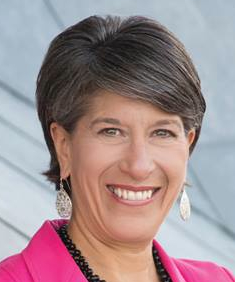
In her commencement address to the students at the University of California, Berkeley, Sheryl Sandberg, chief operating officer of Facebook and author of “Lean In,” said that, instead of sharing what she had learned about life, she would tell them what she learned in the midst of death.
Sandberg’s husband died unexpectedly in 2015. During the many months she was swallowed by grief, she learned about the depths of sadness and the brutality of loss. She learned that when life sucks you under, you can kick against the bottom, find the surface and breathe again. She also learned that in the face of challenges you can choose joy and meaning.
She expressed her wish that the students could learn lessons of hope and strength amidst all of the day’s joy.
“Everybody has experienced some disappointment you will almost certainly face more and deeper adversity,” she said.
In the midst of the adversity, what do you do next? The easy days will be easy; it is the hard days that challenge you to your very core, that determine who you are. You will be defined not just by what you achieve, but by how you survive.
Sandberg said she found psychologist Martin Seligman’s research helpful on how people deal with setbacks. Personalization, pervasiveness and personalization are three common ways people deal with adversity in their lives. The seeds of resilience are planted in the way we process life’s hardships.
Personalization is the belief that we are somehow at fault for what happened. Sandberg noted that this is different from taking responsibility, which one should always do. This is the lesson that not everything that happens to us happens because of us.
For example, Sandberg shared that she pored over her husband’s medical records after his death looking for what she had missed. In reality, her husband’s coronary artery disease had gone undiagnosed. There was no way she could have known.
Getting past personalization can make you stronger. Students who believe they can do better tend to revisit their methods and excel in future classes. Not taking failures personally allows you to recover and thrive.
Pervasiveness is the belief that an event affects all areas of your life. Everything is awful. There is nowhere to hide from the all-consuming sadness. The best response to this is getting back into your routine as quickly as possible.
Permanence is the belief that the sorrow is unending. Sandberg said this was the hardest for her because it felt like the overwhelming grief would never leave. We must learn to accept our feelings, but know they won’t last forever.
“I wish I had known about the three “P’s” when I was your age,” Sandberg said. “There were so many times they would have helped me.”
If you recognize you are falling into these traps, you can self-correct. Our bodies have a physical immune system, and so does the brain.
At one point a friend told Sandberg, “Think about how much worse things could be.” She asked him how things could be worse.
He said, “Your husband could have been driving with the children when this happened.” Sandberg immediately felt overwhelming gratitude, which overtook some of her grief.
“Finding gratitude and appreciation is key to resilience,” Sandberg said. “People who lift up what they are grateful for are healthier and happier. Before I go to bed at night, I think about what I am grateful for. Try it.”
Eleven days before the anniversary of her husband’s death, Sandberg said to a friend, “A year ago he had 11 days left and we had no idea. How would you live if you had 11 days left?”
She encouraged the students to live as if they had 11 days left, saying, “I don’t mean blow everything off and party all the time. I mean live with the understanding of how precious every day would be because that is how precious every day actually is.
“I stand before you today, one year after the very worst day of my life, and two things are true. I have a huge reservoir of sadness that is always with me. For the first time, I am grateful for each breath in and out. I am grateful for the gift of life itself. I used to celebrate my birthday every five years and my friend’s birthday sometimes. Now I celebrate always.”
Sandberg used to go to bed at night thinking about everything she did wrong that day. Now she focuses on that day’s moments of joy. Losing her husband helped her find deeper gratitude.
“I hope you live your life, each precious day of it with joy and meaning,” Sandberg said. “When the challenges come, I hope you remember that deep within you is the ability to learn and grow. You are not born with a fixed amount of resilience. It is a muscle. You can build it up and draw on it when you need it. In that process you figure out who you really are. You might just become the very best version of yourself.”
These are surely wise words for those graduating from high school and college, and perhaps for all of us. In the midst of life, may we not take a single day of living for granted.
Julie Baumgardner is the President and CEO of First Things First. Contact her at julieb@firstthings.org