
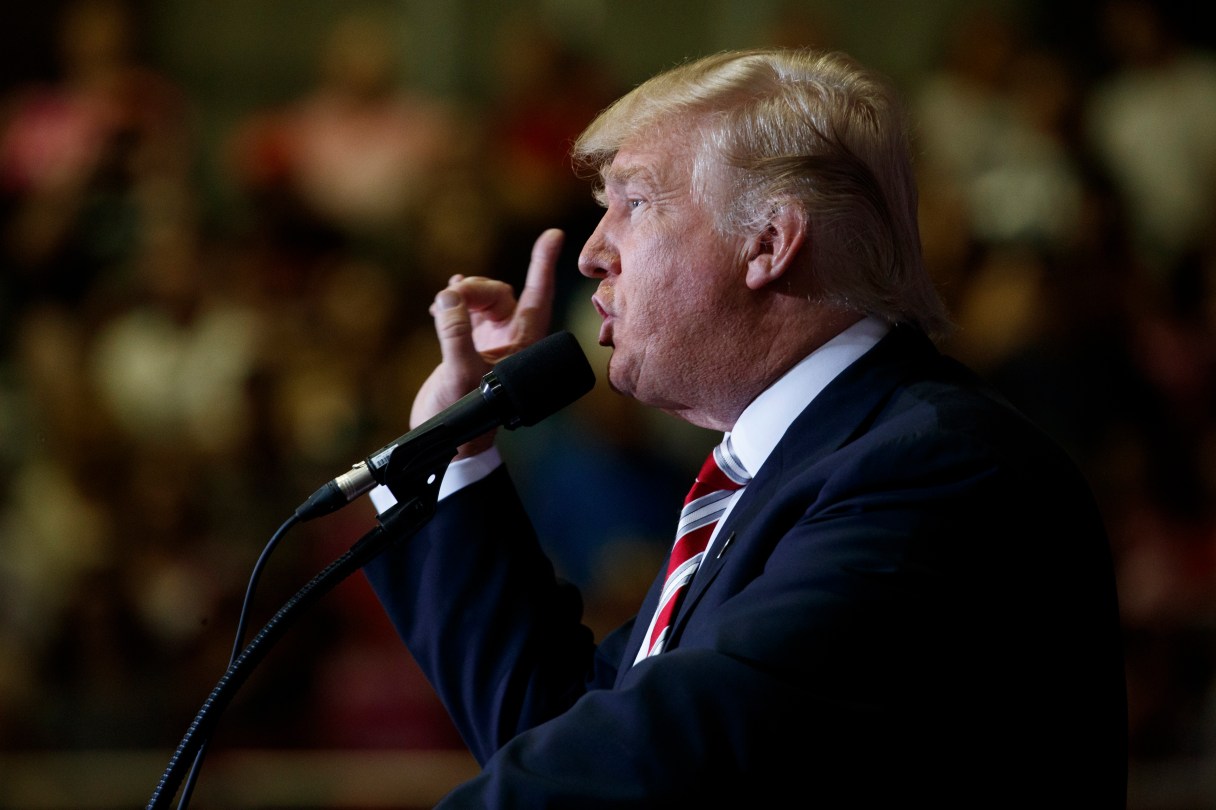
WASHINGTON (AP) – Hillary Clinton is rushing to secure Michigan and bolster the Democratic Party’s vaunted blue wall of upper Midwestern states that have backed the party’s presidential nominee for two decades, sending in reinforcements as Donald Trump aims to upend the former secretary of state’s path to a winning 270 electoral votes.
Clinton plans to rally Democrats on Friday in Detroit, where a large turnout of black voters has long been crucial to success. She’ll arrive after a last-minute meeting by former President Bill Clinton with black ministers on Wednesday night.
Clinton’s campaign notes both Michigan and Pennsylvania do not have in-person early voting, requiring them to intensify turnout efforts in the days leading up to Tuesday’s election.
But the late focus on Michigan, which has not received extensive attention from Clinton during the campaign, underscores Democratic concerns that Trump may be gaining in a state that hasn’t backed a Republican presidential candidate since 1988.
Trump’s fortunes have appeared to improve in the wake of FBI Director James Comey’s announcement the bureau is looking into newly discovered emails that may be related to the investigation into Clinton’s use of a private email server while at the State Department.
The GOP nominee still faces a tough path to reach the White House. Given the current state of the political map, even victories in the premier swing states of Ohio and Florida would not guarantee Trump the presidency.
In order to overtake Clinton, Trump would likely need to win several battleground states, including Iowa, Nevada, New Hampshire and North Carolina, if he fails to pick off a blue-collar state like Pennsylvania, Michigan and Wisconsin now viewed in Clinton’s column. Combined, those three states account for 46 electoral votes.
But if Trump managed to win one or two of those states, it opens more pathways for him to overtake Clinton, who would then need to rely more heavily on swing states. In addition to Detroit, Clinton was campaigning Friday in Pittsburgh and Cleveland, while Trump planned a campaign stop in Hershey, Pennsylvania, on Friday night.
The Clintons will be joining President Barack Obama and first lady Michelle Obama in Philadelphia on the eve of the election and the president will headline a Monday afternoon rally in New Hampshire on Clinton’s behalf.
At the same time, Clinton has mounted a late charge in Arizona, where Republicans have won all but one presidential election since 1952. Trump’s hard-line position on immigration and the influx of Hispanic immigrants, who tend to vote Democratic, are behind the tightening in that state.
Likewise, Trump cannot bank on carrying traditionally Republican Utah, where former CIA officer Evan McMullin’s independent candidacy is winning significant support.
Losing either state would likely require Trump to carry some combination of Michigan, Pennsylvania and Wisconsin to have a shot at 270 Electoral College votes.
In a sign of the urgency of the race’s final days, the candidates and outside groups have shuffled advertising money to emphasize Pennsylvania, New Hampshire and Michigan – places with only same-day voting.
Clinton and the main super PAC helping her are spending at least $8 million in Pennsylvania, while Trump and super PACs aiding him have about $3.5 million on the air. In Michigan, a state that had seen no major advertising during the general election, Clinton and groups helping her are spending about $1.5 million.
Clinton’s team is roughly doubling Trump’s ad spending this week in New Hampshire.
In Detroit, Bill Clinton met privately Wednesday with black ministers, community leaders, members of the state’s congressional delegation and the city’s Democratic mayor, Mike Duggan, “to galvanize support for Hillary and Democrats up and down the ballot,” Clinton’s campaign said.
Voter turnout in Detroit, especially among African-Americans, is pivotal to Democrats in the state. Detroit’s metropolitan region typically accounts for nearly half of the Democratic vote in statewide elections.
Hillary Clinton’s trip to Michigan will be the latest by a Democratic nominee since 2004, when John Kerry visited Detroit the day before the election. Kerry won the state by 3 percentage points. In his two campaigns, Obama easily carried Michigan twice, by 16 points in 2008 and nearly 10 points in 2012.
Republicans said the race has tightened in suburban Detroit, especially Oakland County, home to thousands of traditional Republicans, and Macomb County, home to working-class white voters who were known as “Reagan Democrats” in the 1980s.
“Michigan is definitely in play,” said Dan Pero, chief of staff to former Michigan Gov. John Engler, a Republican. “You began to see Republican movement this week. And the Trump message plays very well in rural and working-class Michigan. We’re seeing state numbers showing the race in low single digits.”
The race was never expected to be a landslide, said Amy Chapman, a senior adviser to Obama’s two statewide races. Clinton may have revived her ad campaign, she said, but so would any campaign with the fundraising advantage the Democratic nominee has over her opponent.
“They wouldn’t put all the resources into the state that they have,” Chapman said, referring to the staff Clinton has assembled there. “You don’t do that in a state where you don’t think you’re going to have to run a robust campaign.”
__
Beaumont reported from Prole, Iowa. Associated Press writers David Eggert in Lansing, Michigan, and Julie Bykowicz in Washington contributed to this report.