
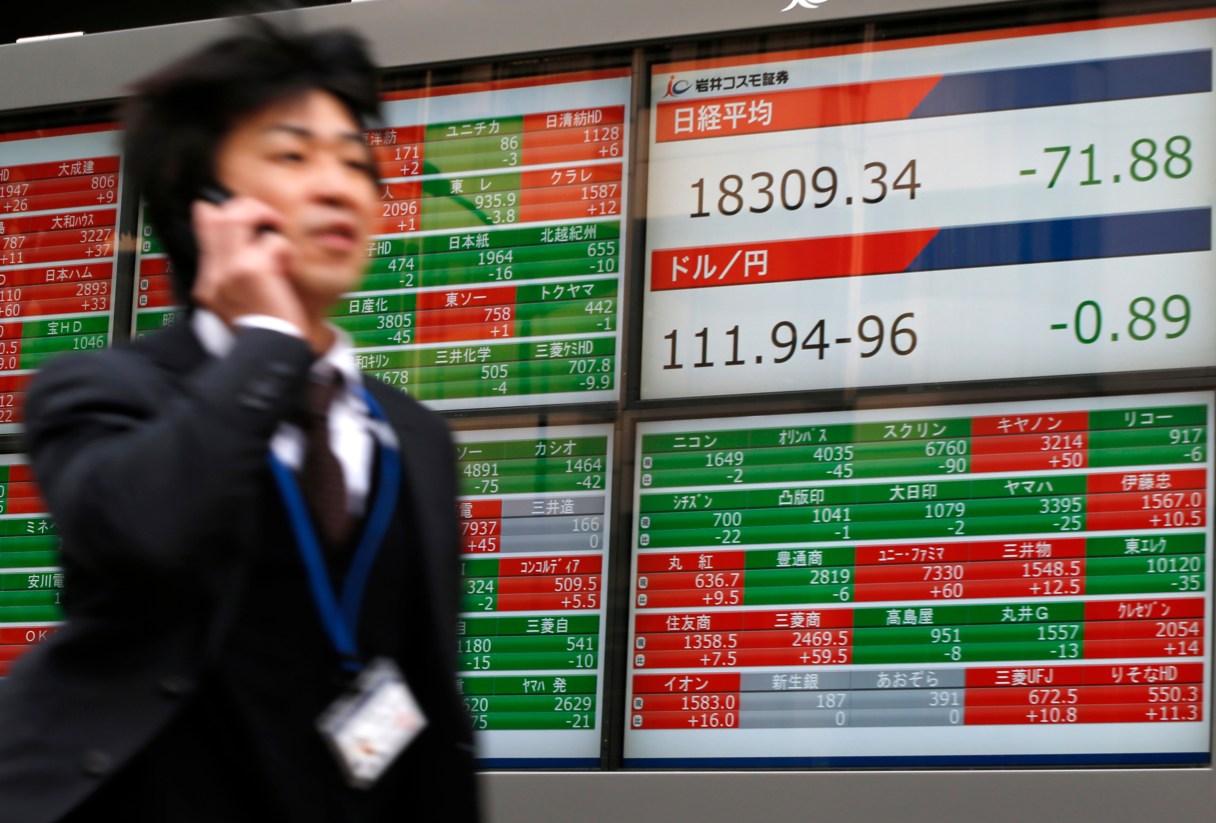
BEIJING (AP) – Chinese shares rose but most other global markets retreated Monday as oil prices fell further on unease about this week’s OPEC meeting to discuss possible output cuts.
KEEPING SCORE: Germany’s DAX index lost 0.8 percent to 10,612.49 points and France’s CAC-40 lost 0.7 percent to 4,517.86. London’s FTSE 100 declined 0.7 percent to 6,792.74. On Friday, the FTSE 100 and CAC-40 each rose 0.2 percent while the DAX gained 0.1 percent. On Wall Street, futures for the Dow Jones industrial average and Standard & Poor’s 500 index were off 0.5 percent. On Friday, the Dow and the S&P both hit fresh highs, gaining 0.4 percent, while the Nasdaq composite added 0.3 percent.
OPEC WATCH: Major oil producers meet Wednesday to discuss output cuts to shore up prices, but Iran and Iraq have failed to agree to a reduction, raising doubts over the Vienna meeting’s likely outcome. OPEC’s top producer, Saudi Arabia, has suggested it might be open to no output cut, departing from previous statements in a move analysts said makes an agreement less likely. The Saudis also pulled out of a meeting with Russia and other large non-OPEC producers, leaving all decisions to the Vienna meeting.
ANALYST’S TAKE: The latest developments suggest “cartel members may fail to agree on production cuts,” Nicholas Teo of KGI said in a report. “This game of brinkmanship will continue to the very end.” Teo said Donald Trump’s election as president could change market conditions due to his support for U.S. shale oil, which would add to global supply and to downward pressure on prices. “Still, it is one thing to believe in any cuts that may be announced, and another to expect the cartel members to actually conform to their quotas.”
YUAN REBOUND: China’s yuan rebounded from an eight-year low against the U.S. dollar after a central bank official said Beijing wants it to remain stable. The yuan’s exchange rate is based on a basket dominated by the American currency and has been dragged up by the dollar’s rise while other developing country currencies have weakened. On Monday, the middle point of the narrow band in which the yuan is allowed to fluctuate against the dollar rose by just over 0.1 percent to 6.9042 to the dollar. That came after Yi Gang, a deputy central bank governor, was quoted on the bank’s website as saying the yuan has “characteristics of a strong and stable currency” and was likely to “remain relatively stable at a reasonable and balanced level.”