
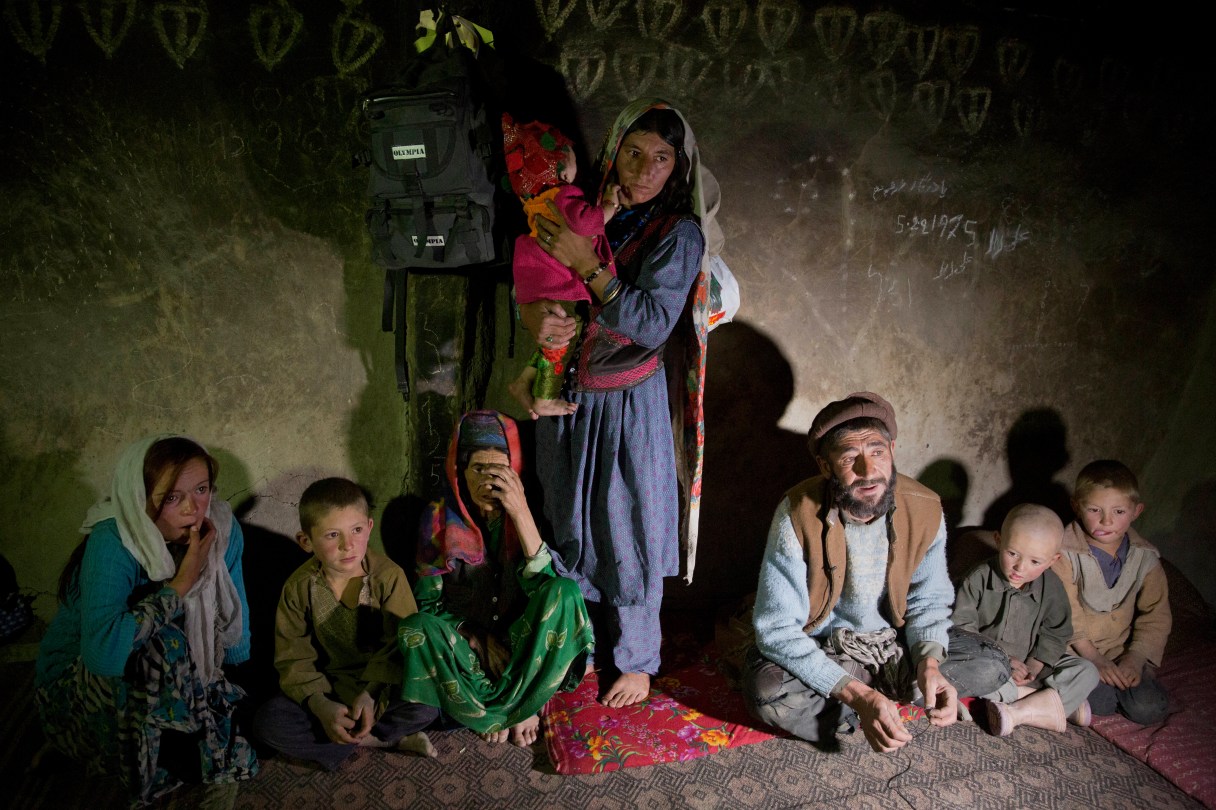
WAKHAN, Afghanistan (AP) – Saeed Beg and his family live in a two-room mud house with no electricity or running water, no bathroom, no kitchen and no furniture apart from a few threadbare rugs and a couple of thin mattresses.
With his mother, wife and five children aged from 8 months to 14 years sitting alongside, he describes life in the Sarkand valley of Afghanistan’s far northeastern Wakhan corridor as “very difficult.” As he talks, the face of a child laying kindling on the roof to dry appears in the pentagonal hole in the ceiling – typical of the homes of Ismaili Muslims, supported by five pillars. The hole lets in the fading evening light, and when Beg’s wife Azalma sets a fire, the smoke curls up toward the velvety-blue, starlit sky.
Beg describes how he exchanges his sheep and goats for food – rice, cooking oil, salt – in the barter system that is the main form of financial transaction here in the shadow of the Hindu Kush.
“We do it because there is no money,” he says. “We don’t have any income, and if we don’t do it, my kids will go hungry. We’ll all be hungry all the time.”
He looks at his boys, snotty-nosed but healthy, their clothes dirty but enough to keep them warm as they tend the livestock after school. Beg wants them to grow up to work for the government “so then they can feed me.”