
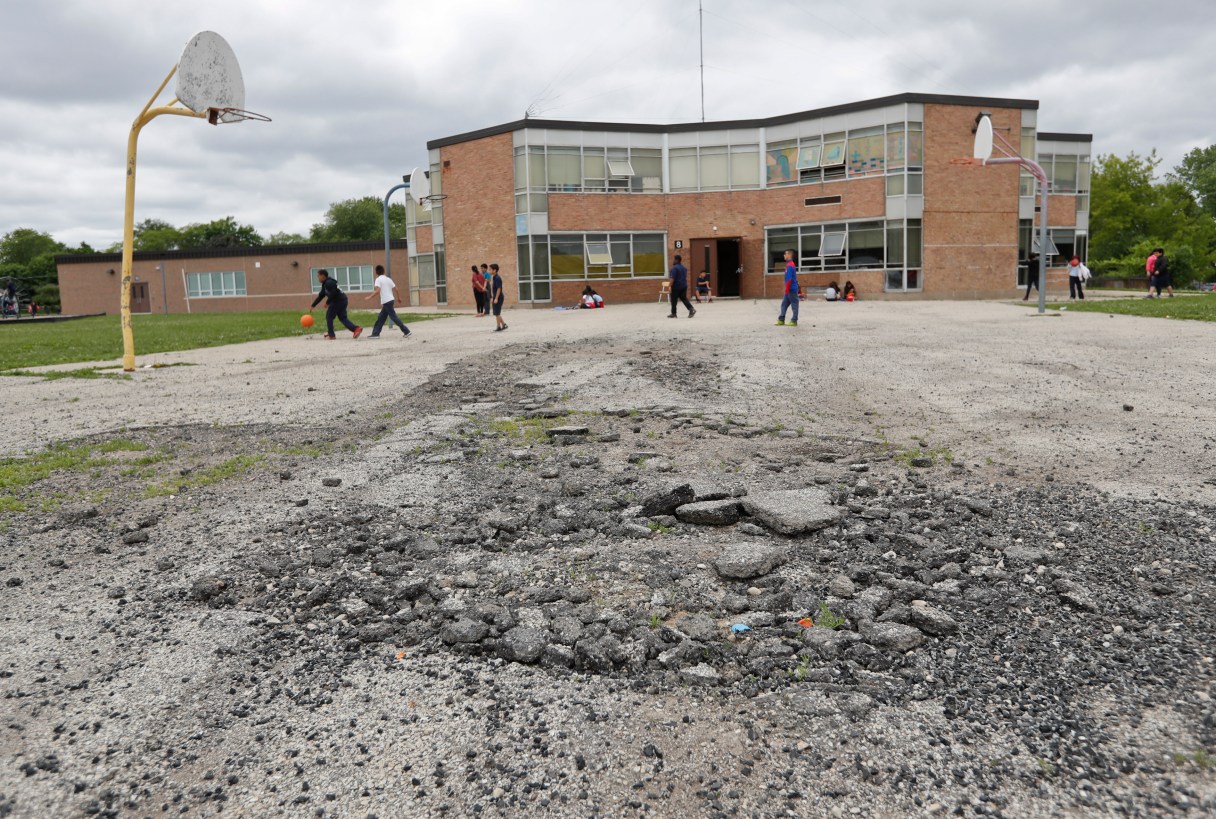
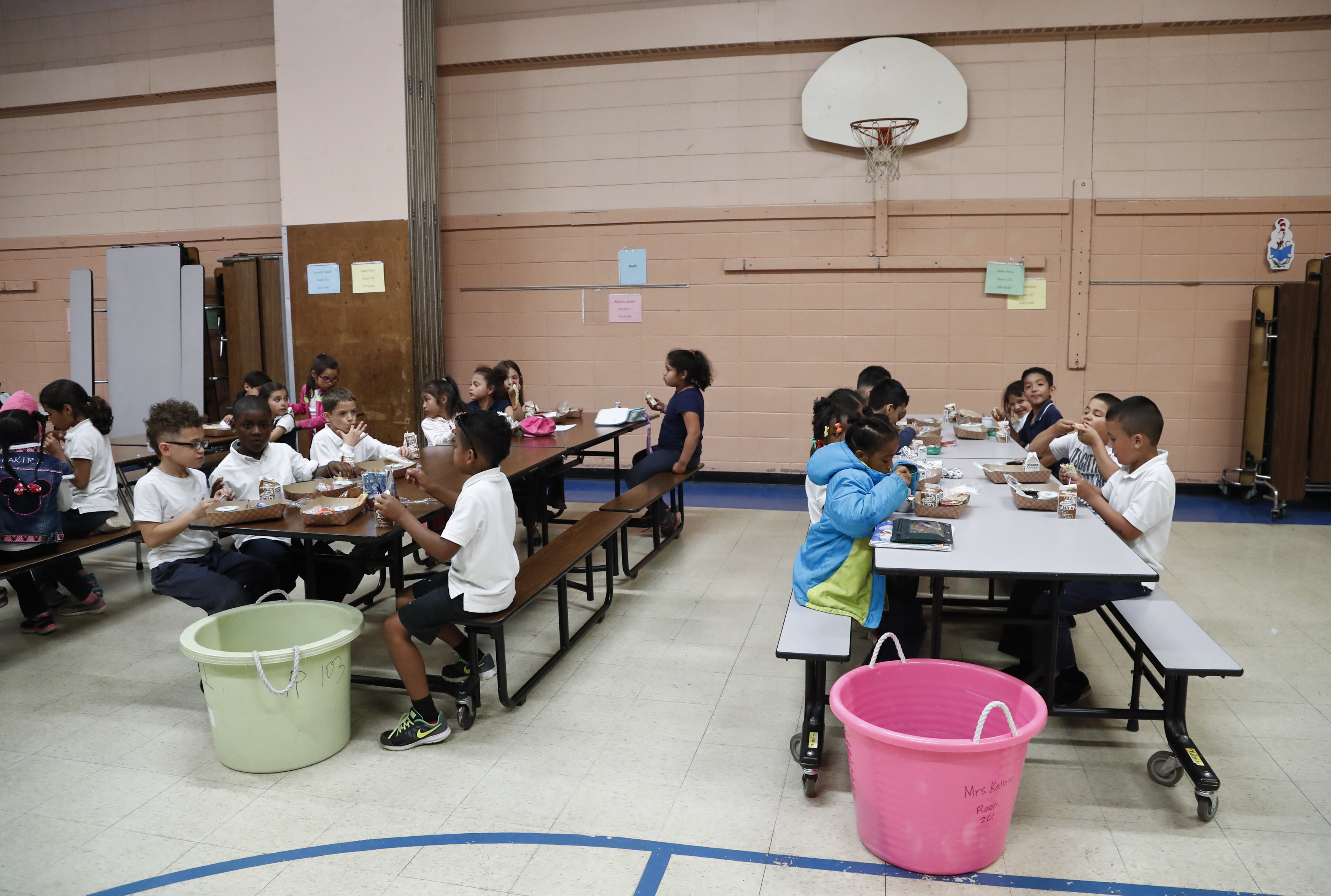
 In this Tuesday, June 7, 2016 photo, students eat lunch inside the school’s gym at Little Fort Elementary School in Waukegan, Ill. For schools in the poorest 25 percent of Illinois districts, as measured by child poverty rates, per-pupil funding stalled at around $13,500 in 2014, the most recent year for which full data are available. Meanwhile, per-pupil funding climbed to over $15,000 in the wealthiest 25 percent. (AP Photo/Kamil Krzaczynski)
WAUKEGAN, Ill. (AP) – Consider Waukegan and Stevenson, two Illinois school districts separated by 20 miles – and an enormous financial gulf.
Stevenson, mostly white, is flush with resources. The high school has five different spaces for theater performances, two gyms, an Olympic-size pool and an espresso bar.
Meanwhile Waukegan, with its mostly minority student body, is struggling. At one school, the band is forced to practice in a hallway, and as many as 28 students share a single computer.
Last year, Stevenson spent close to $18,800 per student. Waukegan’s expenditure? About $12,600.
And the gap has only been getting wider – here in the suburbs north of Chicago, and in many places across the nation. In the years following the 2008 financial crisis, school districts serving poor communities generally have been hit harder than more affluent districts, according to an Associated Press analysis of local, state and federal education spending.