
Monday, November 16, 2026Nov 16

Human-wildlife conflict in India: 1 human killed every day

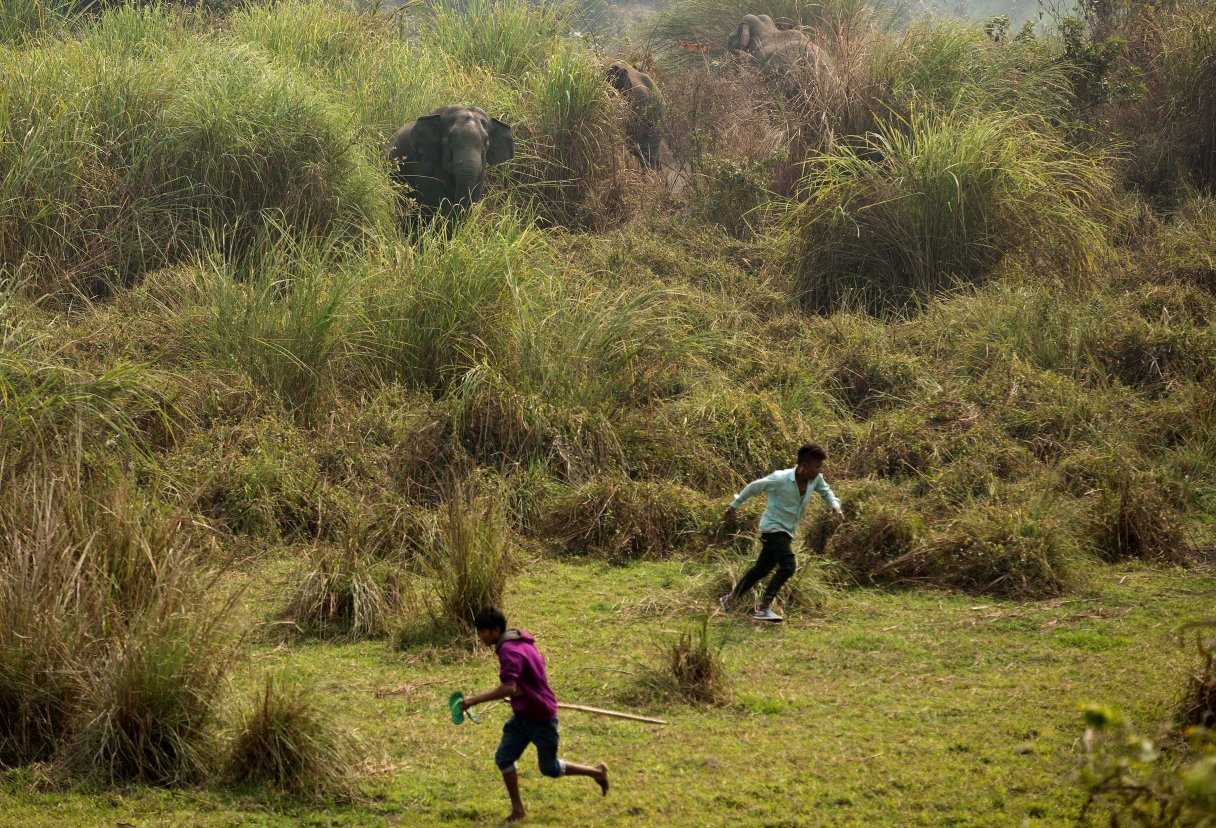
FILE- In this Feb. 9, 2017 file photo, wild elephants chase back Indian villagers who were trying to chase them away from their Misamari village on the outskirts of Gauhati, Assam state, India. A deadly conflict is underway between India's growing masses and its wildlife, confined to ever-shrinking forests and grasslands, with data showing that around one person has been killed every day for the past three years by roaming tigers or rampaging elephants. Statistics released this week by India's Environment Ministry count a total 1,144 people killed between April 2014 and May of this year. (AP Photo/Anupam Nath, File)

NEW DELHI (AP) – A deadly conflict is underway between India’s growing masses and its wildlife, confined to ever-shrinking forests and grasslands, with data showing that about one person has been killed every day for the past three years by roaming tigers or rampaging elephants.

Statistics released this week by India’s Environment Ministry count a total of 1,144 people killed between April 2014 and May of this year.

That includes 426 human deaths in fiscal 2014-15, and 446 killed the following year. The ministry released only a partial count for 2016-17 of 259 killed by elephants up to February of this year, along with 27 killed by tigers through May.

“Conflict is already one of the biggest conservation challenges,” said Belinda Wright, founder of the Wildlife Protection Society of India, based in New Delhi. “In India it is particularly acute because of the high human population.”

That population of 1.3 billion is still growing, and as it does it is increasingly encroaching into the country’s traditional wild spaces and animal sanctuaries, where people compete with wildlife for food and other resources.