
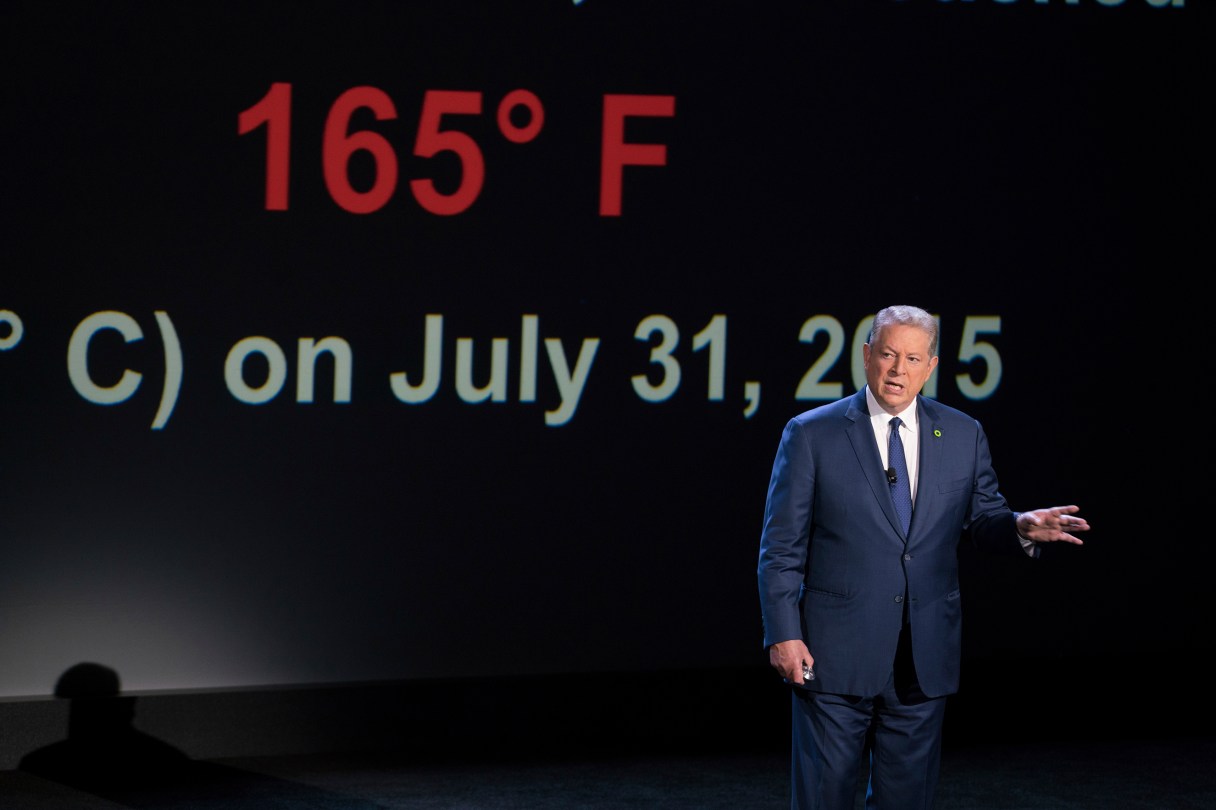
NEW YORK – Al Gore admits he was frustrated upon hearing the news last month that President Trump was pulling out of the Paris Climate Accord, but since then he’s become more optimistic.
Gore worried that a U.S. withdrawal from the treaty would compel other nations to opt out of the historical pact for adopting clean energy solutions. But that’s not what happened.
“The whole rest of the world has redoubled their commitment. And in this country, the governors and the mayors and the business leaders have all said, ‘We’re still in the agreement, and we’re gonna fill the gap. We’re gonna meet the U.S. commitment, regardless of what Donald Trump does,” Gore told the Associated Press last week at a special screening for “An Inconvenient Sequel: Truth to Power.”
It follows the 2006 Oscar-winning documentary, “An Inconvenient Truth,” and continues the conversation of finding solutions for the effects of climate change, including an emphasis on renewable energy. Much like the first film, Gore is front and center in leading the discussion.
To see it
‘An Inconvenient Sequel: Truth to Power” is playing in limited release. It is scheduled for wide release Friday, though the film is not yet listed on Chattanooga theater schedules.
It’s been a remarkable second act for Gore since winning the popular vote, but losing the Electoral College in the 2000 presidential election. There’s no question that Gore was devastated from the loss, but his stature as an important voice for environmental issues has proven equally successful, as he amassed a Nobel Prize, Academy Award, an Emmy, and a Grammy for his relentless dedication to climate change activism.
“I’m under no illusion that there’s any position with as much chance to do good as president of the United States, but I’m very grateful to have found another way to serve the public interests. I’m devoting my life to this and hoping to make a big difference,” Gore said.
CNN Legal Analyst Jeffrey Toobin, who also attended the premiere, agrees that Gore “had done pretty well for himself” after the disputed 2000 presidential election.
“Al Gore could have done many things after he was not inaugurated in 2001, but what he did was become the leading global spokesman for perhaps the most important scientific and environmental cause of our lifetime, and he won a Nobel Prize in the bargain. So I don’t think anyone could quarrel with how Al Gore has decided to live his life,” he said.
A big part of Gore’s mission depends on convincing people that climate change is not a hoax. Instead, it’s based on science that shows the global mean surface temperature continues to rise, due in part to an increase in greenhouse gasses. So while global warming is immune to politics, the topic remains a partisan issue in the United States. That’s something the former vice president blames on corporate funding for political campaigns.
“The truth about the climate crisis is still inconvenient for the big carbon polluters, and the politicians that they support with their big campaign contributions and lobbying activities are scared to cross them. That’s the main reason. They’ve spent a lot of money trying to put out false information about it,” Gore said.
Still, he remains confident that the problem can be fixed.
“People are seeing through this now. Two-thirds of the American people want to solve this big time. We are gonna solve it. We just need to move faster on it,” Gore said.
Gore feels that change will come from the “grass roots up.” That’s why he spends a great deal of time training climate activists around the globe.
“We need to get more people involved. That’s one of the real purposes of this movie. To tell people what they need to know, to show them that there is hope and there are solutions now, and inspire them to get involved,” Gore said.
Davis Guggenheim directed the first film to box office and Oscar glory, bringing climate change into the mainstream. The sequel, directed by Bonni Cohen and Jon Shenk picks up the conversation with more of a battle cry for saving the planet.
Knowing he was stepping into big shoes for this film, Shenk noted the importance of his predecessor’s film.
“An Inconvenient Truth” was one of the most successful documentaries in history. Not only did it do fabulously well at the box office, but by almost any measure it put the words global warming and climate crisis on the map for the entire world,” Shenk said.
In order to keep the information timely, producers changed the ending from what audiences saw at the Sundance Film Festival to reflect Trump’s announcement about withdrawing the United States from the global climate agreement in time for the film’s limited release on July 28 and its wide release on Aug. 4.
Gore also said he’s recently spoken to Hillary Clinton, and that’s “She’s gonna be fine.”
Clinton won the popular vote, but lost the Electoral College to Trump, just as Gore lost to George W. Bush in 2000.
As for Trump’s continued attacks on the news media, Gore feels disheartened by them.
“Well, I think that’s really unfortunate. We need someone who will unite us and not divide us. The press obviously plays an absolutely crucial role in making our democracy work. If the press isn’t free to get out there and tell people what’s going on, then we can’t make the changes we need to know about and then change,” Gore said.
Part of the news coverage called into question surrounds the constant flurry of revelations in the ongoing investigation of possible collusion with the Russian government by the Trump administration.
“Every day there seems like there’s something different and they’re not getting anything good done. That’s a problem,” Gore said.
Al Gore, at a glance
Since departing politics, Al Gore has become a successful businessman, author, public speaker and environmental advocate. Here’s a look back at his early years and rise into politics.* Childhood: Albert Arnold Gore Jr. was born March 31, 1948, in Washington, D.C., where his father, Albert Gore Sr., D-Tennessee, was serving in the U.S. House. The younger Gore spent his childhood divided between a hotel room in the nation’s capital during the school year and his family’s farm in Carthage, Tenn., in the summer.* Initial education: He attended Harvard, where he roomed with future actor Tommy Lee Jones. He earned a degree with high honors in government in June 1969.* Military service: Gore opposed the Vietnam War but said his sense of civic duty led him to enlist in the U.S. Army in August 1969. After basic training he was assigned as a military journalist writing for The Army Flier, the base newspaper at Fort Rucker. With seven months left in his enlistment, he was shipped to Vietnam in January 1971. He served with the 20th Engineer Brigade in Bien Hoa and at the Army Engineer Command in Long Binh.* Entry into politics: When he returned to the states in 1971, he worked as a reporter at The Tennessean in Nashville. After he was moved to the city politics beat, he uncovered political and bribery cases that led to convictions. While at the newspaper, Gore studied philosophy and phenomenology at Vanderbilt University. In 1974 he enrolled in Vanderbilt’s law school. He quit law school in March 1976 to run for the U.S. House from Tennessee. He was elected four times. In 1984, he successfully ran for a seat in the U.S. Senate, which had been vacated by Republican Majority Leader Howard Baker.* Vice presidency: In 1988, Gore made a bid for the Democratic nomination for the presidency. He won five Southern states on Super Tuesday but eventually lost to Michael Dukakis. He remained in the Senate until presidential candidate Bill Clinton chose him as his running mate in 1992. They were elected into office that year and re-elected in 1996.* Bush vs. Gore: In his 2000 presidential campaign, Gore won the Democratic nomination. He chose Sen. Joseph Lieberman of Connecticut as his running mate. Gore won the popular vote but conceded defeat to Republican George W. Bush after five weeks of complex legal argument over the voting procedure in the presidential election.Source: www.biography.com