
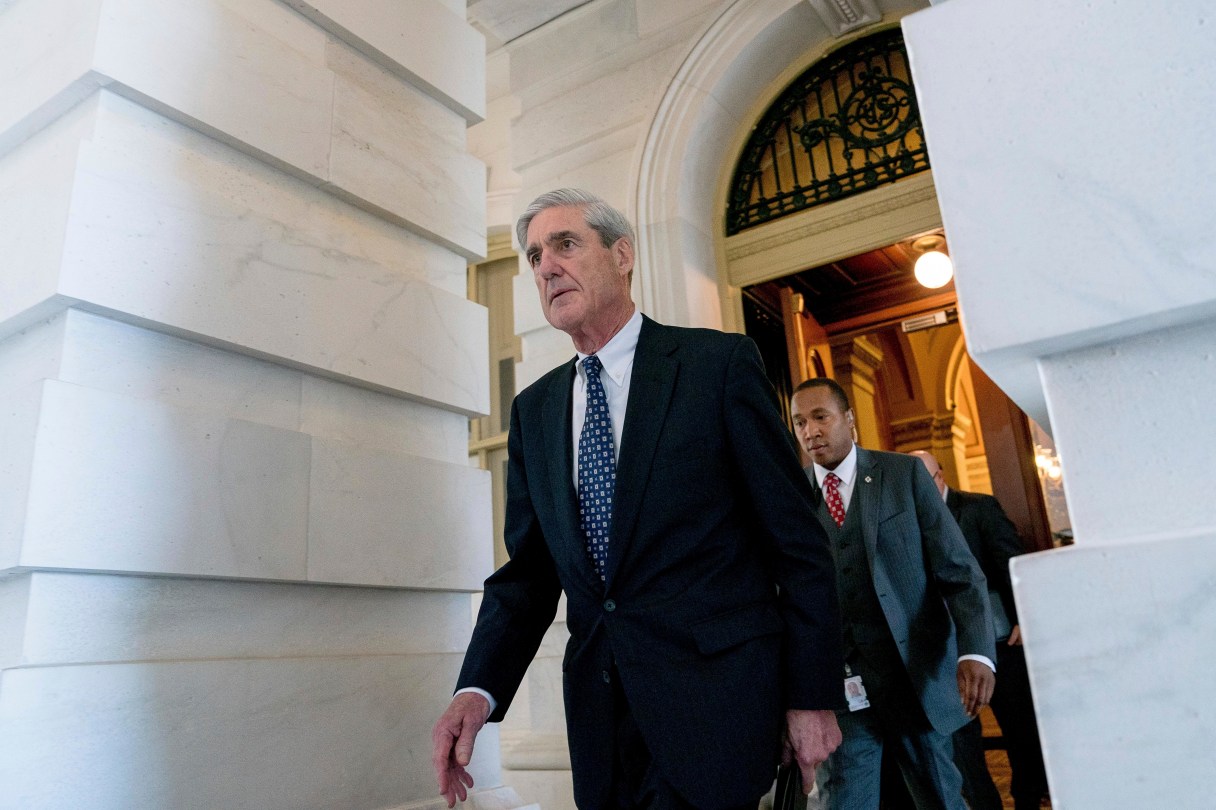
Americans should be seriously concerned about the Republican smear campaign against Russia Special Counsel Robert Mueller and his team.
The pattern is clear. As Mueller, whose team is investigating possible Trump campaign collusion with Russian hacking and interference in our 2016 election, moves closer to Trump’s inner circle, Republicans try to discredit the special counsel, the FBI and the Justice Department.
The aim, many believe, is to undercut the probe’s eventual findings or dull any political fallout should the president fire Mueller.
Already, Mueller has filed indictments against Trump’s former campaign manager Paul Manafort and former adviser Rick Gates on various charges. He also already has obtained guilty pleas from Trump’s fired national security adviser, Michael Flynn, and a former Trump campaign foreign policy adviser, George Papadopoulos.
Now the GOP has seized onto a story about politically charged text messages between two former members of Mueller’s FBI team who were having an affair. Peter Strzok, one of the FBI’s top counterintelligence experts, and FBI lawyer Lisa Page exchanged a months-long running commentary of criticism of then-presidential candidate Trump.
Mueller immediately removed Stzrok from his team last summer (the lawyer had already quit) after the text messages were uncovered through an internal investigation at the Justice Department. The removal just recently made news, and Deputy Attorney General Rod Rosenstein found himself on the hot seat before the House Judiciary Committee on Wednesday.
Rosenstein told congressmen there’s no good cause for firing Mueller. He also said that both he and Mueller understand FBI agents and prosecutors have political opinions, “but it is our responsibility to ensure that those opinions do not influence their actions.”
(After all Mueller is a registered Republican, and the new head of the FBI, Christopher Wray, has donated nearly $50,000 to the GOP campaigns of John McCain, Mitt Romney, and others, but the GOP doesn’t question that.)
It should be clear to everyone that having political opinions and being professional in any job – from journalist to police officer, from investigator to prosecutor, from teacher to school superintendent – are two different things. One does not disqualify the other.
Jill Wine-Banks, a former assistant Watergate special prosecutor and MSNBC legal analyst, explained this using the example of a jury. Every juror, she said, has an opinion, and when a judge or attorney questions a juror about his or her opinion it doesn’t mean they are excluded from the jury – unless they cannot set aside their pre-existing opinions and judge a case based on the evidence they are provided.
“And so far they’ve [Mueller’s investigators] come up with facts that support criminal indictments of at least four members of the Trump team, and we’ll have to wait and see whether they get it closer to his family or even to the president – but it will be based on facts,” Wine-Banks said Wednesday.
In other words, having a political opinion is OK. Having a bias that precludes fairness and facts is not.
The danger with the GOP smear campaign on the Mueller investigation is that it aims to whip up a climate in which Trump’s base will believe the Mueller team is “out to get” the president.
On the contrary, the Mueller team is essentially the only effort of our government right now that is “out to get” anyone – absolutely anyone – who has had anything to do with security threats to our country from past or future Russian interference in our elections.
Our president has done nothing on this. Nothing.
“Nearly a year into his presidency, Trump continues to reject the evidence that Russia waged an assault on a pillar of American democracy and supported his run for the White House,” according to a Thursday Washington Post story headlined, “Doubting the intelligence, Trump pursues Putin and leaves a Russian threat unchecked.”
The piece points to Trump’s “personal insecurities” as the primary impairment to our government’s response to this national security threat. Rather than seek ways to deter Kremlin attacks or safeguard U.S. elections, Trump – and now the lemmings in the GOP – work to discredit the only investigation into the matter.
Trump repeatedly dismisses concerns that Russia poses a threat. His administration moved to undo at least some of the sanctions the Obama administration imposed on Russia, and when Congress moved to impose additional penalties on Moscow, Trump opposed the effort.
He has never convened a Cabinet-level meeting on Russian interference, and a former high-ranking Trump administration official told Post reporters there is an unspoken understanding within the National Security Council “that to raise the matter is to acknowledge its validity, which the president would see as an affront.”
President George W. Bush’s CIA director, Michael V. Hayden, has likened the Russian interference as the political equivalent of the Sept. 11, 2001, attacks. Trump’s only response is to call it the “Russian ruse.”
That ruse, which the Russian government terms the 2016 “active measures” campaign, was a resounding success. It had two main objectives – destabilizing U.S. democracy and preventing Hillary Clinton, who is despised by Putin, from reaching the White House.
At least one of those objectives was shared by Trump and his campaign. Actually both were, if you include Steve Bannon’s aim to “deconstruct” government.
And here we are: Political polarization and cultural tensions are raging. Our country’s closest alliances are fraying. And our president is a disruptive narcissist with nothing but praise for all things Russian.