
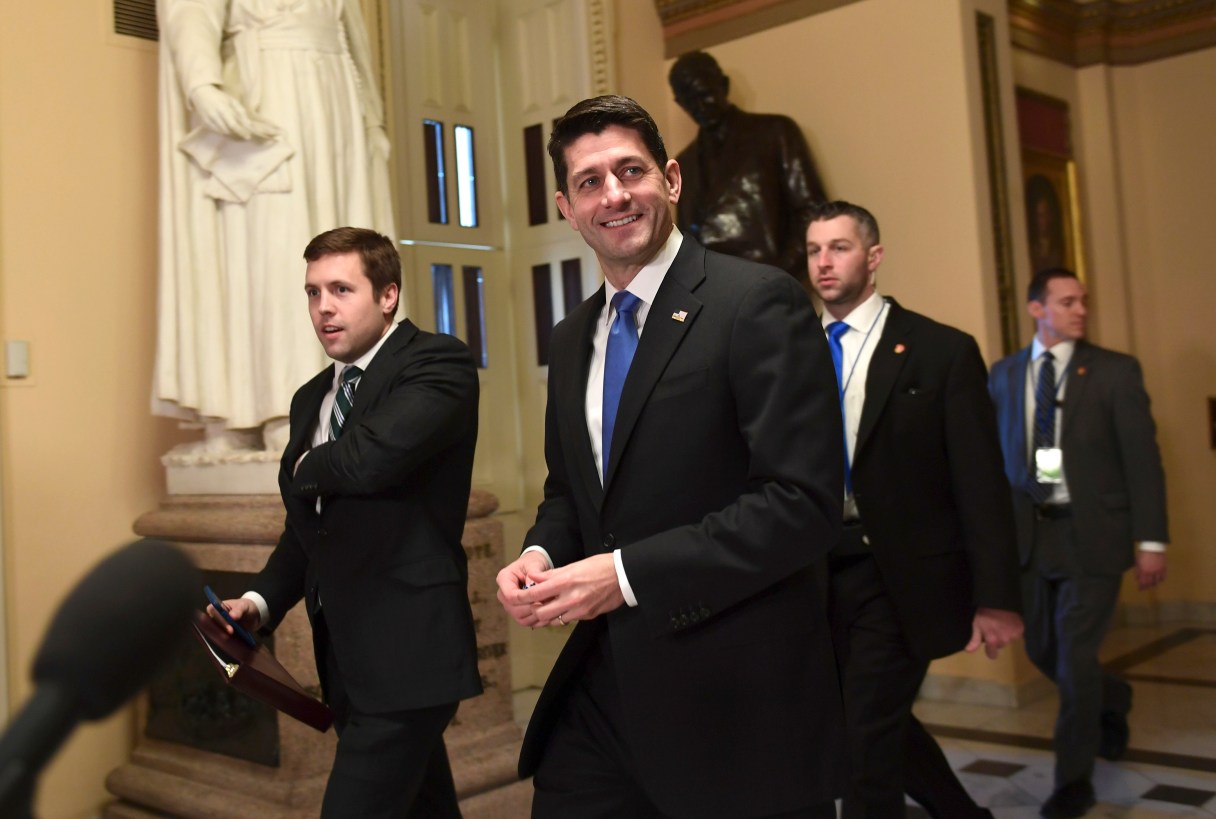
WASHINGTON (AP) – Gleeful Republicans on Tuesday muscled the most sweeping rewrite of the nation’s tax laws in more than three decades through the House. House Speaker Paul Ryan dismissed criticism of the widely unpopular package and insisted “results are what’s going to make this popular.”
The vote, largely along party lines, was 227-203 and capped a GOP sprint to deliver a major legislative accomplishment to President Donald Trump after a year of congressional stumbles and non-starters.
Senate Majority Leader Mitch McConnell, R-Ky., said the Senate would vote Tuesday evening, sending the legislation to Trump for his signature.
The massive $1.5 trillion package would touch every American taxpayer and every corner of the U.S. economy, providing steep tax cuts for businesses and the wealthy, and more modest tax cuts for middle- and low-income families. It would push the national debt ever higher.
Responses
“I’m pleased my radical prostatectomy surgery went well enough for me to make a day trip to Washington to vote on tax reform. This tax reform is an historic opportunity to put more money into the pockets of working Alabamians at all income levels and spur much-needed economic growth that will both help with America’s deficit and debt crisis and improve struggling American family incomes. With this bill, the typical family of four earning the median family income of $73,000 will receive a tax cut of $2,059. That is a lot of money working families need to help pay their bills. America faces a dangerous $20 trillion national debt and an unending string of $1 trillion/year deficits starting in just four years. Economic growth is critical to avoid a national debilitating insolvency and bankruptcy that could destroy an American economy it took our ancestors centuries to build. The Tax Cuts and Jobs Act cuts corporate and pass-through tax rates, allows full and immediate expensing of new equipment, and encourages companies to bring back overseas profits needed to spur investment in factories and jobs in America. Overall, these tax reforms make American job-creators more competitive in a cut-throat international marketplace, thereby protecting and creating even more jobs and bigger paychecks for struggling American families.” – Congressman Mo Brooks (AL-05) “This is a historic moment for our country. When President Trump signs the Tax Cut and Jobs Act into law later this week, it will mark the first time the tax code was reformed in more than three decades. Our bill creates a simpler, flatter and fairer tax code. It puts more money in the pockets of hard-working Georgia families and makes the annual tax filing process much easier. It also spurs economic growth and private-sector job creation by slashing the corporate tax rate, which is currently the highest in the developed world, and cutting tax rates for small business income to the lowest levels since the 1940s. This bill is a Christmas present for every American family and business. Beginning on January 1, 2018, the new tax code will take effect, meaning Americans will start taking home more of their hard-earned money as soon as February. The American people elected President Trump and the Republican Congress to do big things, and this fulfills one of our promises.” – Rep. Tom Graves’ (R-GA-14) “The last time Americans witnessed tax reform was 1986, and I am proud to have voted to change that today. This legislation demonstrates what can happen when Members work in a bicameral fashion toward one common goal- tax relief for families, workers, and businesses. I commend the leadership of Chairman Brady and the tireless work from Members of the Conference Committee, and look forward to seeing this legislation on the President’s desk.” – Congressman Chuck Fleischmann (TN-03)
The standard deduction used by most families would be nearly doubled, to $24,000 for a married couple, while those who itemize would lose some deductions.
“We’re delivering a tax code that provides more jobs, fairer taxes and bigger paychecks to Americans across the country,” said Rep. Kevin Brady of Texas, Republican chairman of the tax-writing Ways and Means Committee. “Our local job creators will see the lowest rates in modern history so they can invest more in their workers and in their future.”
Democrats called the bill a giveaway to corporations and the wealthy, providing little if any tax help to the less-than-well-to-do and no likelihood that business owners will use their gains to hire more workers or raise wages.
And the Republicans’ contention that the bill will make taxes so simple that millions can file “on a postcard” – an idea repeated often by the president – was simply mocked.
“What happened to the postcard? We’re going to have to carry around a billboard for tax simplification,” declared Rep. Richard Neal of Massachusetts, the top Democrat on the Ways and Means Committee.
Tax cuts for corporations would be permanent while the cuts for individuals would expire in 2026 in order to comply with Senate budget rules. The tax cuts would take effect in January. Workers would start to see changes in the amount of taxes withheld from their paychecks in February.
During debate, decorum on the House floor was fleeting as two New Yorkers – a Democrat and a Republican – voiced their opinions on the bill. Rep. Joe Crowley, D-N.Y., yelled, “Hell no” in opposition to the bill. Rep. Tom Reed, R-N.Y., replied, “Hell yes!” The proceedings were interrupted several times by protesters shouting from the gallery.
The bill is unpopular among the public, and Democrats plan to campaign against it in next year’s congressional elections. Senate Democrats posted poll numbers on the bill on a video screen at their Tuesday luncheon.
“This bill will come back to haunt them, as Frankenstein did,” said House Democratic leader Nancy Pelosi.
Not so, said Ryan, who has worked for years on tax overhaul.
“When we get this done, when people see their withholding improving, when they see jobs occurring, when they see bigger paychecks, a fairer tax system, a simpler tax code, that’s what’s going to produce the results,” said Ryan, R-Wis.
The bill would slash the corporate income tax rate from 35 percent to 21 percent. The top tax rate for individuals would be lowered from 39.6 percent to 37 percent.
It scales back a popular deduction for state and local taxes, repeals a key tenet of Barack Obama’s Affordable Care Act and allows drilling in the Arctic National Wildlife Refuge.
Despite GOP talk of spending discipline, it is projected to add $1.46 trillion to the nation’s debt over a decade. GOP lawmakers say they expect a future Congress to continue the tax cuts so they won’t expire. If achieved, that would drive up deficits even further.
Republicans acknowledged they still have to convince many Americans of the benefits of their bill. Many voters in surveys see the legislation as a boost to the wealthy, such as Trump and his family, and only a minor gain for the middle class.
“I don’t think we’ve done a good job messaging,” said Rep. Greg Walden, R-Ore. “I don’t think we’ve gotten out there with specifics, and the final bill has only come together in the last week or so. Now, you’re able to look at the final product.”
The $1,000-per-child tax credit doubles to $2,000, with up to $1,400 available in IRS refunds for families who owe little or no taxes. Parents would have to provide children’s Social Security numbers to receive the child credit, a measure intended to deny the credit to people who are in the U.S. illegally.
The legislation also repeals an important part of the health care law – the requirement that all Americans carry health insurance or face a penalty – as the GOP looks to unravel a law it failed to repeal and replace this past summer.
The bill would initially provide tax cuts for Americans of all incomes. But if the tax cuts for individuals expire, most Americans – those making less than $75,000 – would see tax increases in 2027, according to congressional estimates.
Disgruntled Republican lawmakers from high-tax New York, New Jersey and California receded into the background as the tax train rolled. They oppose the new $10,000 cap on the deduction that millions use in connection with state and local income, property and sales taxes. The cap remains in the final bill.
The deduction is especially vital to residents of high-tax states.
Several defectors reaffirmed their “No” votes for the final bill on Tuesday. Rep. Peter King conveyed what people in his Long Island, New York, district were telling him about the tax bill: “Nothing good, especially from Republicans. … It’s certainly unpopular in my district,” he said.