
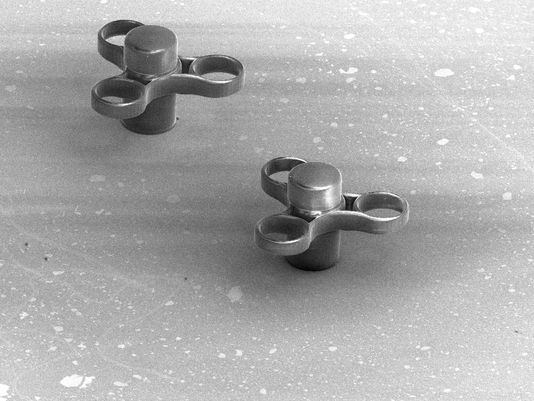
 Oak Ridge National Laboratory has created the world’s smallest fidget spinner (Photo: ORNL via Knoxville News Sentinel)
OAK RIDGE, Tenn. (AP) – Kids across the world emptied their stockings Christmas morning to a host of treats and trinkets, undoubtedly including the newly popular fidget spinner: a simple gadget made of flat plastic spinning on a ball bearing.
Well, Oak Ridge National Laboratory scientists have created their own version, but don’t expect to see kids playing with them at the New Year’s party this year. In fact, don’t expect to see one at all, unless you happen to have an electron microscope.
ORNL scientists have created possibly the world’s smallest fidget spinner, which measures just 100 microns wide, almost 130 times smaller than Texas A&M University’s earlier take on the record, a half-inch version that had to be spun on the end of a thumbtack.
The gadget is 3-D printed from plastic, though “not the type of plastic you would normally think of, like your hair brush,” staff scientist Adam Rondinone said. “It’s a photo cross-linked polymer, which means it starts out as a viscous liquid.”
When scientists expose the mold to high-intensity laser light, the plastic becomes solid. They wash away the excess liquid and Voila, a teeny, tiny fidget spinner.