
Monday, November 16, 2026Nov 16

Washington court rules against florist in gay wedding case

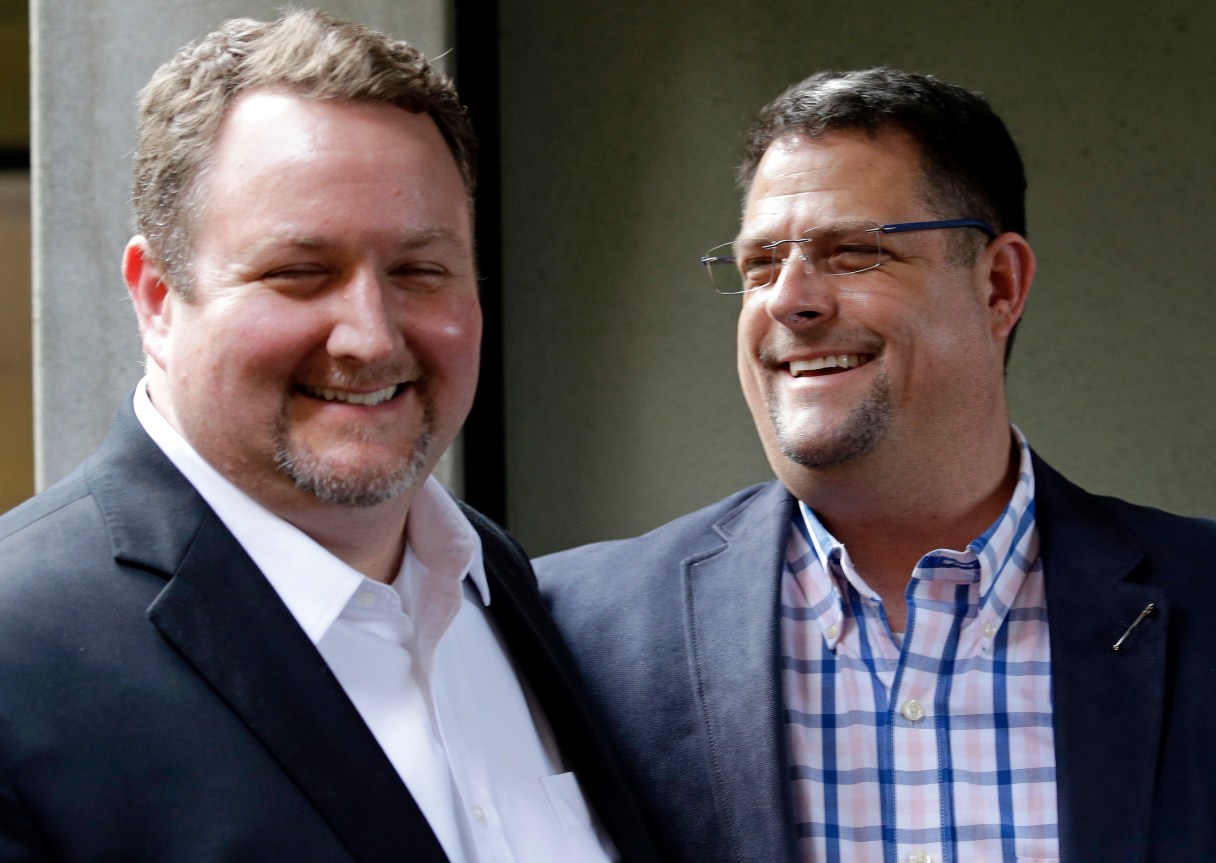
FILE - In this Nov. 15, 2016, file photo, Curt Freed, left, and his husband Robert Ingersoll, the couple who sued florist Barronelle Stutzman for refusing to provide services for their wedding, smile after a hearing before Washington's Supreme Court in Bellevue, Wash. The Washington Supreme Court on Thursday, Feb. 16, 2017, has unanimously ruled that Stutzman, broke the state's antidiscrimination law.  Stutzman said she was exercising her First Amendment rights, and her lawyers immediately said they would ask the U.S. Supreme Court to overturn the decision. (AP Photo/Elaine Thompson, File)
FILE - In this Nov. 15, 2016, file photo, Curt Freed, left, and his husband Robert Ingersoll, the couple who sued florist Barronelle Stutzman for refusing to provide services for their wedding, smile after a hearing before Washington's Supreme Court in Bellevue, Wash. The Washington Supreme Court on Thursday, Feb. 16, 2017, has unanimously ruled that Stutzman, broke the state's antidiscrimination law. Stutzman said she was exercising her First Amendment rights, and her lawyers immediately said they would ask the U.S. Supreme Court to overturn the decision. (AP Photo/Elaine Thompson, File)

OLYMPIA, Wash. (AP) – The Washington Supreme Court ruled unanimously Thursday that a florist who refused to provide services for a same-sex wedding broke the state’s antidiscrimination law, even though she claimed doing so would violate her religious beliefs.

Barronelle Stutzman, a florist in Richland, Washington, had been fined by a lower court for denying service to a gay couple in 2013. Stutzman said she was exercising her First Amendment rights.

But the court held that her floral arrangements do not constitute protected free speech, and that providing flowers to a same-sex wedding would not serve as an endorsement of same-sex marriage.

“As Stutzman acknowledged at deposition, providing flowers for a wedding between Muslims would not necessarily constitute an endorsement of Islam, nor would providing flowers for an atheist couple endorse atheism,” the opinion said.

Stutzman’s lawyers immediately said they would ask the U.S. Supreme Court to overturn the decision.