
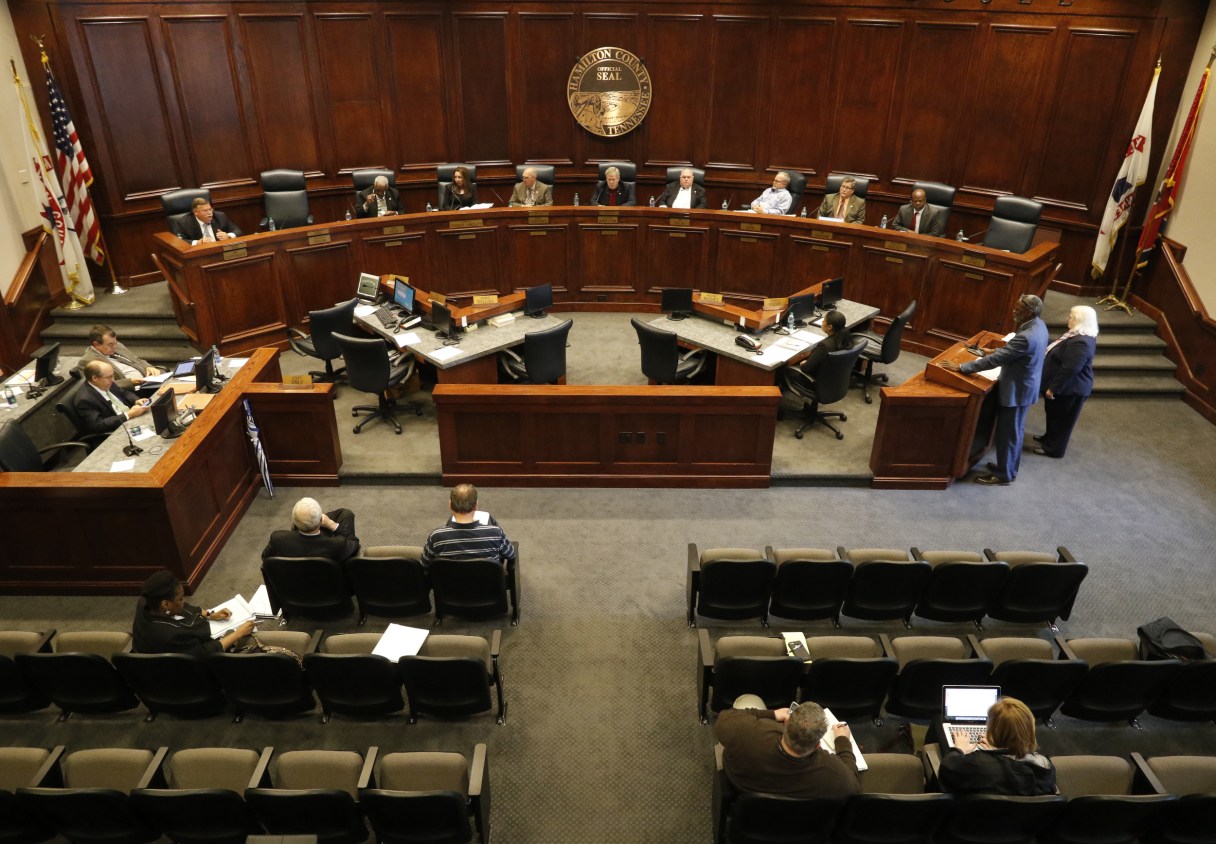
With discretionary fund reserves depleted and no new funds budgeted for the 2016-2017 fiscal year, Hamilton County commissioners representing the East Hamilton area are finding alternate ways to address financial needs.
Each year until 2015, commissioners were each allotted $100,000 in discretionary money to pay for special community projects not funded through the county’s general budget.
This fiscal year, County Mayor Jim Coppinger left the discretionary money out of the 2017 budget for the second time. Though six commissioners fought to revive the funds during the 2016 budget process, none spoke up to defend the unbudgeted $900,000 this year.
In the past, those dollars have been spent to help local organizations like the Orange Grove Center, Veterans Memorial Park of Collegedale and AEGIS Law Enforcement Foundation of Greater Chattanooga. Local representatives, however – Hamilton County Commission Chairman Chester Bankston and Commissioner Sabrena Smedley – said most of the funding requests they receive from Districts 9 and 7 come from schools, recreational centers and volunteer fire departments, in that order.
“It’s always good to be able to relieve your budget from some outside source,” said Tri-Community Volunteer Fire Department Fire Chief Duane Pitts, who received $10,000 in 2016 from Smedley to repair a failing heating-and-air unit. “At the end of the day, we appreciate funds wherever they come from, whatever it is.”
Both Bankston and Smedley said they did not fight for the funds because budgeting the near $1 million expenditure could have meant a bump in property taxes, which have not been raised in Hamilton County since 2007.
“I’m not willing to vote for a tax increase to keep discretionary funds,” Smedley said.
But Smedley said needs in East Hamilton will not be completely met without access to county funding.
Commissioners can still request funds by bringing a project before the rest of the commission for a vote, and Smedley said she intends to work with the county mayor and finance department to bring pressing needs forward. She cited projects like installing defibrillators in schools, which saved a 13-year-old East Hamilton Middle/High School student’s life in 2014, and completing the athletic facility at EHMHS by installing restrooms and a concessions space, a need to which she has dedicated more than $100,000 in discretionary funds over the past few years.
“As things come up, if there’s something I can help with that is a true necessity that can be taken care of with bond funds, I’ll bring that forward,” said Smedley. “I will do what I can, because otherwise, they [constituents] do suffer.”
Using capital bond funds instead of discretionary funds will mean projects will be required to have at least a 10-year lifespan. The mandate disqualifies smaller projects like money spent to finance field trips and award luncheons, but is ideal for larger, more impactful projects in schools.
“Everything I’ve done for my schools, I think, has met that criteria,” Smedley said. “I want to help in various ways throughout my district, but the schools – they are a priority.”
Bankston said one of the reasons he chose not to push for discretionary funds was because they can no longer be used in schools. According to a state comptroller ruling last year, only bond funds can be used.
Before the ruling, Bankston spread his funds among the 11 schools in his district, and now with access to that funding gone, he has showed he will continue to support the schools by dipping into the county’s credit line in addition to the last of his bond funds to pay for an athletic field striping machine for Ooltewah High School. The move, while met with heavy controversy, was passed 5-3 by fellow commissioners.
This year was the first that commissioners were without discretionary money, but whether it will be the last or first of many remains to be seen, Bankston said. The budget could look different for fiscal year 2018, which begins July 1.
“Not saying we’re not gonna fight for it next year,” Bankston said.