
Every January, a small group of volunteers soldiers out across the city, looking high and low for homeless people, hoping they will find fewer than the year before.
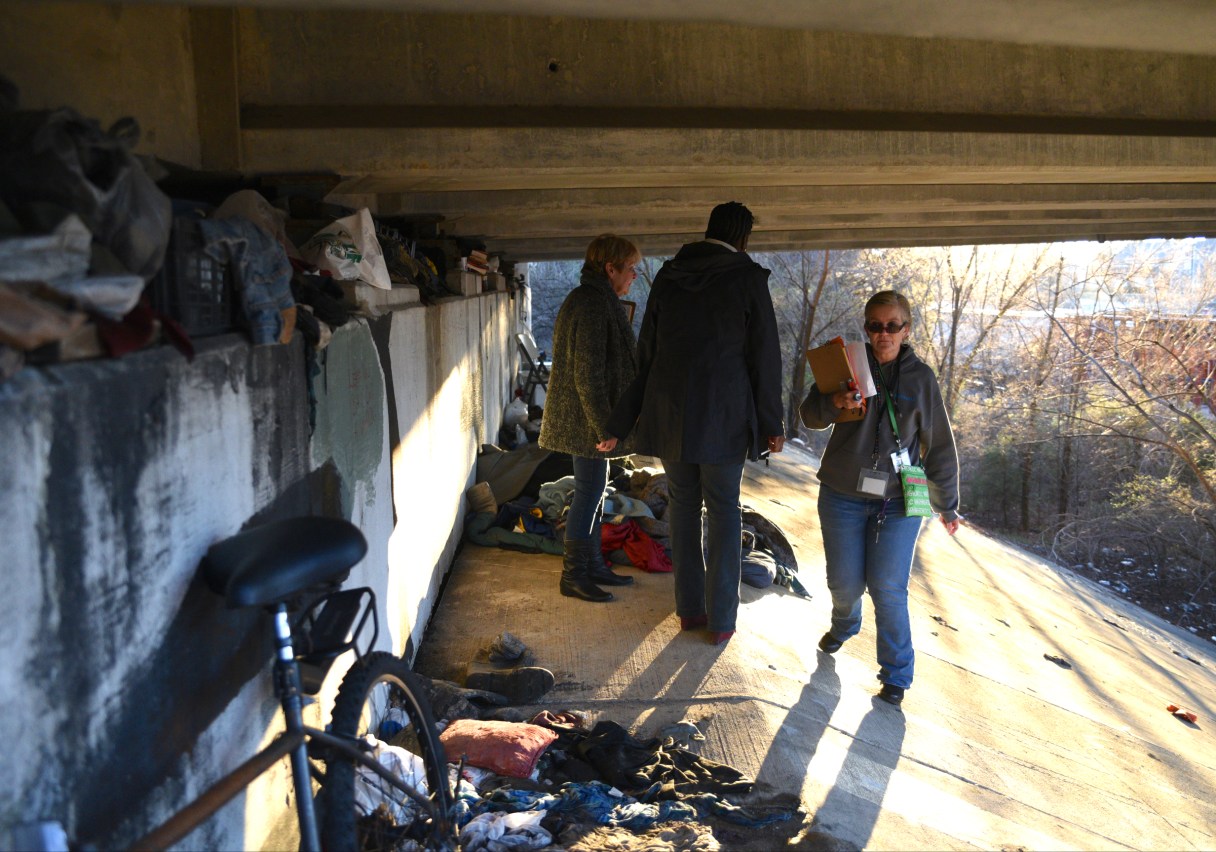
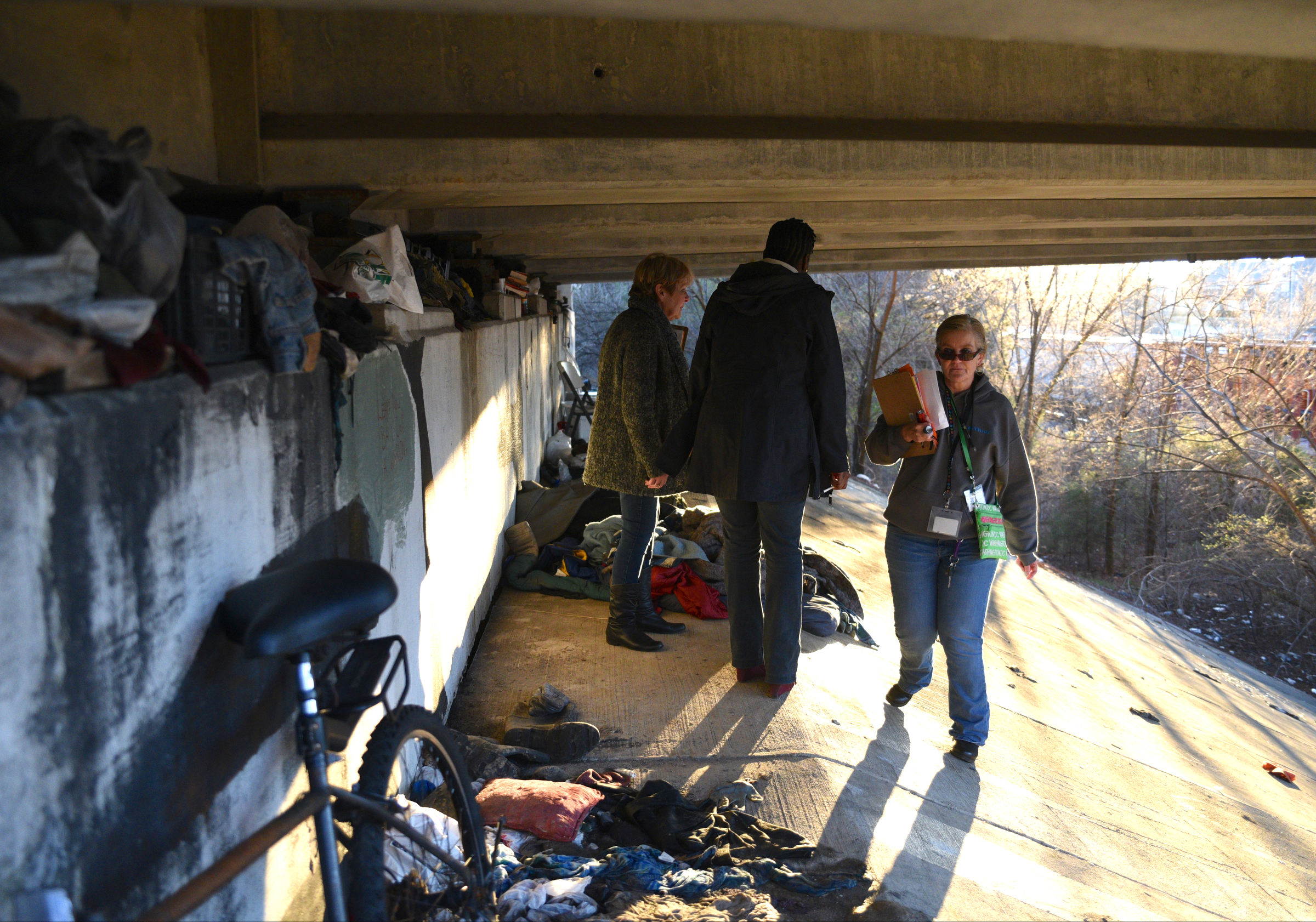
On Thursday, they tromped up underpasses and through the woods, keeping their eyes peeled for tents and other signs of human activity, armed with clipboards, a few forms and arms full of goodie bags.
The Point-in-Time count is an unofficial census coordinated by the Chattanooga Regional Homeless Coalition with the help of several other local agencies. It is intended to be a pulse check for those experiencing homelessness in the city year to year.
From 2015-2016, the number of people counted in the census dropped from 634 to 527 across 11 counties in Chattanooga and Southeast Tennessee, and advocacy groups are confident they’re going to see evidence of continued progress once the numbers come in from this year’s count.
“I would expect another decrease, but it all depends on a lot,” said Stephen Wright, executive director of the coalition.
Unfortunately, because the homeless are often transient, it can be difficult to nail down a precise estimate of the Chattanooga population, which is constantly in flux. The count can, however, be thought of as an absolute floor for the number, and any decrease is a good sign.
Wright partially attributed the shrinking number of individuals experiencing homelessness over the last two years to city initiatives that have focused on housing veterans.
“Since the beginning of that initiative, close to 240 veterans have been housed,” he said. “That was your big reason the decrease last year.”
The actual number housed since January 2015 is 233, said Heather Hoffman, the city’s homeless program coordinator. She said the number of homeless veterans in Chattanooga has successfully been cut down to a couple dozen.
While the most obvious issue with addressing homelessness is the need for quality, affordable housing, Hoffman said a variety of smaller programs have helped immensely.
“One of the programs that has been extraordinarily successful and proven to be important is our donation program,” she said. “We get things like glasses and dishes and towels. It might seem superficial because it’s items for the house, but we realized it’s important for housing people.”
She said the progress that has been made with veterans can be used and applied to other groups, as well.
“The next goal community-wide is going to be tackling chronic homelessness,” she said. “We’re cooking now. Now that those paths are in place for us, we’re tackling what is likely to be a more complicated population to help get into housing.”
To be considered chronically homeless, per the Department of Housing and Urban Development’s definition, a person “must have a disability and have been living in a place not meant for human habitation, in an emergency shelter, or a safe haven for the last 12 months continuously.”
Alternatively, a person can have been homeless at least four times over the last three years, totaling a cumulative period of 12 years.
That definition includes a range of people beyond veterans, and Cindy Bennett, a social worker with the Cooperative Agreement to Benefit Homeless Individuals, said it’s important to remember there are plenty of people living outside.
“There’s a lot of people out here who are not veterans,” she said during Thursday’s count while trudging up the sidewalk on Bailey Avenue, peering through a fence into the woods beyond.
She’s glad there was a decrease last year, but she also thinks Chattanooga is earning a name in the community as a destination for the region’s homeless population.
“Chattanooga is the place to come because we have a lot of resources other places don’t,” she said. “We’re starting to see a lot of new faces.”
Contact staff writer Emmett Gienapp at egienapp@timesfreepress.com or 423-757-6731. Follow him on Twitter @emmettgienapp.