
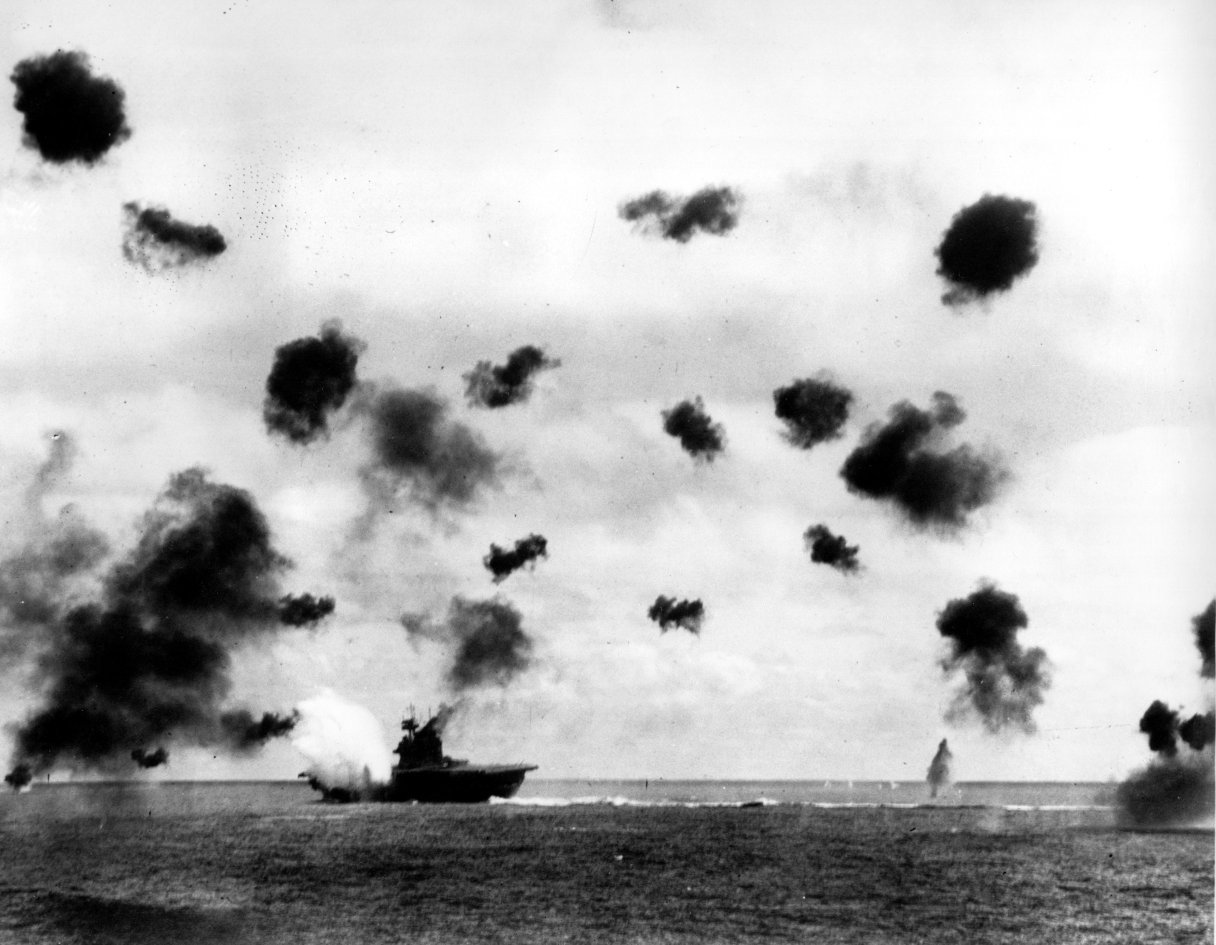
Seventy-five years ago, June 4, 1942, the U.S. Pacific fleet achieved an improbable victory that fundamentally altered the balance of power in the war with Japan.
Six months after the attack at Pearl Harbor, which had severely damaged the fleet, and three months after the Japanese victory in the Philippines, a massive Japanese fleet with four aircraft carriers in the lead unleashed an air attack on Midway, an atoll of 2.4 square miles, located almost 1,500 miles north-northwest of Hawaii. After conquering the vital air and sea base in an attack that was shrouded in deep secrecy, the invaders hoped to lure the U.S. Navy into a decisive battle for control of the entire Pacific Ocean.
Weeks before the attack, U.S. code breakers deciphered the Japanese fleet’s code, learning of the site and approximate date of the planned attack. A heavily outnumbered U.S. force that included three of four remaining aircraft carriers assembled to the southeast of Midway with hopes of delivering a devastating surprise attack on the enemy fleet. Many of the Navy pilots had little or no combat experience, especially in carrier operations.
June 4 began with an air attack against Midway. Though heavily damaged, the forewarned base survived, and its airstrip remained usable. U.S. Army bombers counterattacked but achieved no hits.
 Dr. Clif Cleaveland
Search planes from both sides hunted for enemy ships. A sighting by a U.S. spotter led to the launch of torpedo bombers, dive bombers and fighters from the carriers. Although a coordinated attack was planned, faulty communications and uncertainty of the enemy’s location scattered the attacking elements.