
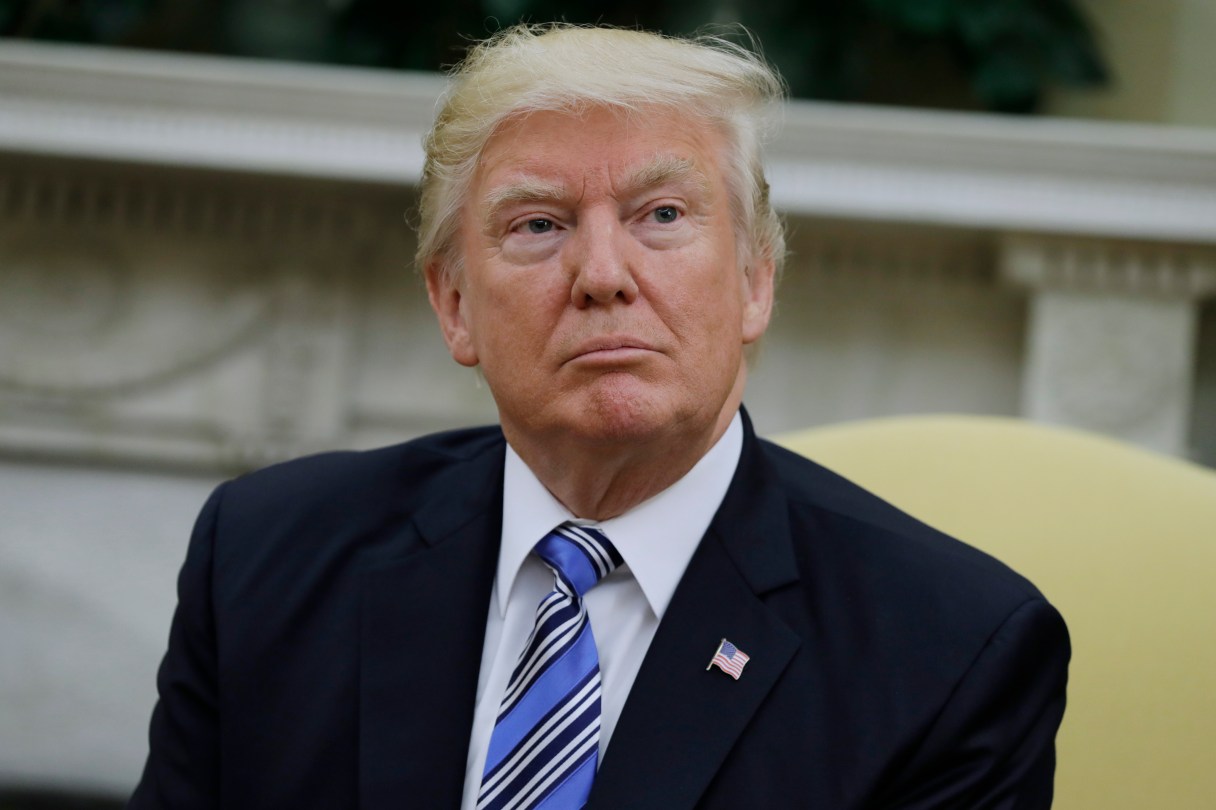

For the time being, it appears the United States Supreme Court is going to have to be the final arbiter on any decision President Donald Trump makes involving immigration.
It shouldn’t be that way, but when judges appointed by Democrats make political decisions that skirt the law, the administration has no choice but to appeal decisions they know to be lawful.
Trump opponents got a taste of what that will be like last week when the high court upheld most provisions in the president’s travel restrictions of people entering the United States from six predominantly Muslim countries.
Thoroughly repudiating the lower courts that had ruled against the president, the decision to lift the injunctions on the travel ban was unanimous, a fact that was left out of most reporting. Even the two Barack Obama appointees on the far left of the court, Sonia Sotomayor and Elena Kagan, went along with it. Three conservative justices partially dissented only in saying all provisions of the travel ban should have been upheld.
The decision should have been clear from the start. Courts have long ruled the Constitution gives presidents alone the final say in foreign policy, and immigration is one of the tenets of foreign policy.
Indeed, Section 212(f) of the Immigration and Nationality Act of 1952 states: “Whenever the President finds that the entry of any aliens or of any class of aliens into the United States would be detrimental to the interests of the United States, he may by proclamation, and for such period as he shall deem necessary, suspend the entry of all aliens or any class of aliens as immigrants or nonimmigrants, or impose on the entry of aliens any restrictions he may deem to be appropriate.”
Obama and his two immediate predecessors, George W. Bush and Bill Clinton, each used the statute six times during their tenures. Former President Ronald Reagan used it five times, and former Presidents Jimmy Carter and George H.W. Bush used it once each.
Trump’s order, in fact, was based on a determination made by the State Department under Obama.
However, the lower courts went back to Trump’s campaign, his statements about a ban on Muslims (which would be a denial of a religious liberty and thus illegal) and made their rulings on what they thought he really believed his travel ban meant. Yes, you read that right. They were making a determination on their interpretation of his thoughts.
So the decisions of the federal district courts, and the subsequent U.S. Circuit Courts of Appeals, on his orders – a second one was written after the first one was denied – were made on the basis of religion.
The Supreme Court, though, made its decision on the second order itself and its national security implications. It will hear full arguments on the power of the president to use such bans in foreign policy in October and probably rule in December.
In the meantime, since the order suspends for only 90 days the travel entry of foreigners into the U.S. from six terrorist-safe countries – Iran, Libya, Somalia, Sudan, Syria and Yemen – and suspends refugees from the countries for 120 days, the administration needs to get to work.
One might argue the administration already might have worked out what it hoped could be policy after the 90- and 120-day suspensions were up, but it has been a little busy with health care, rolling back regulations, peeling back Obama-era excesses and the like.
But it’s not unreasonable to think Trump and company should be able to work out what they believe could be a legal and permanent vetting solution for visitors and refugees from the countries by the time the Supreme Court makes its decision on the case this fall.
Trump has said – and millions in the country support him in saying it – that the U.S. should be more diligent in screening people it allows to come from countries where terrorism is rampant and from which countries many terrorists have hailed or in which many have become radicalized.
Under Obama, it was claimed the U.S. vetting process would take a minimum of two years for refugees from those countries, but that never proved to be the case. Most were allowed into the U.S after only a few months.
While the Supreme Court delivered a big win for Trump, other federal judges still are blocking the administration’s ordered deportation of some criminal illegal immigrants and limiting his crackdown on sanctuary cities.
Experts differ whether the high court decision will stiffen the spines of the Democrat-appointed judges in defying Trump or cause them to be deferential because of the likelihood of being overturned if the cases are appealed to the Supreme Court.
“The lesson to them,” Hans von Spakovsky, a former Justice Department lawyer in the Bush administration told the Washington Times, “is they need to quit making political decisions based on the fact they don’t like the president and his policy, and start making legal decisions that follow binding precedent.”
It’s a shame that’s the state in which we find ourselves today. We hope the judges eventually will take the hint.