
Monday, November 16, 2026Nov 16

UN says 66,000 displaced in 5 months of north Syria fighting

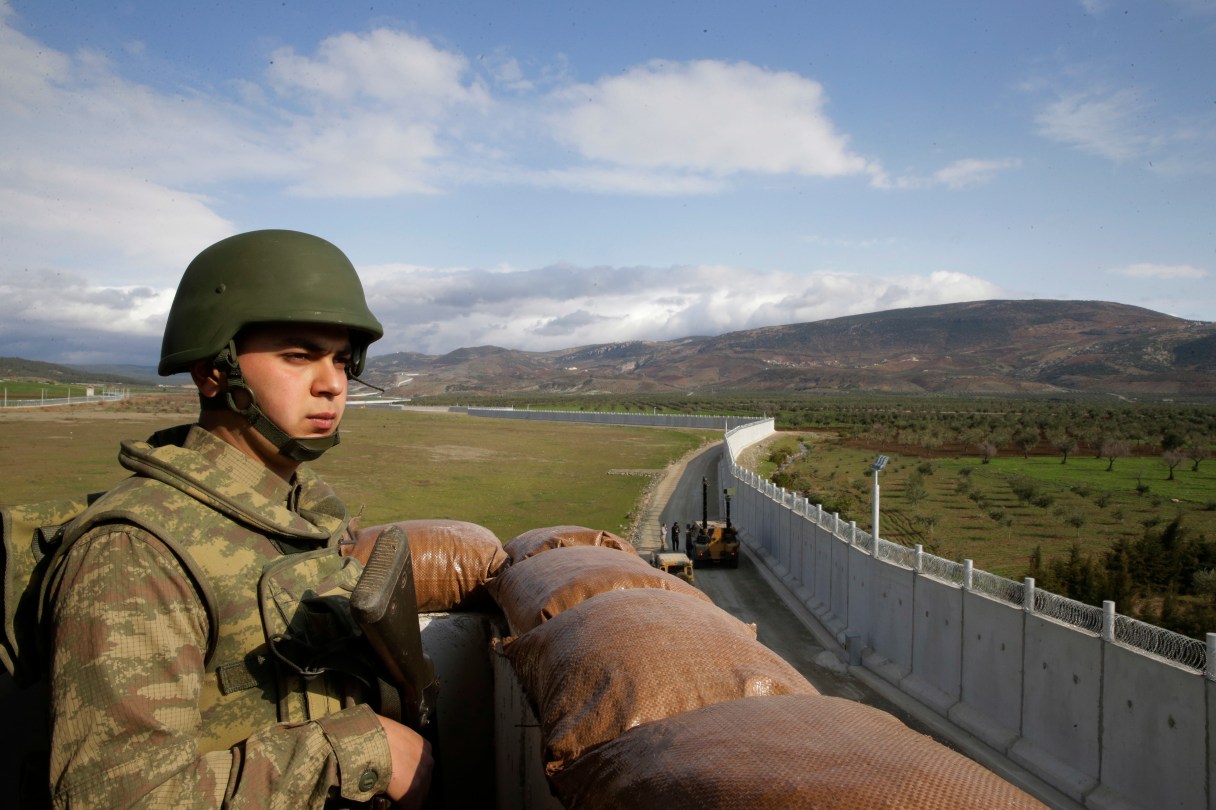
FILE - In this Thursday, March 2, 2017 file photo, a Turkish army soldier mans an outpost near the town of Kilis, southeastern Turkey, adjacent to the wall the country had been constructing to boost security along its border with conflict-stricken Syria. A U.N. humanitarian agency said Sunday, March 5, 2017, that some 66,000 people have been displaced in five months of fighting in Syria's crowded northern battlefield. Turkish, Syrian government, Syrian opposition, and autonomous Kurdish-led forces have all been jostling for territory formerly held by the Islamic State group near the Turkish-Syrian frontier, as preparations are being made to attack the extremists' de facto capital, Raqqa. (AP Photo/Lefteris Pitarakis, File)

BEIRUT (AP) – Five months of multi-sided clashes in Syria’s crowded northern battlefield have displaced some 66,000 people, a U.N. humanitarian agency said Sunday, a day after the U.S. bolstered Kurdish-led forces with a deployment of armored vehicles amid preparations for a push toward the Islamic State group’s de facto capital.

Besides the autonomous Kurdish-led forces, Turkish, Syrian government and Syrian opposition fighters have all been jostling for territory formerly held by the Islamic State group near the Turkish-Syrian frontier.

The U.S.-backed Syrian Democratic Forces, led by the Syrian Kurdish PKK party, are the current front runners in the race to Raqqa, the IS capital. They are now stationed eight kilometers (five miles) north of the Euphrates River city and supported by U.S.-led coalition airstrikes and a deployment of some 500 U.S. special forces operators. The Pentagon has said they are working in an advisory capacity.

But Turkey, a U.S. ally through NATO, says the PKK is an extension of the Kurdish insurgency inside its own borders and has classified the party as a terror organization. It has objected strongly over the SDF offensive and vowed, too, to throw the Kurdish-led forces in Manbij – the SDF’s westernmost flank – back over the banks of the Euphrates. This would disrupt the Raqqa campaign.

There are Turkish forces stationed in al-Bab, 40 kilometers (25 miles) southwest of Manbij. The threats prompted the SDF to ask Russia and the Syrian army to establish a buffer between Manbij and al-Bab.