
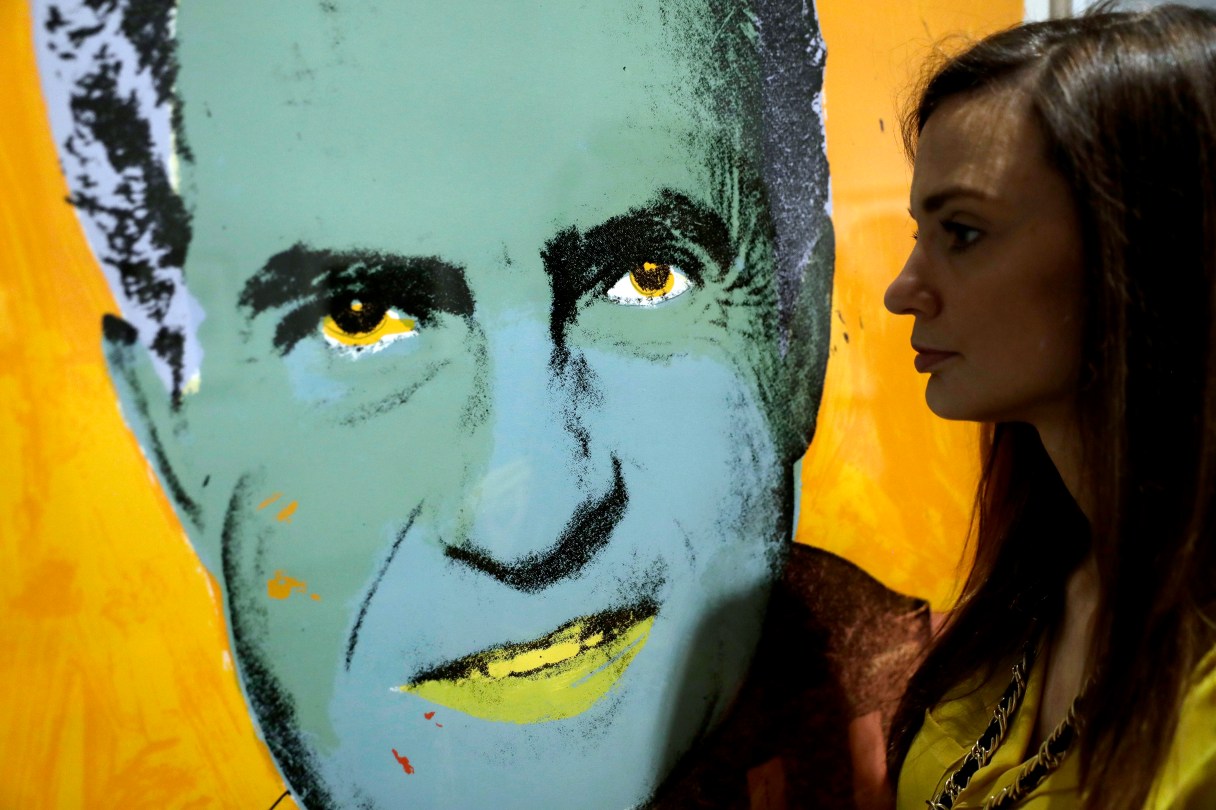
LONDON (AP) – The British Museum, famed for a collection ranging from Egyptian mummies to Roman artifacts to medieval manuscripts, has turned its gaze on the modern United States.
The museum’s new exhibition, The American Dream: Pop to the Present , charts the half-century from the 1960s to the present through artworks broadly classed as printmaking. That is a deceptively plain label that embraces wildly diverse styles, from Donald Judd’s abstract woodcuts to Roy Lichtenstein’s comic-style pop art.
By turns humorous, lyrical and confrontational, the artworks suggest that political turmoil is as American the 4th of July, whether in the transformative 1960s or at the dawn of the Trump presidency.
British Museum director Hartwig Fischer said that “as a new president enters the White House and another chapter of U.S. history begins, it feels like an apposite moment to consider how artists have reflected America as a nation over 50 tumultuous years.”
Drawing on the museum’s own collection and loans from New York’s Museum of Modern Art and other galleries, the show begins in the 1960s, when artists including Robert Rauschenberg, Andy Warhol and Jasper Johns began experimenting with printmaking. A process that allows for easy reproduction, printmaking was perfectly suited to an era of mass media, mass production, mass consumerism and the threat of mass destruction.