
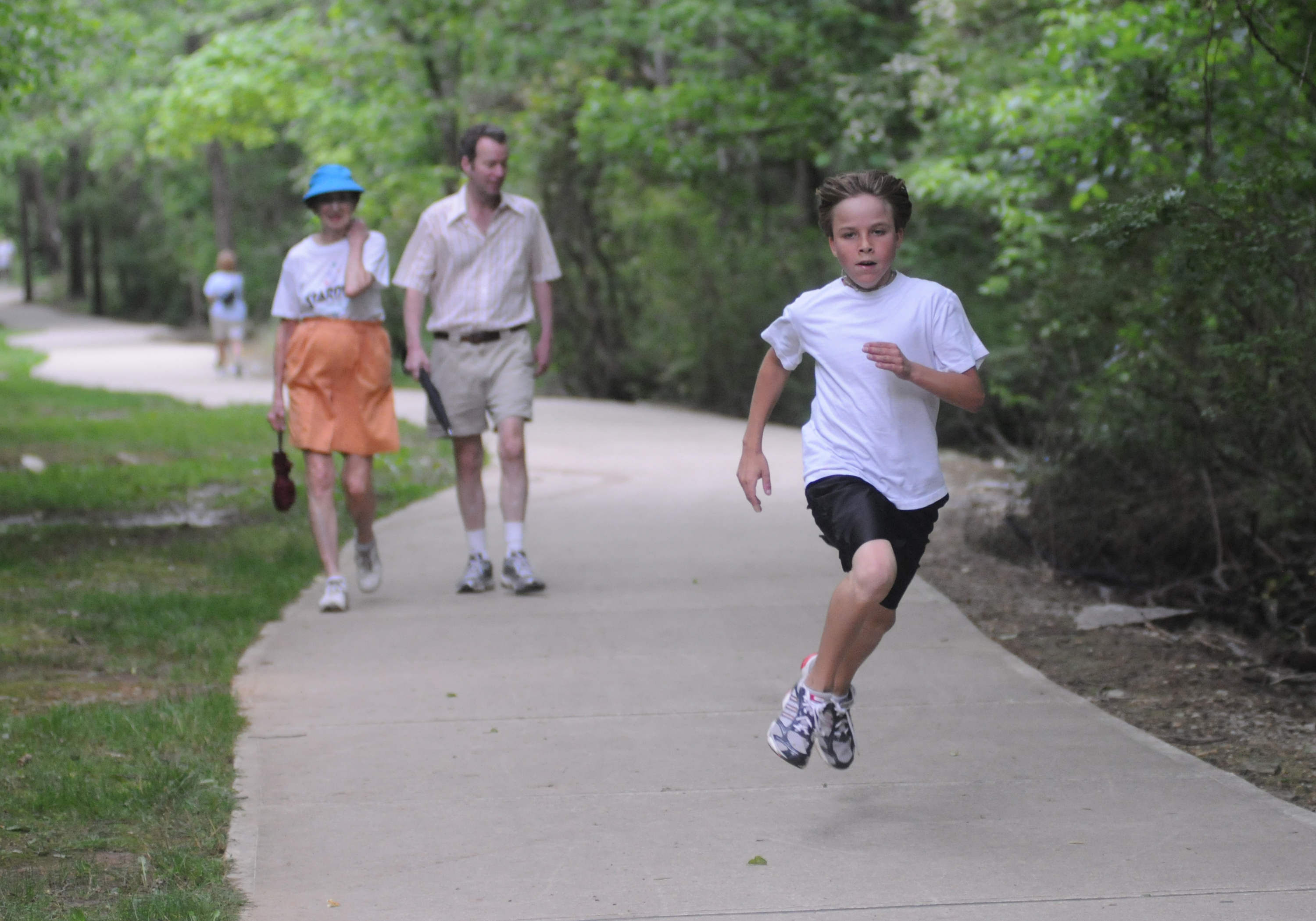
 Randsom Mark races toward the finish line of a fun run fundraiser on the Wolftever Creek Greenway as Trudy Brooks, left, and son Steve Brooks, center, walk. A survey of East Hamilton residents recently revealed a desire for more open spaces, like greenways.
Initial results from the White Oak Mountain Area Plan Survey revealed the obvious: Most East Hamilton residents are concerned about traffic congestion and road conditions. But survey responses also revealed that locals are just as concerned about the potential loss of rural character as the area continues to grow.
The survey, which wrapped up its online availability May 8, was conducted by the Chattanooga-Hamilton County Regional Planning Agency, and was also administered during public input meetings on March 30 and April 1.
During those meetings, about 75 residents from Apison, Collegedale, East Brainerd, Ooltewah and Summit – collectively defined as the White Oak Mountain Area by the RPA – filled out questionnaires to help shape what the area will look like in 10 years.
Of that group, many marked “rural character” and “amount of open space” as reasons they enjoy living in the White Oak Mountain Area, but also indicated they feel like those natural features and character traits are being threatened by overdevelopment.
“We moved here because housing was not packed in,” one resident wrote. “That’s quickly disappearing.”
When asked what types of development they would like over the next 10 years, many expressed interest in seeing more greenways and natural areas. They also favor walkable retail centers like Cambridge Square over drivable centers like strip malls.
RPA officials are still compiling final survey results from the online entries, but based on the initial survey results, RPA Principal Planner Pam Glaser said growth discussions moving forward will be framed around parks, greenways and maintaining the area’s character. The next phase of the process will be visiting the different areas within the White Oak Mountain Area to present residents with “community choices.”
“That’s where we take all this information and start to say, ‘OK, you want to keep that rural area? Here are your options and here are the consequences of each of those options,'” explained Karen Hundt, director of the RPA’s community design group.
One such consequence of preserving rural qualities could be higher tax rates, noted members of the advisory committee working with the RPA to redo the area’s comprehensive growth plan. The RPA’s latest studies show that the area is slated to receive 17.5 percent of the coming housing demand over the next 10 years, and restricting development could mean forfeiting property tax revenue even as local officials deal with increased traffic from growth in surrounding areas, former Chattanooga city Councilman Larry Grohn has said.
Finding that balance is an issue Collegedale Tomorrow Foundation Director David Barto said his municipality is already facing.
“The question we’re asking ourselves in Collegedale is, are we willing to pay a higher tax rate to actually have less development in some areas?” said Barto, who sits on the advisory committee for the White Oak Mountain Area’s growth plan.
Questions like these will be addressed when the RPA visits each area to discuss community choices, Glaser said. Those meetings will help determine how much development locals want to see, where they want to see it and what type of development they envision. Community members will be presented with a variety of place types to choose from so they can point to elements they believe would be best for their area.
Those meetings could start taking place as early as June, Glaser said.