
More Info
Vanderbilt will present free training on developmental disabilities at Siskin Children’s Institute for families and professionals on May 12. Contact tara.j.minor@vanderbilt.edu to register by May 4.
When it comes to diagnosing children with autism spectrum disorder, Katherine Gotham says the earlier the better.
“The key is really to get kids assessed as early as there are concerns, so that they have the opportunity for early intervention, which we think makes the most difference in their lives,” said Gotham, an assistant professor of psychiatry and behavioral sciences at Vanderbilt Kennedy Center.
But diagnosing autism is challenging, because it varies widely in severity and symptoms, which typically include difficulty communicating, obsessive interests or repetitive behaviors, hence the title autism “spectrum” disorder, or ASD.
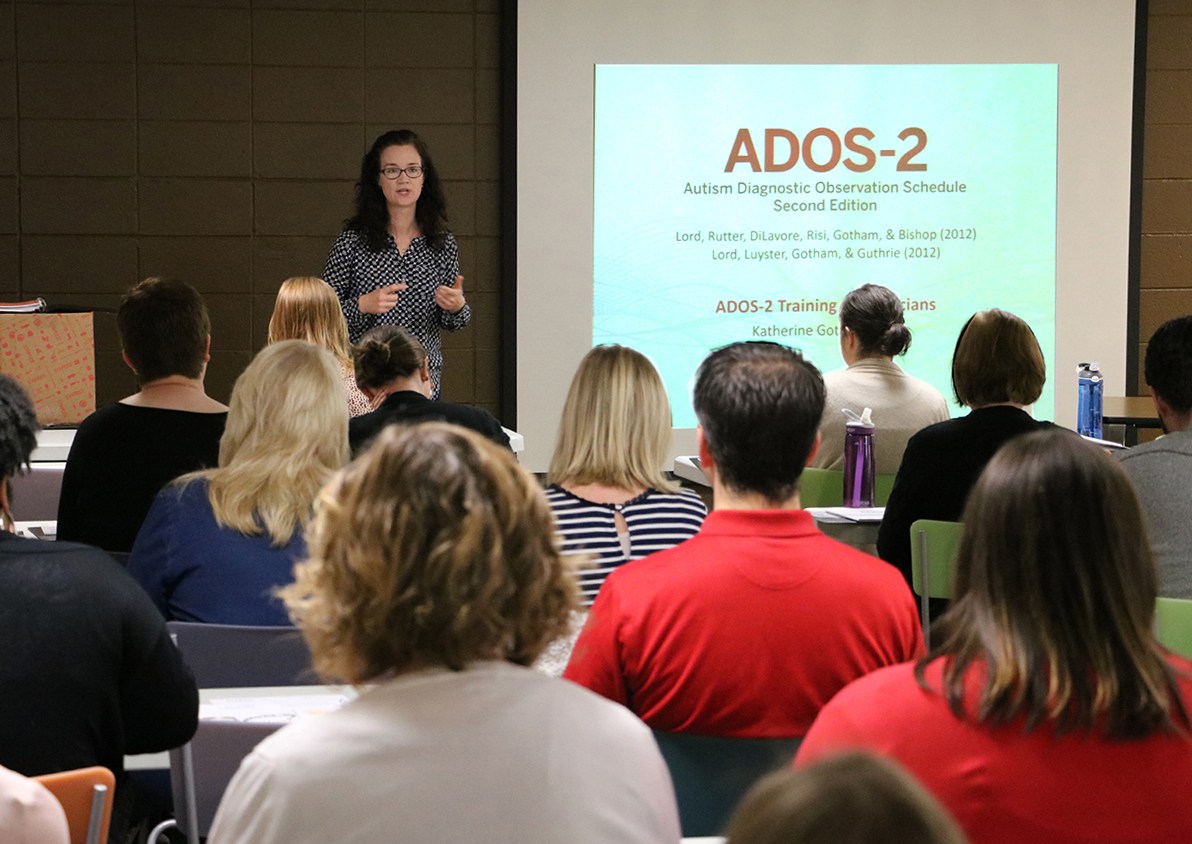
Gotham helped develop the autism assessment instrument called the ADOS-2, a series of interactive tasks for a patient to complete while a provider observes, and spent Thursday and Friday at Siskin Children’s Institute in Chattanooga teaching its ins and outs.
“Both the instrument and also our understanding of what goes into making an autism diagnosis has grown,” she said. “Really what we’re doing is learning to administer and score these various sets of tasks that help us standardize ASD assessment.”
Gotham said standardizing autism assessment is important, because factors such as a provider’s background and how well they know a child, as well as a child’s age, IQ and language level, can influence the evaluation process.
Seminar attendees included psychologists, pediatricians, psychiatrists, social workers, speech and language pathologists, occupational therapists, nurse practitioners and behavior analysts.
“There’s a lot of difference in what ASD assessments look like based on the discipline of the professional that’s giving it,” she said. “Sometimes, which wait list you get on or who you go see determines a lot whether you will or won’t get an ASD diagnosis, which then in turn kind of opens you up to what sort of services or interventions you’re eligible for.”
Sharon Aalfs, a psychologist from Catoosa County public schools, said although research has helped providers identify elements of autism that may have been overlooked in the past, the workshop helped refresh her skills.
“Probably the toughest thing is that every individual with autism is very different, so each time that you’re doing an evaluation for it may look different,” Aalfs said. “It’s been an extremely helpful seminar in learning this measure, and that’s going to help me refine what I do.”
More than 60 professionals enrolled in the workshop, including 25 local and regional participants who attended at no cost through a grant from the Rotary Club of Chattanooga.
“With the rising diagnostic rates of autism spectrum disorders, there is a need to provide additional training to local professionals to expand diagnostic options for families of children with autism concerns,” Brandon Rodgers, director of behavioral health services at Siskin Children’s Institute, said in a statement. “Our hope is that equipping more professionals with these tools will result in shorter wait times for children to receive these critical assessment services in the Chattanooga area.”
Contact staff writer Elizabeth Fite at efite@timesfreepress.com or 423- 757-6673.