
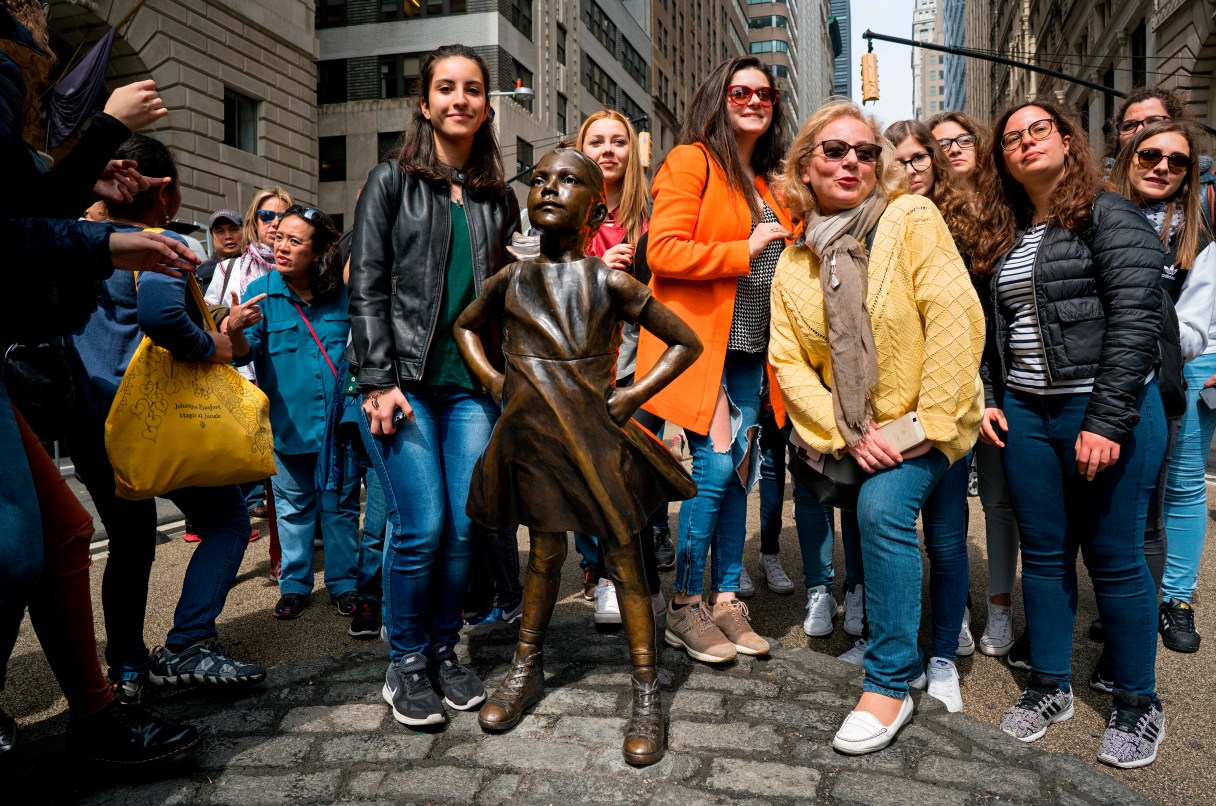
New York’s “Fearless Girl” statue that has become a global symbol of female business prowess will be moved from her spot staring down Wall Street’s bronze “Charging Bull” to a new home facing the New York Stock Exchange.
And the bull, a longtime fixture and tourist attraction at the foot of Broadway, may wind up following in her footsteps.
Mayor Bill de Blasio announced Thursday that “Fearless Girl,” a sculpture by Kristen Visbal of a girl with her hands on her hips and chin pointed up, will be moved by the end of the year to a permanent home near the stock exchange.
The statue was installed in March 2017 by the Boston-based State Street Global Advisors financial firm as a temporary display lasting a few weeks to encourage corporations to put more women on their boards. But its popularity spawned an online petition seeking to keep it. The city agreed.
Much of its popularity hinged on its juxtaposition with the 11-foot-tall, 7,100-pound bull statue, which Italian sculptor Arturo Di Modica created as a symbol of American financial resilience following the 1987 stock market crash. Di Modica wanted the girl gone, saying she altered the dynamic of his bull and was no more than what he called “an advertising trick.”