
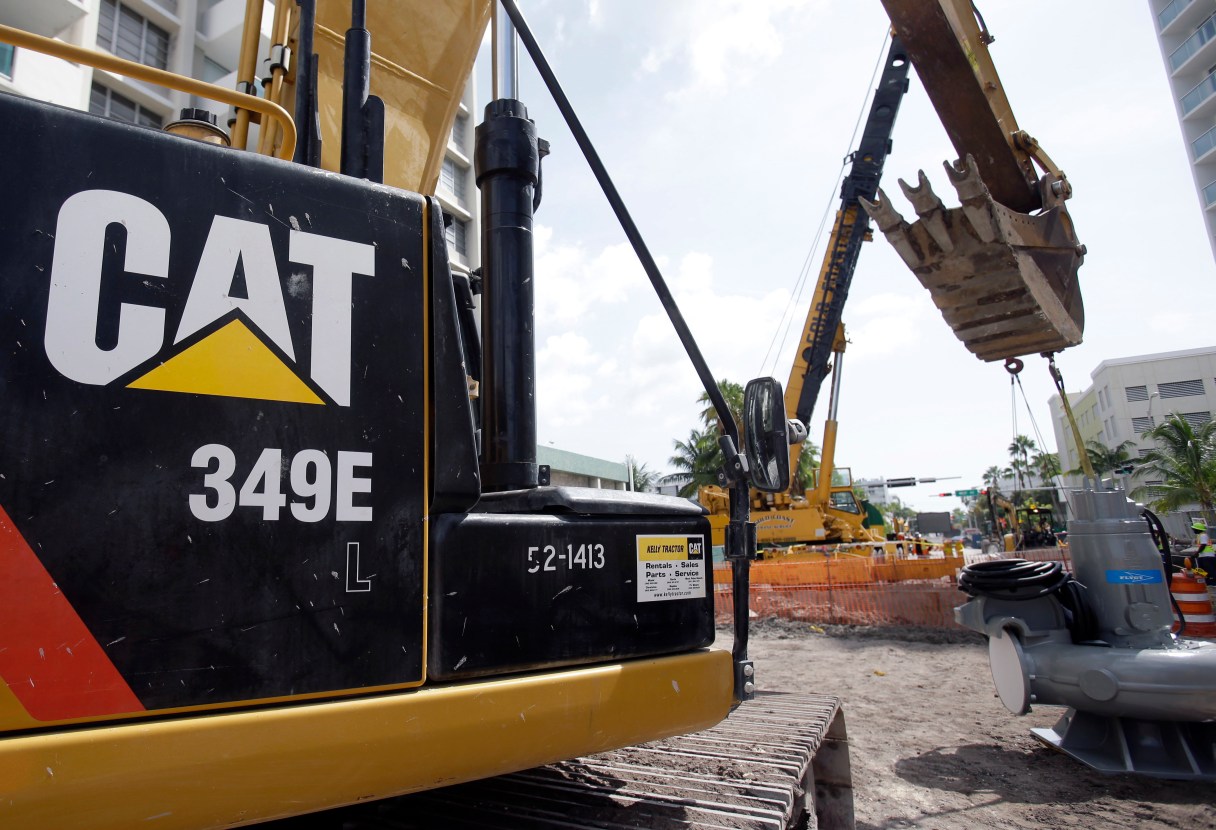
Caterpillar profits surge with sales
A boost in equipment sales propelled Caterpillar’s first-quarter profit, as a strong global economy helped support construction and energy industry projects.
The maker of heavy equipment and machinery also greatly increased its outlook for the year, citing an upbeat global markets, better pricing and demand.
Profit for the quarter ended March 31 rose eightfold to $1.67 billion, or $2.74 per share, while revenue surged 31 percent to $12.86 billion. The results topped Wall Street expectations.
Construction equipment sales rose 38 percent during the quarter, while energy and transportation equipment sales rose 26 percent. Caterpillar increased its full-time workforce by 4.6 percent to 99,700 employees between March of 2017 and 2018 to help meet higher demand.
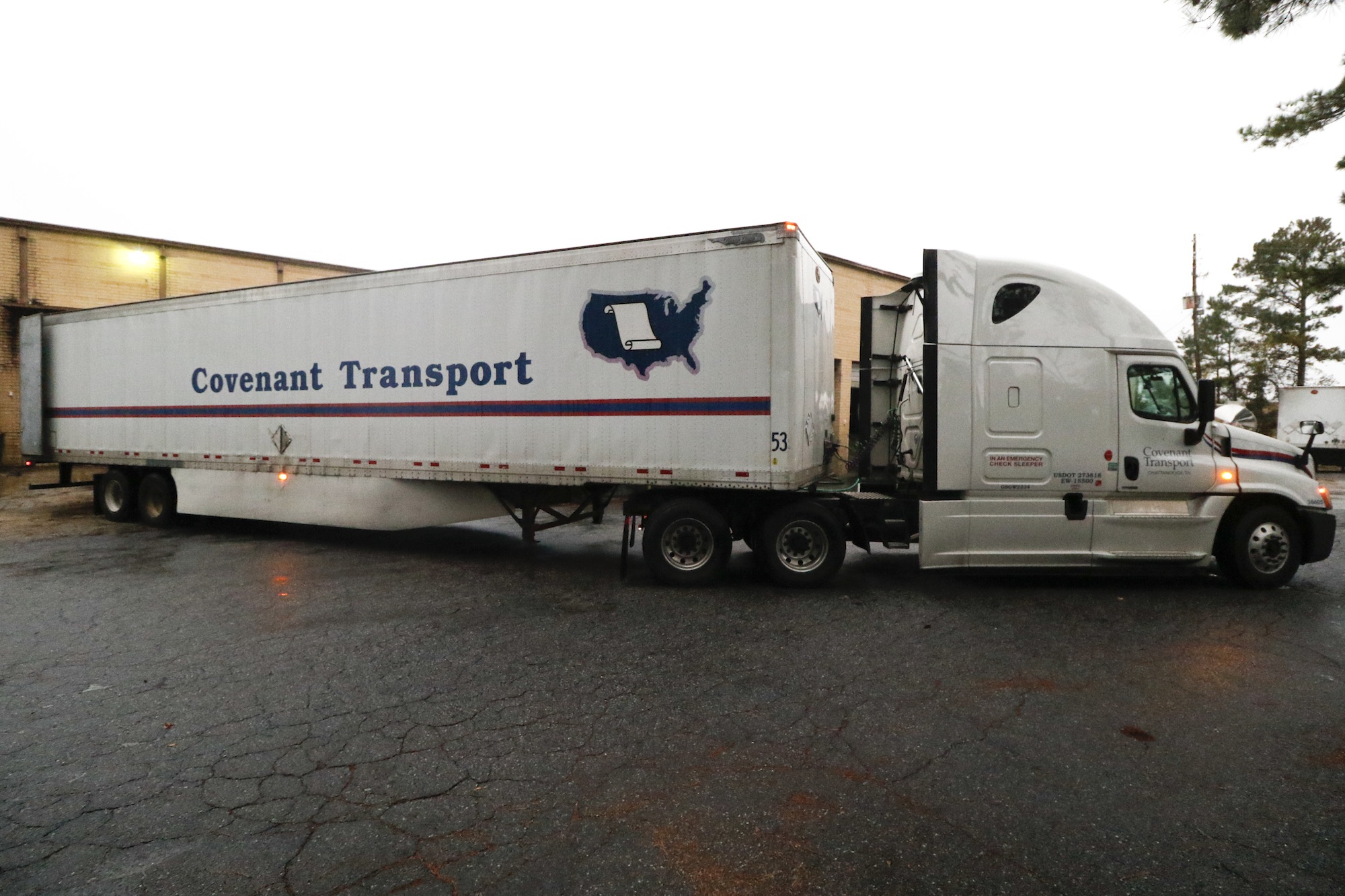 Staff Photo by Dan Henry / The Chattanooga Times Free Press- 10/26/15. Gary Helms, a master trainer for Covenant Transport, transports a load of soda ash from Chattanooga to Atlanta on October, 26, 2015.
Covenant rides better quarterly earnings
Covenant Transportation Group on Tuesday reported sharply higher first-quarter net income based on improved margins in its expedited, dedicated and solo refrigerated trucking lines.
Net income hit $4.4 million, or 24 cents per diluted share, compared with a net loss of $39,000 a year ago, according to the Chattanooga-based company.
The trucking business reported operating income of $6.4 million compared with operating income of $300,000 in the first quarter of 2017.
Total revenue in the quarter was $173.6 million, up 9.3 percent, the company reported.
“We were pleased that each of our three asset-based units – expedited, dedicated, and solo refrigerated – generated an improved operating margin compared with the 2017 quarter,” said David R. Parker, the company’s chairman and chief executive officer, in a statement.
Meanwhile, Covenant Transport Solutions, the company’s nonasset-based managed freight subsidiary, posted operating income of $1.1 million in the first quarter, down from $1.4 million a year ago.
Covenant cited a more competitive market for sourcing third party capacity for the drop.
Richard B. Cribbs, the company’s executive vice president and chief financial officer, said Covenant is forecasting sequential operating income improvement in each of the remaining quarters of 2018.
“Based on our expectation of a continuation of recent U.S. economic growth, as well as continued regulatory and demographic capacity constraints on driver availability, we expect year-over-year average freight revenue per total mile to be positive over the remainder of the year by a high single digit percentage,” he said.
Covenant’s shares on the NASDAQ closed at $28.86, down 96 cents, or 3.22 percent.
Astec profits up, but shares decline
Astec Industries boosted its first quarter earnings by 33.8 percent from a year ago as the Chattanooga-based maker of paving equipment and heavy machinery improved both its sales and profit margins in the first three months of the year.
But shares of Astec fell nearly 3.8 percent, or $2.17 per share, to $55.13 in trading Tuesday after the company reported less-than-expected revenue gains and fell short of what some investors had hoped for the company.
Astec reported net income in the quarter rose to $20.3 million, or 87 cents per share, on sales of $325.5 million. In the same period a year earlier, Astec earned $15.1 million, or 65 cents per share, on sales of $318.4 million.
The profit results were slightly better than what most analysts had forecast even though sales were not as strong as what Wall Street had expected.
Astec CEO Benjamin Brock said he was pleased with the first quarter performance and the increased backlog, which rose by 17.8 percent in the past year to $444.9 million as of March 31.
“While we have a good start to the year, we have opportunities to improve,”Brock said. “Given our backlog and customer feedback on their markets, we are optimistic for 2018 as a whole.”
SmartBank mergers help boost profits
The parent company of SmartBank boosted its first quarter earnings this year to a record $3.4 million, or 30 cents per share, compared with only $38,000 in first quarter profits a year ago.
SmartFinancial said its organic bank loans grew more than 15 percent on an annualized basis in the first quarter and return on average assets for SmartBank rose to 0.91 percent, also a record high.
“We had a great first quarter with a new record high return on average assets and earnings per share,” SmartFinancial CEO Billy Carroll said in an announcement Tuesday of the quarterly results. “As an organization we continue to improve on our efficiencies as we capture further economies of scale, even with over half a million in merger related costs.”
SmartBank bought Capstone Bank in Tuscaloosa, Ala., for $84.8 million last year and is in the process of acquiring Tennessee Bancshares, which operates Southern Community Bank, later this spring, in a deal valued at $31.8 million.
“Our resulting company will have assets approaching $2 billion by quarter end, setting us up for the next stage of growth,” SmartFinancial’s Chairman Miller Welborn said. “The opportunities before the company and in turn for our shareholders have never been greater. We are well on our way in creating one of the Southeast’s next great community banking franchises.”
SmartBank, based in Knoxville, merged with the former Cornerstone Bank in Chattanooga in 2015 to become a publicly traded company and has since acquired banks in the panhandle of Florida, Alabama and East Tennessee.
Shares of SmartFinancial are up 10.6 percent so far in 2018.
Diet Coke grows after makeover
Diet Coke’s makeover, which put the sugar-free drink in skinny, colorful cans, helped the low-calorie brand sell more soda in North America for the first time in nearly eight years.
Coca-Cola Co. introduced four new flavors of Diet Coke in February, including mango and ginger lime, to lure back customers who switched to other flavored fizzy water and other low-calorie drinks. The Atlanta-based company also redesigned the 35-year-old drink’s logo.
CEO James Quincey said the relaunch was able to bring back people who stopped drinking Diet Coke, as well as attract new drinkers, such as millennials.
Its other diet drink, Coca-Cola Zero Sugar, also posted growth after a relaunch last year that replaced Coca-Cola Zero.
Overall volume rose 3 percent in the first three months of the year, helped by its namesake Coca-Cola brand.
The company also has been selling its bottling business to focus on selling concentrates of its drinks. The move helped Coca-Cola’s profit rise 16 percent to $1.37 billion, or 32 cents per share. Adjusted earnings came to 47 cents per share, beating Wall Street’s per-share expectations by a penny.
Revenue fell 16 percent to $7.63 billion during the quarter, mainly because of the shedding of its bottling operations, which cuts costs, but lowers revenue. The numbers still topped Wall Street expectations.
Burger King grows with new sandwich
A new burger and a spicy chicken sandwich sold well at Burger King, helping boost profits for its owner, Restaurant Brands. But the company’s other chain, Tim Hortons, didn’t do as well, and Restaurant Brands plans to remodel those stores to try to get more people to come in to buy its coffee and doughnuts.
“We’re not happy with our sales growth and overall financial results at Tim Hortons,” said Restaurant Brands CEO Daniel Schwartz, in a call Tuesday.
Tim Hortons, where sales fell 0.3 percent at existing locations, will renovate most of its nearly 4,800 stores in the next four years. Increasing competition from other coffee sellers hurt sales, Schwartz said.
At Burger King, sales rose 3.8 percent at existing restaurants after the launch of the Double Quarter Pound King and the spicy chicken sandwich. Sales at its fried chicken chain Popeyes, which the company bought last year, rose 3.2 percent.
Restaurant Brands International said it had net income of 59 cents per share during the three months that ended March 31. Adjusted earnings came to 66 cents per share, 10 cents above what analysts expected, according to Zacks Investment Research.
It had revenue of $1.25 billion in the period, beating the $1.13 billion analysts expected, and helping to boost company shares by 5 percent to close at $56.30 Tuesday.