
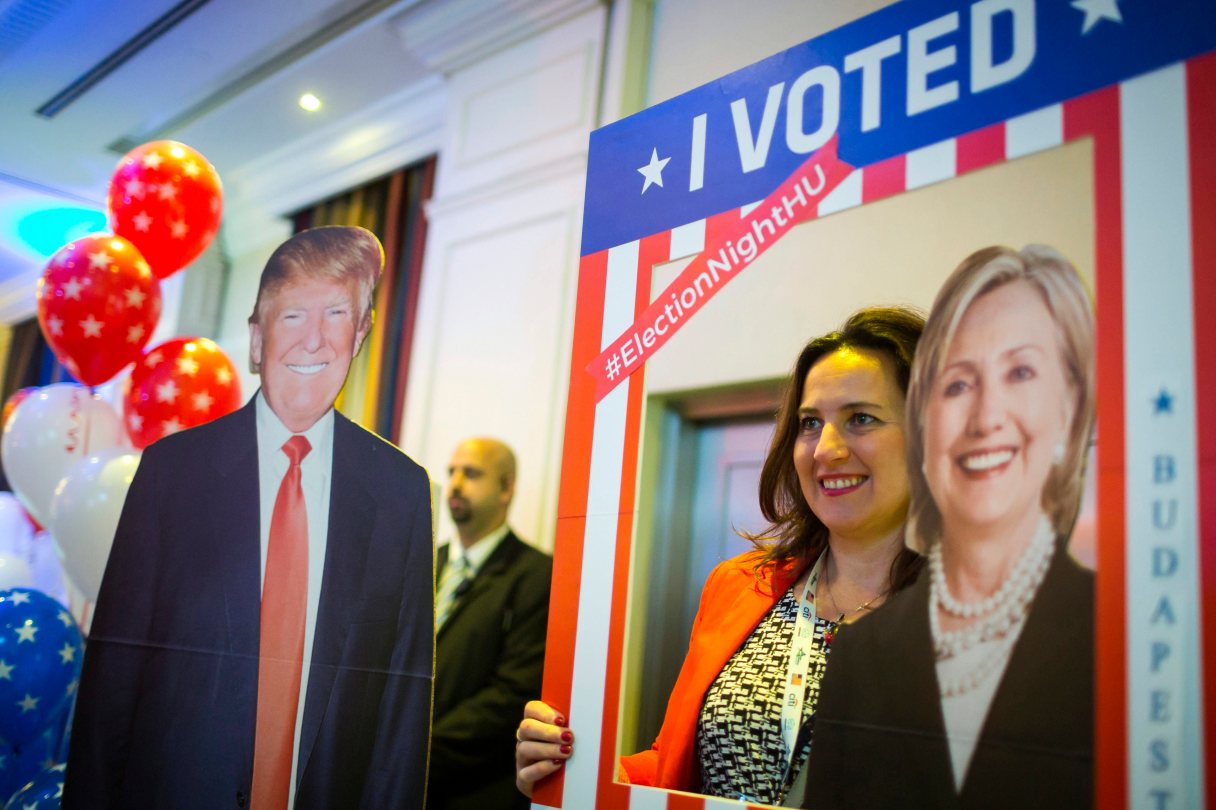
We live in two Americas.
In one America, a mentally unstable president selected partly by Russia lies daily and stirs up bigotry that tears our social fabric.
In another America, a can-do president tries to make America great again as lying journalists stir up hatred that tears our social fabric.
The one thing we all agree on: Our social fabric is torn. In each America, people who inhabit the other are often perceived as not just obtuse but also dangerous.
This is not to equate the two worldviews. I largely subscribe to the first, and I’m a villain in the second. But I do believe that all of us, on both sides, frequently spend more time demonizing the other side than trying to understand it, and we all suffer a cognitive bias that makes us inclined to seek out news sources that confirm our worldview.
A classic study offered free research to ordinary Democrats and Republicans. People on both sides were eager to get intelligent arguments reinforcing their views and somewhat interested in arguments for the other side that were so silly they could be mocked and caricatured. Neither Democrats nor Republicans were interested in intelligent arguments challenging their own views.
Decades ago, a media expert at MIT named Nicholas Negroponte foresaw the emergence of a news product that he called “The Daily Me,” with information tailored to a user’s needs. Negroponte was thinking of local weather, sports, particular interests and so on, but what actually arrived with the internet was a highly political version of “The Daily Me.”
I’m not advocating that you waste time on Breitbart propaganda any more than I’m saying that it was worth listening to leftists in the 1970s who praised Chairman Mao. But wherever we stand on the spectrum, there are sane, intelligent voices who disagree with us – and too often we plug our ears to them.
On the left, there has been some outrage at conservative voices on the Times op-ed pages. But as a progressive myself, steeped in the liberal worldview, I must say that I often learn a lot – however painfully – from these conservatives with whom I utterly disagree, partly because they gleefully seize upon inconvenient facts that my side tends to ignore because they don’t fit our narrative.
Moreover, there’s some experimental evidence that our biased approach to getting news actually makes us dumb. For example, one experiment asked 1,000 people to look at a simple data set and draw conclusions about a skin cream’s effectiveness. Not surprisingly, Democrats and Republicans were about equally good at calculating the math and determining how well it worked.
But when the experiment offered the very same data set and said it referred to the effectiveness of a gun control measure, Democrats and Republicans alike went to pieces. In one version, the numbers showed that a gun control measure worked – and Republicans kept flubbing the math. In another version, the gun control measure was ineffective, and this time the Democrats couldn’t manage the calculations.
What seems clear is that rigid ideological beliefs impair our cognitive functions.
The ideological blinders may worsen because of our tendency to seek out like-minded people. A 2014 Pew survey found that half of consistent conservatives and 35 percent of consistent liberals say, “It’s important to me to live in a place where most people share my political views.”
It should be possible both to believe deeply in the rightness of one’s own cause and to hear out the other side. Civility is not a sign of weakness, but of civilization.
The New York Times