
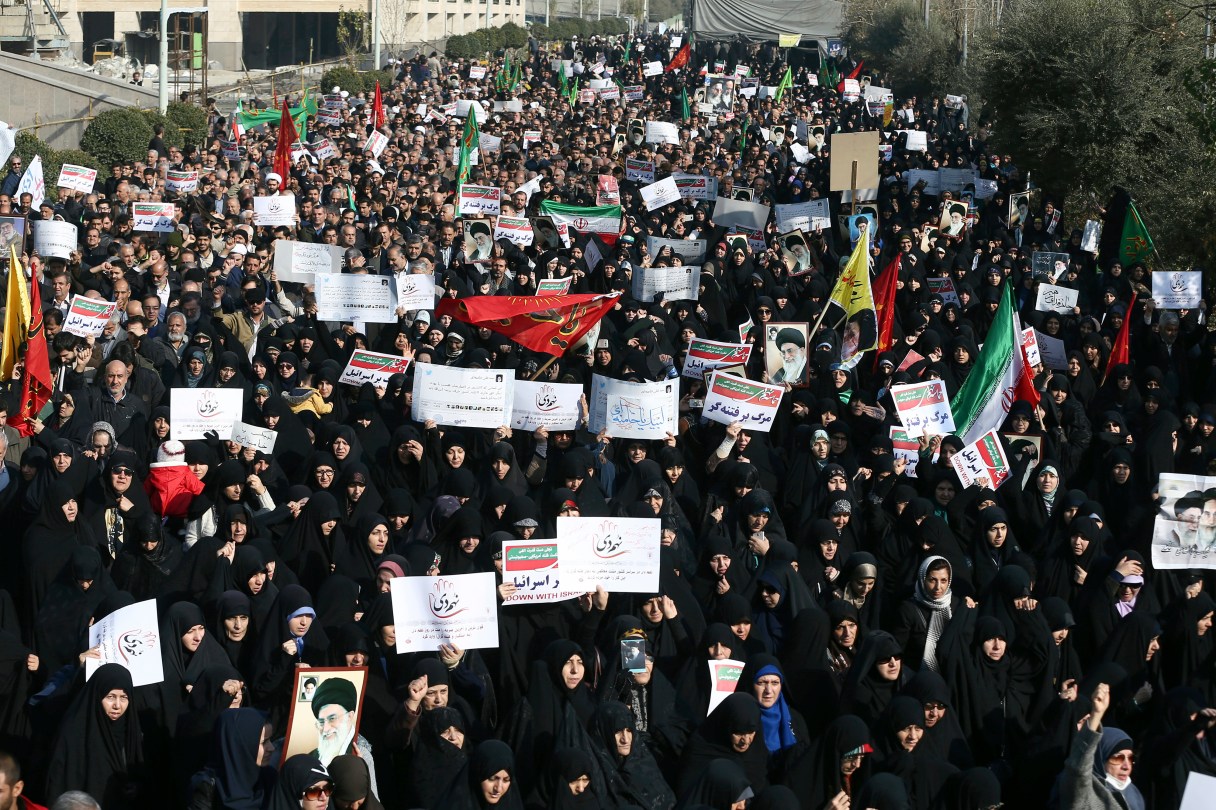
The biggest question about the recent protests in Iran – combined with the recent lifting of religious restrictions in Saudi Arabia – is whether together they mark the beginning of the end of the hard-right puritanical turn that the Muslim world took in 1979, when, as Middle East expert Mamoun Fandy once observed, “Islam lost its brakes” and the whole world felt it.
The events of 1979 diminished the status of women, pluralism and modern education across the Arab-Muslim region, and they fueled religious extremist groups like al-Qaida, Hezbollah and the Islamic State, whose activities have brought ruin to so many innocent Muslims and non-Muslims alike – and so many metal detectors to airports across the globe.
But today Iran and Saudi Arabia have something new in common: a majority of their populations are under age 30, young people connected through social networks and smartphones. And a growing number of them are fed up with being told how to live their lives by old, corrupt or suffocating clerics.
The spontaneous demonstrations that just erupted across Iran were triggered by the release, through social networks, of the latest national budget. Unemployed Iranian youth saw just how much money was being poured into the Islamic Revolutionary Guards – and their adventures in Syria, Lebanon, Iraq and Yemen – and into Islamic institutions, and even, as The New York Times’ Thomas Erdbrink put it, into “someone who was upkeeping the library of his deceased ayatollah father.” This at a time when the government was canceling subsidies to 30 million low-income Iranians.
Iran has an educated population and a rich cultural heritage. It’s a nation capable of breakthroughs in science, medicine, computing and the arts. However, its regime has been focused not on empowering Iranian youth but on extending Tehran’s influence over failing Arab states, costing billions of dollars.