
All the tasting-menu options that Susan Shek and Noah Sexton have sampled for their August wedding are delicious, but they want food that makes a visual statement.
They are leaning toward caviar on a buckwheat blini that bears no resemblance to a blini; it is a squat little tower made of reconfigured blini ingredients. The caterer has also suggested the steak frites, a slender rectangle of beef encircled by a flat ribbon of fried potato that floats inches above it, anchored at the base.
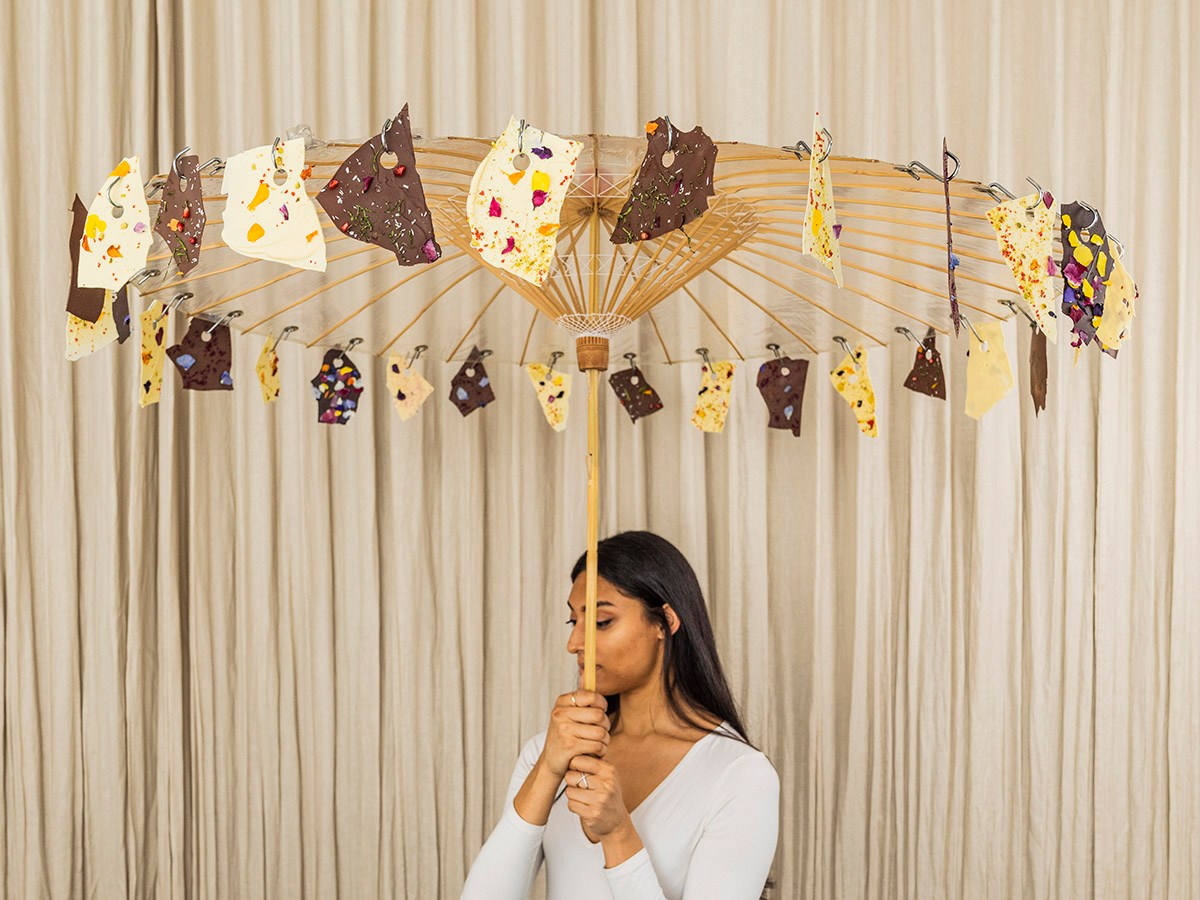
These are just two of 16 image-forward hors d’oeuvres offered by Pinch Food Design, a Manhattan caterer. Other potential menu items include “tartare Jackson Pollock style” – the sauce spattered over chunks of raw salmon or tuna – and shards of chocolate bark dangling from the spokes of a large umbrella that a server carries at the reception, inviting guests to pluck at will.
Expectations for wedding meals have been rising for years. Couples raised on food television have a palpable disdain for the old formula of fish, chicken or beef accompanied by a vegetable and a starch. And it is not uncommon for a bride and groom to ask how and where the components of their meal were grown, raised or slaughtered.
But big-city wedding planners and designers say a new criterion is coming into play: The food has to have a distinctive, if not downright startling, look. It has to grab the eye as much as the palate, and should be displayed on something more exciting than standard banquet tableware. If there is a performance element to the presentation, as with the traveling chocolate bark, so much the better.
“The camera eats first,” Shek said. She is a wedding photographer and Sexton is a private chef, and they are determined to create a dinner with a memorable look.
Chalk it up to the demands of Instagram, or the need to one-up the competition. But the bar has once again been raised, at least among people with the means to invest in more bells and whistles.
“The wedding used to be a statement of who you are,” said Abijah Tabb, the sales manager for events at the Wythe Hotel in Williamsburg, Brooklyn, and part of a team that orchestrates about 150 weddings each year. “Now, increasingly, it’s about how everything in the room looks.”
That starts with the menu, and even those who embrace a more traditional, formal approach, like Samantha and Timothy Goodrich, want what Goodrich called “the wow factor,” or visual pizazz.
The Goodriches married at the Wythe in May, and dinner for 130 included a pork shoulder dish – in part because “the Swiss chard just popped,” Goodrich said. It did not include the vegetable curry the couple tried at their tasting, because she “couldn’t visualize how it would come out on a platter with all that rice underneath.”
“Look is everything,” said Goodrich, an interior designer who has worked on restaurants and hotels.
Carla Ruben founded Creative Edge Parties 30 years ago, in Manhattan, with the slogan “Not just another chicken dinner,” which now applies to style as well as content. Ruben, who last year catered the November wedding of tennis champion Serena Williams and Reddit co-founder Alexis Ohanian in New Orleans, likes to mix the familiar with the unexpected, so short ribs come to the table inside a one-piece latticed pastry dome that seems to defy gravity.
What the food sits on is just as important. “There isn’t an hors d’oeuvre that gets created without a tray to match,” said TJ Girard, who owns Pinch Food Design with chef Bob Spiegel (who was a founding partner of Creative Edge).
Girard has designed 3D-printed trays with spikes that hold small bites, and a wall hanging of science-lab pipettes, each one filled with just enough wine to accompany a cheese and charcuterie display. The company’s signature appetizer plate is grooved on one side to hold a fork, and its bottom fits snugly over the top of a cocktail glass, so guests can keep a hand free without spilling.
Ruben oversees a 10,000-square-foot design studio in New Jersey where she employs ironworkers, woodworkers and other artisans to construct everything down to the tables, if need be.
Christina Lecki, the executive chef at Reynard, the restaurant in the Wythe Hotel, matches courses with a variety of plates and platters and wooden slabs. At the Goodriches’ tasting, she slapped a Post-it label on each one, to ensure the right pairings of food and plate.
If that’s not enough to satisfy the client, caterers can set the meal in motion. Shek and Sexton opted for what the Pinch planners call a roaming dinner, in which guests can wander from one specially designed mobile unit to another for entrees like the Jackson Pollock tartare, or single-portion sous vide preparations served in glass jars.
David Sax, a Toronto journalist who writes about food trends, says that upping the ante is inevitable among couples who choose a high-end wedding, because they have only one shot at making a memorable impression.
“You have to ask, what’ll give it impact, provide the thrill,” said Sax, who had cupcakes at his 2010 wedding instead of a more expensive cake. “In order for someone’s wedding to stand out even for a few days, it has to move beyond what everyone else has done. Caterers are selling pyrotechnics.”
While what he calls the “no-limit” crowd can spend whatever it takes, Sax sees the competitive mindset in an even larger population: anyone who is “in the prime wedding decade, late 20s to late 30s, and lives in a city and goes to a half-dozen weddings a year.”
They want to stand out. As Sax put it: “What do they serve the desserts in? The carved-out shell of a monkey’s head.”
Jove Meyer, a wedding and event planner and designer in Manhattan, says food and related costs have become the largest budget item for his clients, who want the meal “to overwhelm and impress at every level,” in part because of the added cost of the design element. Meyer and the owners of Pinch and Creative Edge say the average cost for this visually distinctive food starts at $230-$250 per person. (No one said where it ends.)