
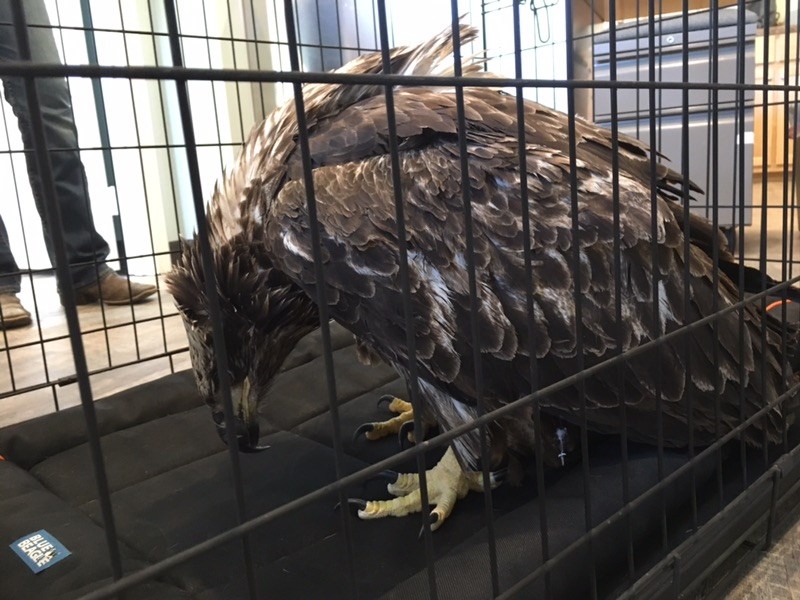
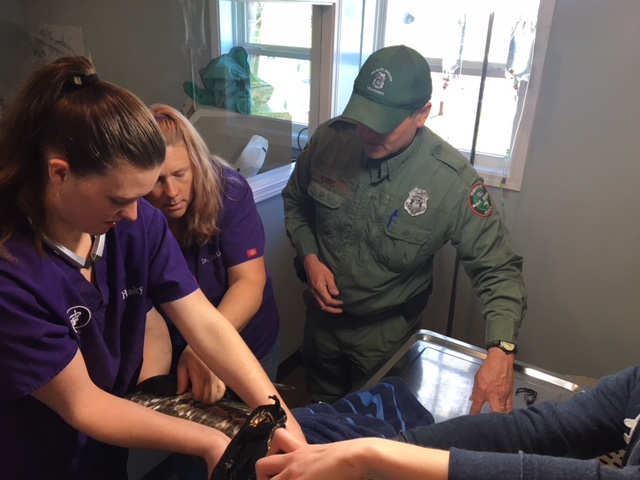
 Wildlife officer Norris with a bald eagle that was saved on Tuesday, March 6, 2018 in Pickett County.
A juvenile bald eagle that had become tangled in a discarded “limbline” used for catching catfish was rescue by state wildlife officers on Tuesday in Pickett County.
Pickett County wildlife officer Craig Norris and Clay County Sgt. Bill Moulton retrieved the injured juvenile bald eagle from Meetinghouse Branch.
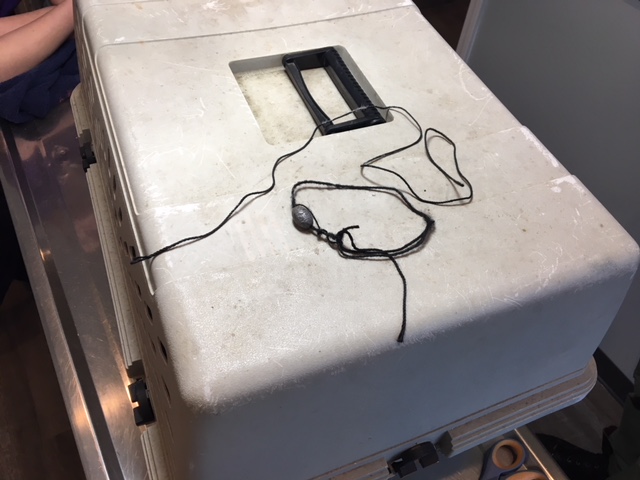 Limbline removed from a bald eagle in Pickett County on Tuesday, March 6, 2018.
“The eagle was taken to Dr. Dawn Lindsey, with the Clay County Animal Hospital,” TWRA officials said in a news release. “The fishing line was removed and the eagle was fed with trout from The Dale Hollow National Fish Hatchery. It is expected to recover.”
Norris heard about the bald eagle on Monday but he couldn’t find it when he searched the area. Then on Tuesday, Norris got a second report on the eagle and was able to find it early in the day, officials said.
Norris, who had been part of the bald eagle hacking program in 1988, was grateful to see the bird to safety. An eagle hacking program, according to the American Eagle Foundation’s website, is a method used to stimulate eagle nesting and eagle population recovery in a specific area by releasing fledgling eagles into the wild.
Wildlife officials warn against doing nothing.
“Please contact the TWRA office whenever you see something out of the ordinary,” Norris said in the release. “Never assume someone else has. If you see something, say something. In this case, it saved a bald eagle.”
According to the Tennessee Wildlife Resource Agency, abandoned or discarded fishing line can be very harmful to wildlife. Anglers should always place fishing line in a trashcan or take it home and throw it away. Trotlines and limblines should be checked at least once daily and never set within 100 yards of the mouth of any river, creek or slough, according to TWRA.
Bald eagles are somewhat common to see in the Dale Hollow reservoir area, officials said. TWRA coordinated efforts to restore bald eagles, starting in 1980 and continuing through 2003. The first successful eagle nest was discovered near Dover in 1983.
There are over 180 nesting pairs in the state today.