
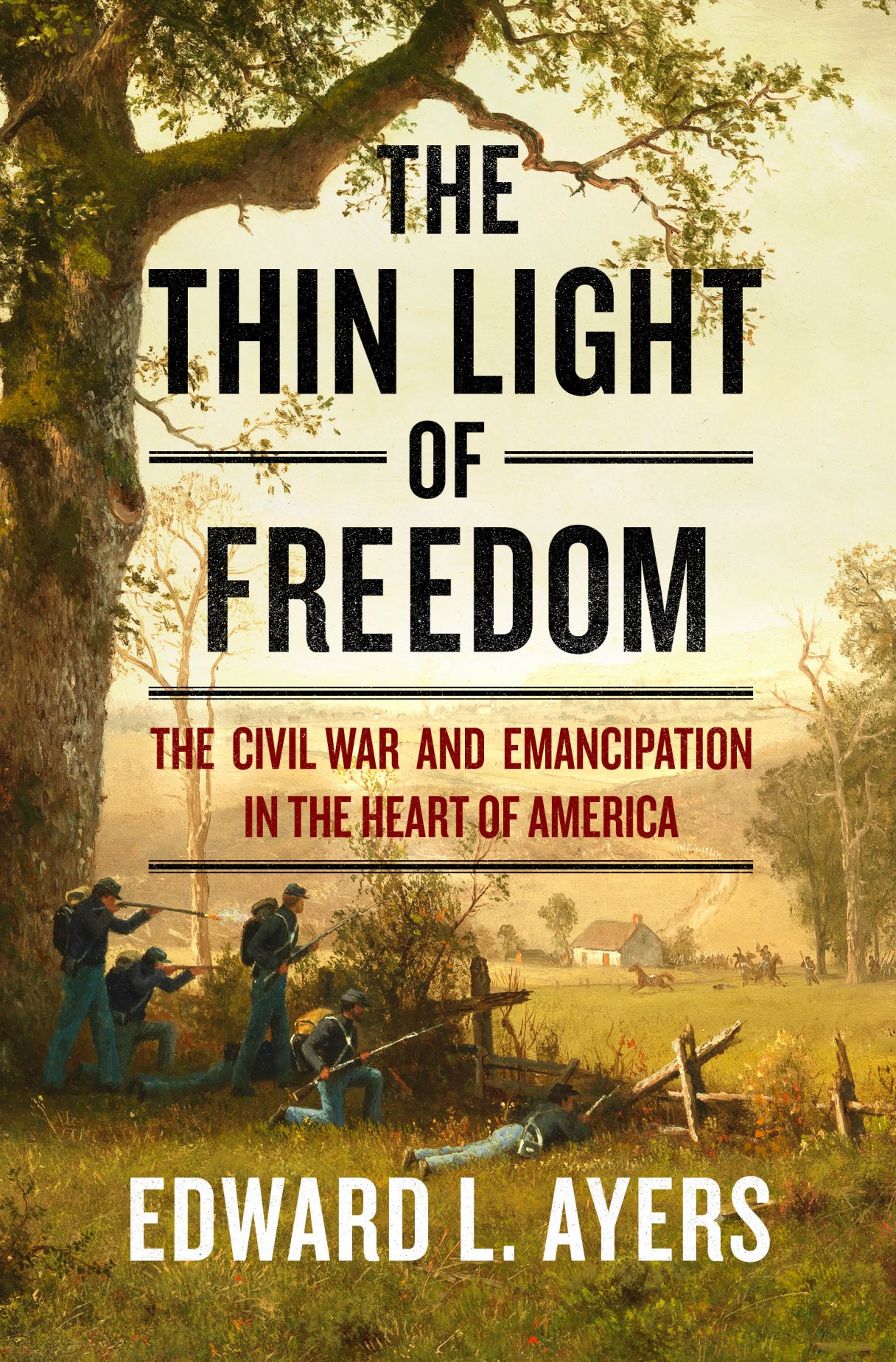
“THE THIN LIGHT OF FREEDOM: THE CIVIL WAR AND EMANCIPATION IN THE HEART OF AMERICA” by Edward L. Ayers (W.W. Norton, 288 pages, $26).
In recent months, Faulkner’s oft-repeated aphorism – “The past is never dead. It’s not even past.” – seems more relevant than ever, particularly regarding the Civil War and its legacy. A history that once seemed settled is undergoing radical revision, with sometimes violent conflicts over the placement of Confederate monuments erupting alongside the opening of new historic exhibits – like the Legacy Museum in Montgomery, Alabama – designed to educate the public about the roots of racism.
“Our stories of the American Civil War and Reconstruction keep changing,” writes historian Edward L. Ayers. “In our own time, we can see that the Civil War and its consequences, straightforward and familiar at a distance, prove intricate and surprising when considered at close range.”
With “The Thin Light of Freedom: The Civil War and Emancipation in the Heart of America,” his newest work of Civil War scholarship, Ayers illuminates the intricacies of the undead past through the experience of two communities – one Northern, one Southern – occupied by invading armies made up of their own former countrymen.
Winner of a host of honors, including the Pulitzer Prize and the National Humanities Medal, Ayers has long been revered for the depth and breadth of his research and for his fluent, lucid writing. “The Thin Light of Freedom,” recipient of the 2018 Lincoln Prize for the best nonfiction historical work on the American Civil War, resumes the narrative Ayers began with “In the Presence of Mine Enemies” (2003). At the center of the two volumes is the war’s turning point: Lee’s decision to lead the Army of Northern Virginia into Pennsylvania before being repelled by his defeat at the Battle of Gettysburg.