
This popular children’s rhyme found its way over the decades into many autograph books, which held signatures of friends and family as well as poems, snippets of advice and illustrations. Those entries remind us of friends, school days and childhoods spent on playgrounds. Some autograph books are a bit more serious, holding signatures of the rich, famous, or about-to-be famous thespians, musicians, athletes, activists and politicians. The Chattanooga Public Library has a worthwhile collection of those books.
The recording of autographs got started in Germany and Holland several hundred years ago, when graduating scholars asked professors and fellow students to sign their personal Bibles. The oldest autograph book on record belonged to Claude de Senarclens in 1545. Small bound books with blank pages began replacing bibles about that same time. Students kept the books and any correspondence as a form of scholarly affirmation as well as a simple address network.
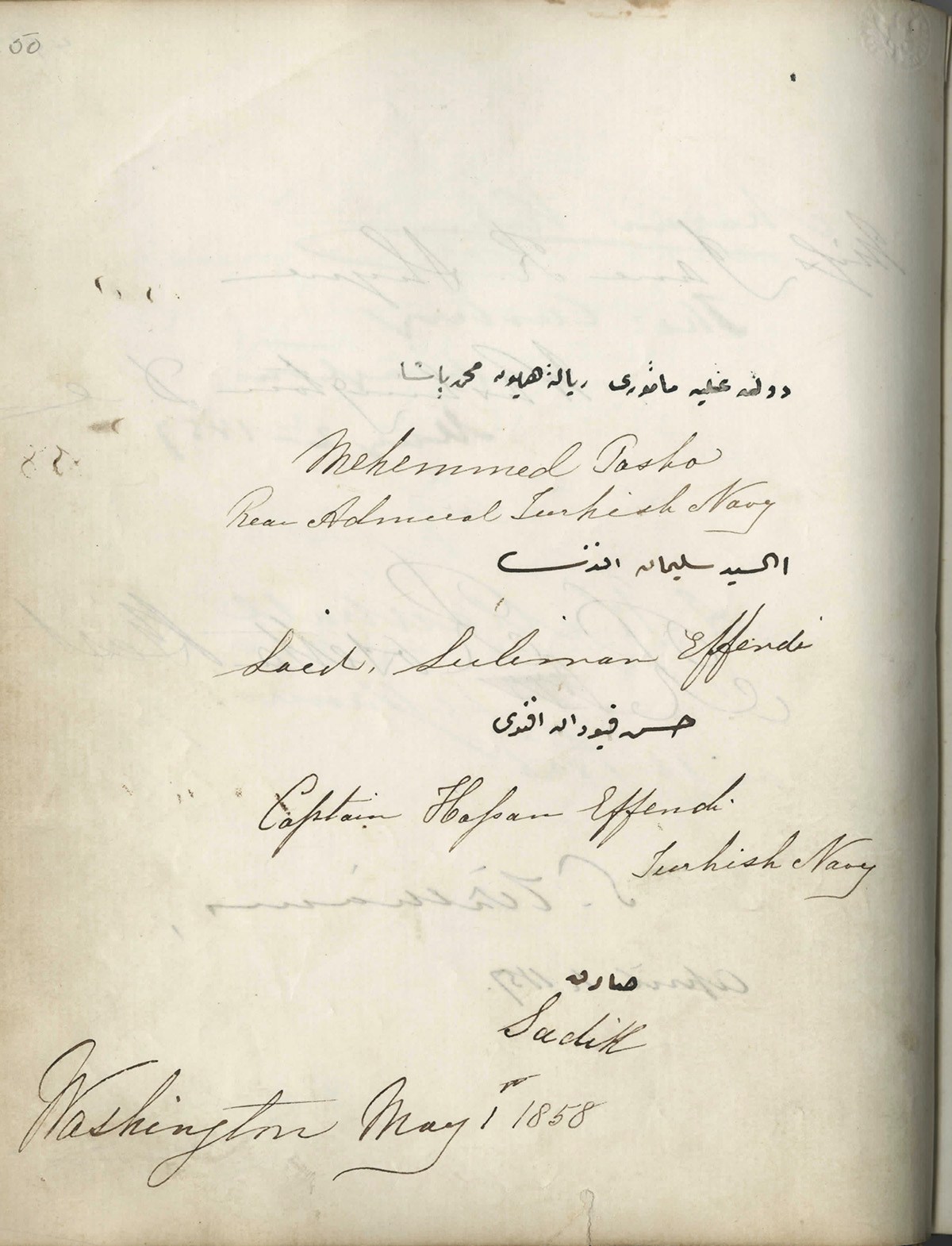
 The Edward Kimble Valentine collection of autographs contains signatures dated from 1843 to 1916. This example shows the signatures from a Turkish delegation visiting Washington, D.C., in 1858. (Photo courtesy of the Chattanooga Public Library)
Women and men outside academia begin keeping autograph books in the 18th century. Those books peaked in popularity in the United States around the time of the Civil War and remained in vogue until the late 19th century, when school yearbooks replaced autograph books as a way of remembering friends and classmates.
Laura Ingalls Wilder wrote of her autograph book in “Little Town on the Prairie.” Laura and her sister Carrie received books after Ma and Pa took sister Mary to college in Vinton, Iowa. Ma explained to Laura that all the fashionable girls kept books, and her friends were to write in her album. Laura’s album was red and embossed in gold; Carrie’s was blue. Laura’s mother cautioned her daughter to be careful in this verse:
“If wisdom’s ways you wisely seek, Five things observe with care, To whom you speak, Of whom you speak, And how, and when, and where.” Your loving mother, C. T. Ingalls, De Smet, November 15, 1881.”