
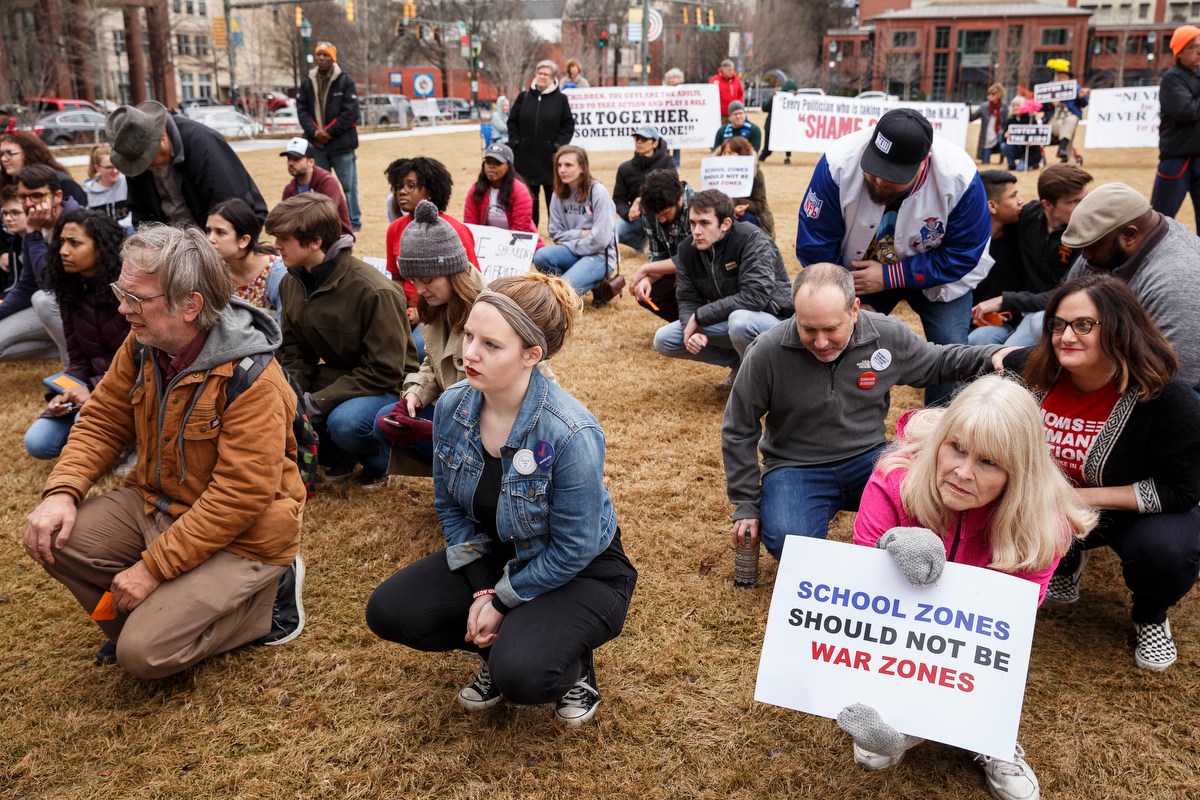

A community forum on the effects of gun violence in Chattanooga won’t keep someone who desperately wants a gun from getting it, won’t stop the next shooting and won’t solve the issue.
But an event sponsored by the Times Free Press at the Carver Youth and Family Development Center Wednesday evening may make more people think about the wide-ranging cost of such violence, and those thoughts in turn could spur conversations and actions that in fact might stop the next incident.
The forum was an outgrowth of the newspaper’s in-depth series “The Cost of the Crossfire” by Allison Shirk Collins and Elizabeth Fite and was held to discuss possible solutions or ways to combat gun violence.
It was not staged, as one attendee seemed to suggest, to see how the newspaper could solve the issue, and it was not a political forum, as another attendee seemed to want to make it, by loudly declaring that “America is a culture of violence.”
Instead, it was real people whose lives had been affected – teachers, students, parents, neighborhood leaders, organization workers and community members – discussing what fuels gun violence in the city and what approaches and programs might be taken in light of it.
Dwayne Marshall, vice president of community investment for the Community Foundation of Greater Chattanooga and a resident of Chattanooga, may have spoken for all in attendance in understanding the cost of such violence.
“We’re all affected,” he said.
Although the 60-plus community members in attendance noted the absence of elected city and county leaders, their absence may have prompted those there to be more forthcoming in their comments.
However, the fact they had a myriad of reasons why gun violence occurs might have made the elected leaders feel better. They’re in positions of power with far more resources and experts at their reach, and even they can’t tame the violence.
As individual tables of people voiced their reasons for the violence Wednesday, access to guns repeatedly came up. That’s an easy reason, of course. The harder caveat is that more than 80 percent of gun-related crimes in the country are perpetrated with illegally owned firearms. The not-so-easy solution is to prevent legal guns from getting into the wrong hands.
But community members who thought beyond simple access to guns understood, as one attendee said, that guns don’t kill, but angry persons with guns kill. Others also saw the links between shootings and domestic violence, gun violence and lack of community pride, lack of conflict resolution skills, lack of self-worth, lack of respect, lack of knowledge and lack of parental involvement.
Those “lacks,” others were able to surmise, were exacerbated, or at least not alleviated, by a perceived lack of mental health.
Still other community attendees hit on the often exasperating causes of street-level, male gang violence: “because people like to use guns,” “toxic masculinity” and “what they can’t get out with their mouths, they get out with their guns.”
Potential remedies didn’t mount up as quickly but did correlate with the “lacks” cited in causes fueling the violence.
Access to mental health programs (and removing the stigma of using them) and teaching coping and conflict resolution skills were mentioned again and again by participants. Other ideas included more programs about bullying, mentoring and fatherhood. It also was suggested more schools offer after-school activities and that the city’s youth and family development centers offer activities youth want to participate in rather than what their adult leaders believe they want.
Putting more counselors in schools also was recommended, but a Hamilton County Schools coordinator pointed out not only that many of the aforementioned assistance programs are available and not being taken advantage of but also that the number of school counselors rises every year. Indeed, she said, only county elementary schools now share counselors, and that such professionals need only be asked to offer assistance.
Some attendees thought beyond school-age issues and promoted the need for job training services, jobs programs, economic mobility task forces and laws addressing access to firearms.
One representative for a table even suggested some of the violence issues might be remedied by “more love in the homes.” We wonder if participants who heard that suggestion truly understand what a key “more love” could be in overcoming the issue.
Nevertheless, while the majority of gun violence in Chattanooga is perpetrated in a relatively tiny geographical area of Hamilton County, and by a minuscule number of its nearly 365,000 citizens, it has wide ripple effects. So it’s a problem all of us must discuss and help mitigate. Nothing less than a more successful future is riding on it.