
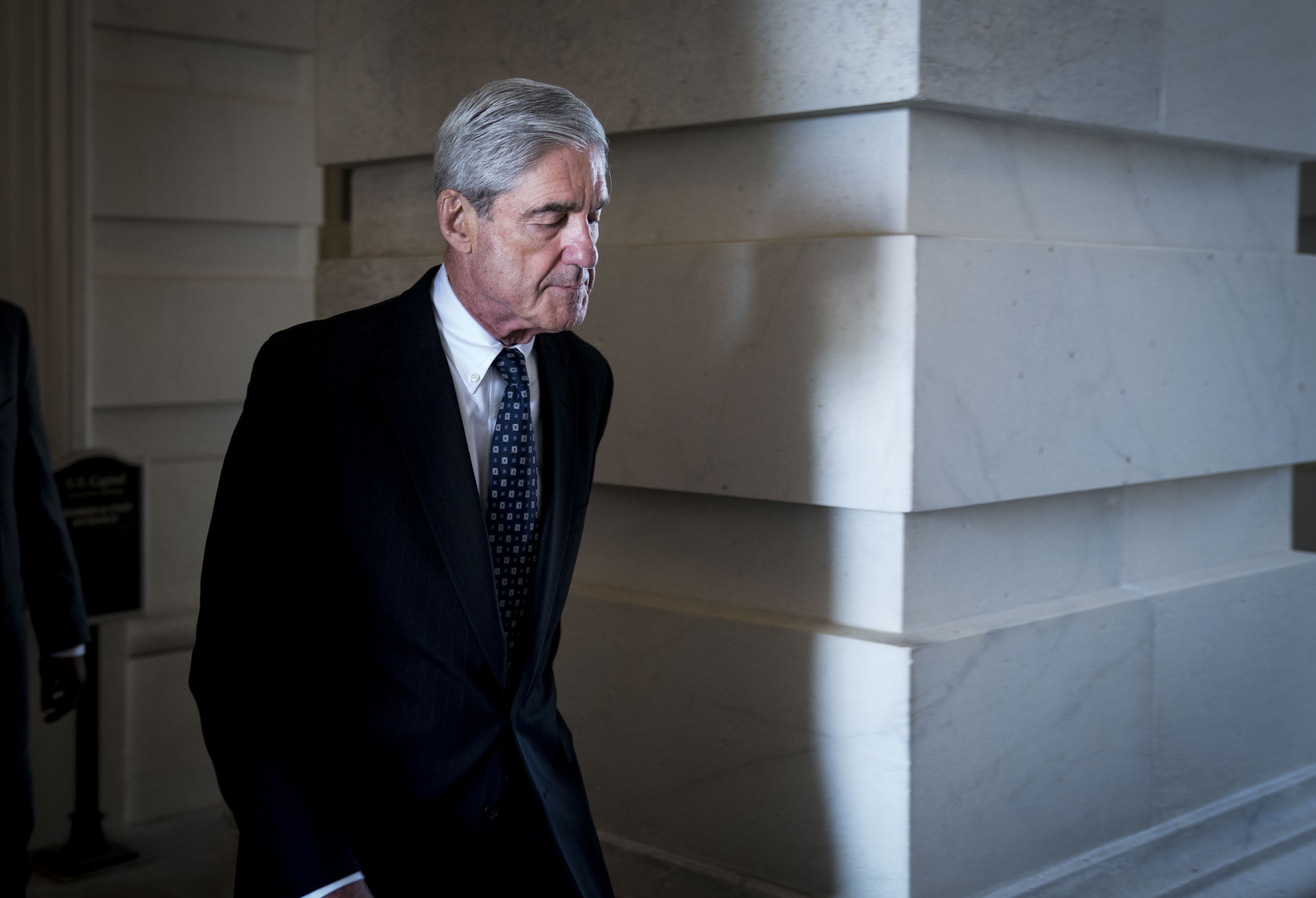
 FILE — Robert Mueller, the special counsel leading the Russia investigation, at the Capitol in Washington in 2017.
No, it’s not over. Nor should it be.
Special Counsel Robert Mueller’s report found plenty of damning evidence about Russian interference into our 2016 presidential election, and it did not clear the president of obstruction of justice. As a matter of record, the report makes clear that Mueller accepted Department of Justice policy that a sitting president cannot be charged by prosecutors. At the same time, however, Mueller made clear that he was not spelling out a “declination” decision, meaning he wasn’t clearing the president, either.
One of the most telling quotes from the Mueller report, as opposed to what Trump’s new fixer William Barr characterized as “no criminality” is this:
“If we had confidence after a thorough investigation of the facts that the President clearly did not commit obstruction of justice, we would so state. Based on the facts and the applicable legal standards, however, we are unable to reach that judgment. The evidence we obtained about the President’s actions and intent presents difficult issues that prevent us from conclusively determining that no criminal conduct occurred. Accordingly, while this report does not conclude that the President committed a crime, it also does not exonerate him.”
Let’s cut to the chase.
Mueller, under the constrictions of his appointment and DOJ policy, felt he couldn’t indict or charge Donald Trump because he’s a sitting president.
The only thing he could do was clear him.
But Mueller put a figurative exclamation point on saying he couldn’t do that.
On page 158 of Volume II of the report:
“The President’s efforts to influence the investigation were mostly unsuccessful, but that is largely because the persons who surrounded the President declined to carry out orders or accede to his requests [Then-FBI Director Jim] Comey did not end the investigation of [Michael] Flynn. [Don] McGahn did not tell the Acting Attorney General that the Special Counsel must be removed, but was instead prepared to resign. [Former campaign manager Corey] Lewandowski and [Former White House Deputy Chief of Staff for Policy Rick] Dearborn did not deliver the President’s message to Sessions that he should confine the Russia investigation to future election meddling only. And McGahn refused to recede from his recollections about the events surrounding the President’s direction to have the Special Counsel removed, despite the President’s multiple demands that he do so.”
As for the Russia “collusion?” The Mueller report states the probe didn’t look for collusion, but rather, a concentrated conspiracy. The reports says investigators found “numerous” Russia contacts, but evidence of “crime” was “not sufficient” or did not “rise” to the point of criminality (for instance, design or participation in the actual hacking of Hillary Clinton emails rather than just benefiting from the hacking).
But the report makes clear the Trump campaign was “receptive” to offers of assistance from the Russians – so receptive that some in the campaign lied about the contacts and have been charged with lying. What’s more, the report makes clear that the president openly encouraged his campaign to reach out to Russians and work with them. Trump himself called on Russia to get Clinton’s emails, then told his campaign to acquire them.
Thursday was a stunning day.
Trump may be crowing “witch hunt” and “no collusion.” But a real read of this lightly redacted 400-plus-page report shows anything but that. A full reading shows that Trump failed over and over to uphold his own oath of office to put the good of the country before his own interests.
We must remember that this was an investigation into the Russian interference of our 2016 presidential election.
Ask yourself if this finding – “[T]he president attempted to remove the Special Counsel; he sought to have Attorney General [Jeff] Sessions unrecuse himself and limit the investigation; he sought to prevent public disclosure of information about the June, 2016, meeting between Russians and campaign officials; and he used public forums to attack potential witnesses who might offer adverse information and to praise witnesses who declined to cooperate with the government” – describes a man we should trust to “faithfully execute the Office of the President of the United States”and “to the best of my ability, preserve, protect and defend the Constitution” of the United States?
Barr, with his shameful news conference an hour and a half before the report was released, once again clearly sought to misleadingly summarize the document and persuade less curious Americans from wading through it themselves. Barr seems guilty of obstruction himself: He obfuscated for the president in plain sight and on camera.
So now what? Truth be told, this is one giant referral to further investigation – especially by Congress, which holds subpoena and impeachment powers.
One doesn’t have have to succeed at obstruction to be guilty of it, according to legal scholars. And even if you read this report and dismiss charging a sitting president, as Americans we must ask ourselves if we think this kind of leader and his abuse of power are good for our country.
That brings us to Congress. Will Congress lay aside political partisanship and pay attention to its oath?
Do we want a Congress that accepts Trump’s abuse of power as being good for America?
We do not. And if Congress does accept that, then it’s up to us to right things.
The presidential and congressional elections on Nov. 3, 2020, are exactly 564 days away.