
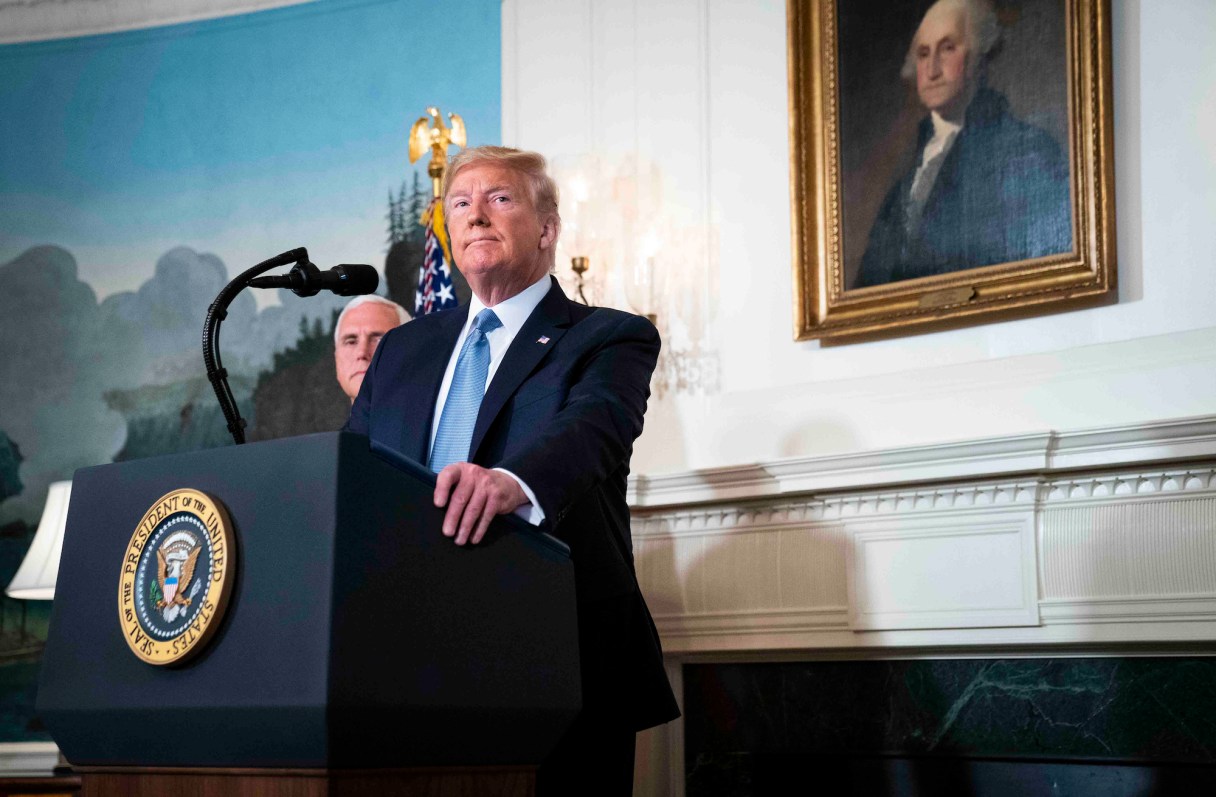
When a president orders up a special script, summons the national media and sends a message to all Americans that the “sinister ideologies” of “racism, bigotry and white supremacy” have no place here, the normal response is to cheer.
But these aren’t normal times. Donald Trump isn’t a normal president. And those words, which he spoke Monday, made me feel sick because they were just cheap and hollow sops to convention.
He doesn’t believe them. Or rather, he doesn’t care. That’s indisputable from his actions to this point, and it will be demonstrated anew by his behavior going forward. You can take this prediction to the bank: Trump will be back to his old tweets and tricks in no time. They have gotten him this far, and he’s not going to mess with a good thing just because the country is in crisis.
That speech of his was a pantomime of dignity to give cover to his Republican enablers, and it took a hell of a lot of nerve. Trump as a healer? A unifier? I have grown dangerously inured to his lies – how can you not, when there are so many of them? – but this one was so big it stopped me in my tracks. And it scared me, because when he pretends that what he has been doing isn’t bigoted and racist and that he’s not pushing a narrative of white people who belong here threatened by dark people who don’t, he encourages that same delusion in his followers. He’s not confronting them. He’s letting them off the hook.
I don’t claim that Trump specifically caused or catalyzed El Paso, Texas, or Pittsburgh or related bloodbaths, because nothing’s that tidy, because I know that mass shootings and mad shooters predate him and because, in a sense, it doesn’t matter. The enmity he sows and the hatred he reaps are unacceptable regardless, and they’re certainly not lowering the temperature of political discourse in America.
I also don’t believe that all of Trump’s backers are bigots, and insistences along those lines are an overreach with the unfortunate effect of inviting many of them to tune out their critics. Trump rose and Trump rules for an array of reasons.
But an us-versus-them racism is prominent among them. Let’s never forget the milestones of his political ascent: In 1989, as he kicked around the idea of running for office, he took out full-page ads in major New York City newspapers against the Central Park Five and denounced the “bands of wild criminals” and “crazed misfits” threatening everyone else. In retrospect, this was throat clearing for his invocation of Mexican rapists more than a quarter century later.
In 2011 he became the best-known face of the birther movement, promoting the notion that Barack Obama was born outside the United States and thus an illegitimate president. “Trump recognized an opportunity to connect with the electorate over an issue many considered taboo: the discomfort, in some quarters of American society, with the election of the nation’s first black president,” Ashley Parker and Steve Eder wrote in The New York Times. “He harnessed it for political gain, beginning his connection with the largely white Republican base that, in his 2016 campaign, helped clinch his party’s nomination.”
He stirs up bigots and bigotry, as he did at a rally in May in Florida where he asked the crowd how to prevent migrants from crossing our Southern border. “Shoot them!” a man shouted. The crowd erupted in laughter. Trump’s response was a smile.
Reflect on that in light of what just happened in El Paso. And while you’re at it, go back and reread the presidential campaign announcement speech when he mentioned rapists and drug smugglers from Mexico. It’s not just an aria but an entire opera of grievance, its unalloyed fury trained on supposedly unprincipled actors from places where people’s skin is darker and their names less bluntly phonetic than Donald Trump. If fits with eerie neatness into the “replacement theory” that animated the El Paso gunman, and it’s not meant to inspire or instruct. It’s meant to inflame.
My Times colleague Peter Baker, who covers the White House for The Times, was precisely right when he wrote a few weeks ago that in regard to race, Trump “plays with fire like no other president in a century.” I’ll say. He’s a moral arsonist, and if he determined that the only way to hold on to power was to burn everything to the ground, he’d gladly be king of ashes. To paraphrase Milton: Better to reign over a ruined country than to be just another crass plutocrat in a noble one.
On Monday he had the audacity to talk about “the perils of the internet and social media,” saying that we must “shine light” on their “dark recesses.” His Twitter account is one of those recesses. He rued how “hatred warps the mind, ravages the heart and devours the soul.” It was the ultimate distraction, decrying what he embodies.
The biggest lies aren’t discrete. They’re overarching. They’re not incidental. They’re spiritual. And when Trump, having lit one match after another, professes distress over the inferno, that’s a charade as grotesque as they come. As dangerous, too.
The New York Times