
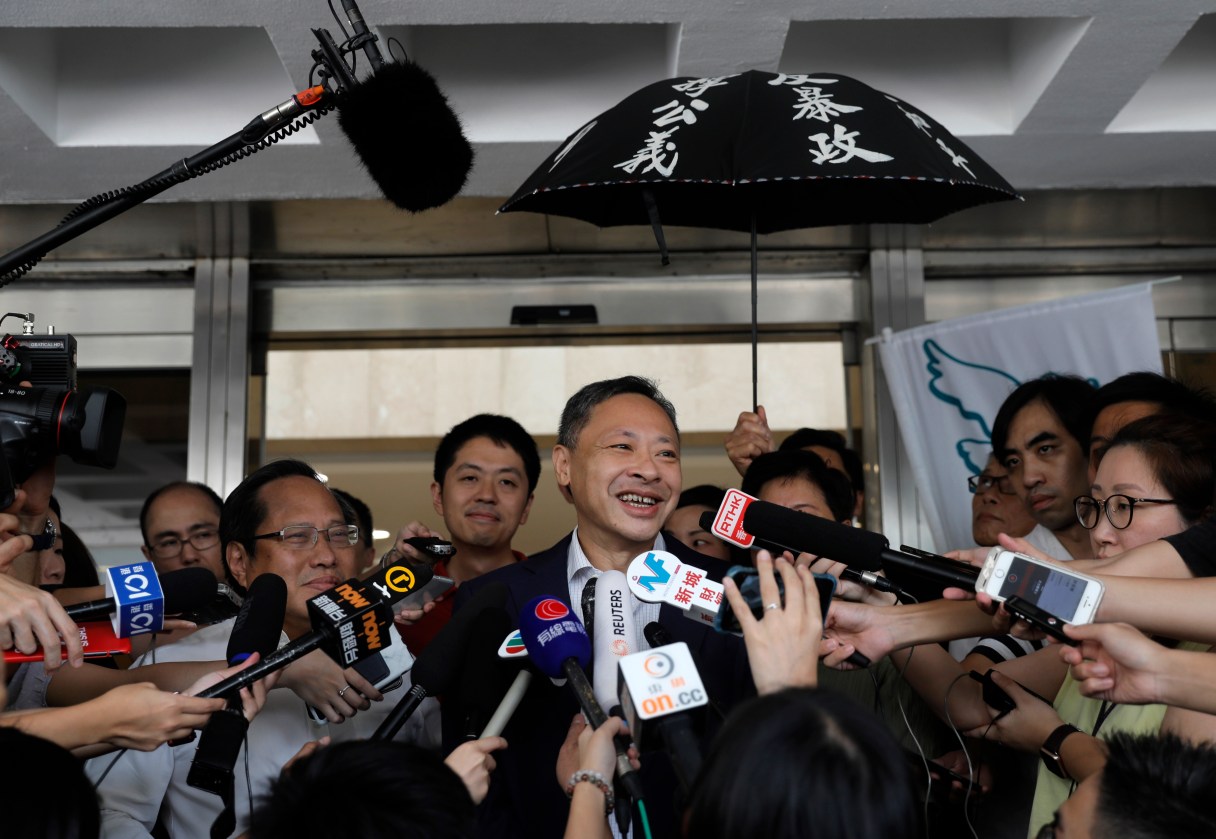
WASHINGTON – President Trump has warned China it must respond “humanely” to the protests in Hong Kong if it wants a trade deal, for the first time suggesting the United States would impose costs on Beijing if it launched a Tiananmen Square-style crackdown on the city. It’s about time. China is in a much weaker position in Hong Kong than many realize. It claims to be showing “restraint,” but if China could easily crush the protesters, at a cost acceptable to Beijing, it would have done so by now.
The situation China faces in Hong Kong is very different from the one in Tiananmen Square three decades ago. At Tiananmen, the protesters were gathered in a large public square like sitting ducks where they could be easily mowed down. In Hong Kong, protest tactics have been adopted specifically to avoid another Tiananmen. Demonstrations are organized on the fly, via social media, and take place in multiple locations simultaneously. If China cracks down in one place, the protesters can disperse and start again in a different location.
In Tiananmen, the clearing operation was conducted in the dark of night and out of sight of the media. A Hong Kong intervention would take place in the full glare of the international press corps and under the scrutiny of millions of cellphone cameras that would record every atrocity for the world to see. And the operation could last for months or even years.
In Hong Kong, the terrain favors the defenders. If the military moved in, it would face determined resistance. China wants to break popular support for the protests, but a crackdown would have the opposite effect.
The one advantage China now enjoys compared with 30 years ago is technology. On the mainland, the regime is constructing an Orwellian surveillance state, with cameras and facial-recognition technology to track its citizens. Protesters can still use technology to their advantage, communicating via encrypted messaging apps and social media. Shutting down communication would also cripple Hong Kong’s financial sector, which depends on the free flow of information.