

For drama, Monday night’s joint meeting of the Hamilton County Commission and the Hamilton County Board of Education will receive no Academy Awards. For action, it will never rival a big-budget Marvel Comics movie. And for politeness, it may receive the Good Housekeeping Seal of Approval.
But it served as a starting place for the two bodies to discuss education in the county ahead of next year’s budget talks, which could become bloody when the subject turns to funding teacher pay, academic instruction and the district’s 10-year facilities master plan.
However, two things did become clear. The bodies reached a consensus on the importance of early childhood and early elementary literacy, and the definition of a teacher is whatever the unelected Tennessee Education Association (TEA) says it is.
Both items are likely to become central to discussions in 2020, the first in how much the county commission might be willing to fund teachers, specialists and programs dealing with literacy in the 2021 budget and the second in how the Tennessee General Assembly is willing to fund educational instruction given that the money they allocate goes not to whom they expect is a teacher but to whom the teachers’ union defines as a teacher.
On the latter point, state Sen. Todd Gardenhire, R-Chattanooga, state Rep. Mike Carter, R-Ooltewah, and other lawmakers have been questioning how a teacher is defined since the legislature and the county commission have wanted to put pay increases in the hands of those in charge of day-to-day classroom instruction but have found many other professionals are often lumped in the category of teachers when pay increases are brought up.
Gardenhire, who attended Monday’s meeting, said Hamilton County Superintendent Dr. Bryan Johnson effectively tabled the discussion until the legislative session begins next year when he said, “The TEA decides what a teacher is.”
And while that topic may not come up again immediately, we hope the county commission and the school board will continue to meet at regular intervals to keep the lines of dialogue open. If they do, it could ease tensions when it comes to funding education, and exactly what to fund, in the 2021 budget.
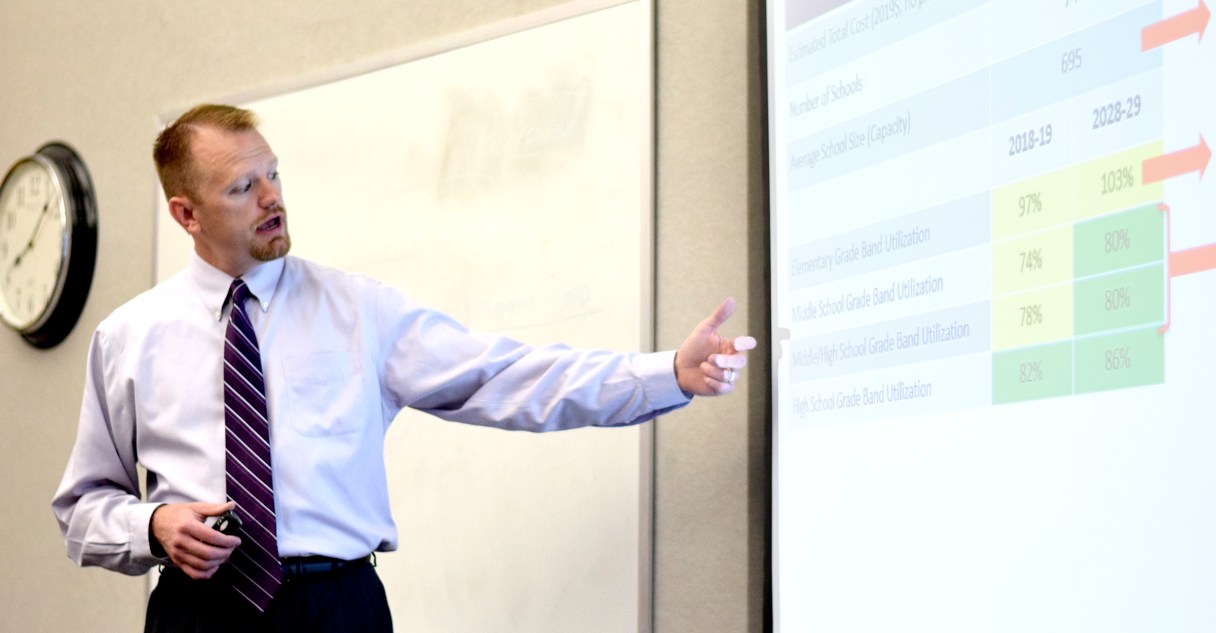
One of the subject matters largely avoided in Monday’s meeting was the district’s 10-year facilities master plan. But there was plenty of discussion about it in five public meetings last week. And since it involves, as preliminarily conceived, 58 of the district’s 74 schools, the plan will continue to ripple through Hamilton County neighborhoods.
In the public meetings, representatives of the Florida-based consulting firm, to which the school board paid $500,000 for a comprehensive examination of district facilities and a preliminary future plan, were basically left alone to answer questions from emotional community members upset their child’s crumbling and woefully underutilized school might close.
This, in our opinion, was a wrong-headed strategy in the extreme. The consultants had done the job for which they were paid – to take a dispassionate look at what the county had and to make recommendations, based on all the information they could compile, for the future.
For the consultants to have had to take the brunt of the public’s feelings without district administration staff or school board members acting as moderators was cruel and unusual punishment. In at least two of the meetings, screams and shouts threatened to thwart the proceedings.
At the meeting at Dalewood Middle School, where community members might have been expected to be the most vociferous because of the potential of losing Barger Elementary, Dalewood and Brainerd High School as entities, no district administrative staff member intervened when the expected occurred, and three school board members sat quietly in the audience.
Finally, MGT consultant Dan Schmidt chucked his presentation, drew up a stool and patiently tried to answer as many questions as possible from the crowd of 70 or so people.
Nobody had wanted to hear that deferred maintenance costs for the 74 schools was $1.36 billion, that some of the schools were as low as 50% utilized and that repairing some was throwing good money after bad. They just wanted to hear how their child’s school was being affected.
That sentiment is understandable, though it is also short-sighted. For Hamilton County to offer its children the best education possible, it must reduce the number of schools it operates, better use the schools still viable, and relocate programs or build new schools to accommodate the most children in the most efficient but sound way available.
Standing still is not an option, though changes from the preliminary master plan may be. But parents and community members who believe that shouting, screaming, writing Facebook screeds and complaining that everything should remain the same as it always was are not only hurting their children but keeping the whole district from making progress.