
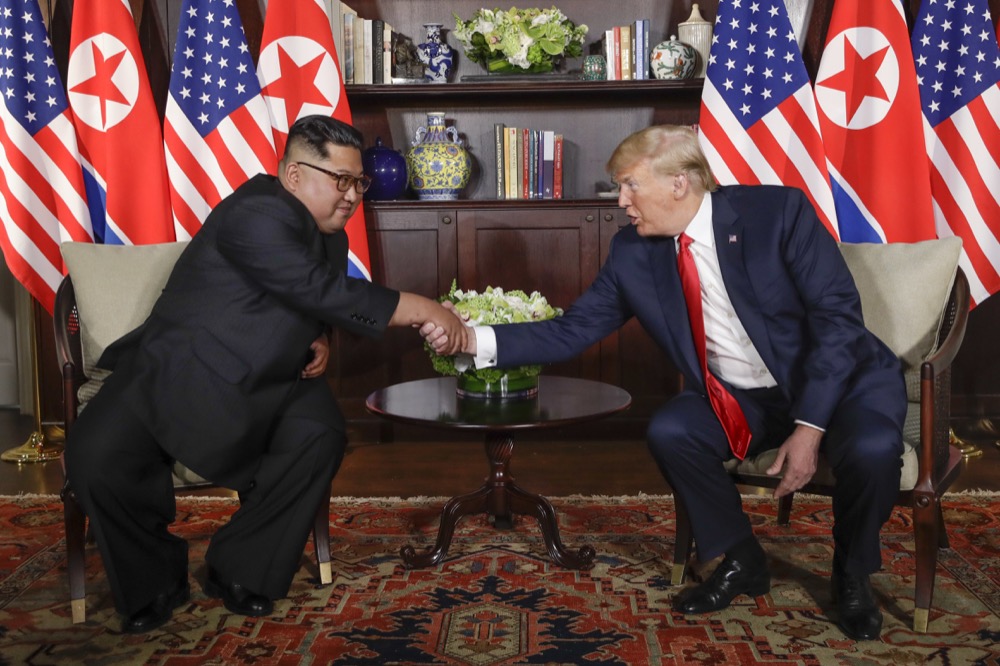
 FILE – In this June 12, 2018, file photo, North Korea leader Kim Jong Un, left, and U.S. President Donald Trump shake hands during their first meeting at the Capella resort on Sentosa Island in Singapore. Vietnam’s selection as the venue for the second summit meeting of them is largely a matter of convenience and security, but not without bigger stakes. (AP Photo/Evan Vucci, File)
BANGKOK (AP) – Vietnam’s selection as the venue for the second summit between President Donald Trump and North Korean leader Kim Jong Un is largely a matter of convenience and security, but not without bigger stakes.
Washington’s goal for the talks Feb. 27-28 is for North Korea to agree give up its nuclear weapons. North Korea frames the issue more broadly, seeking a removal of the “nuclear threat” from U.S. military forces in South Korea.
Host Vietnam hopes to boost its diplomatic leverage against its powerful neighbor, China, which contests waters in the South China Sea claimed by Hanoi.
But Vietnam’s history as a U.S. adversary that transitioned on its own terms to a dynamic free-market economy under a communist political system suggests a larger meaning for the summit.
“By choosing Vietnam, the two leaders send a strong strategic message to the world that they are willing to make a breakthrough decision to turn an enemy into a friend and together make the world a better place, following the example of the U.S.-Vietnam relationship,” said Le Hong Hiep, a research fellow at the ISEAS Yusof Ishak Institute in Singapore.